China Targets 2030 for First Nuclear Fusion Power Generation
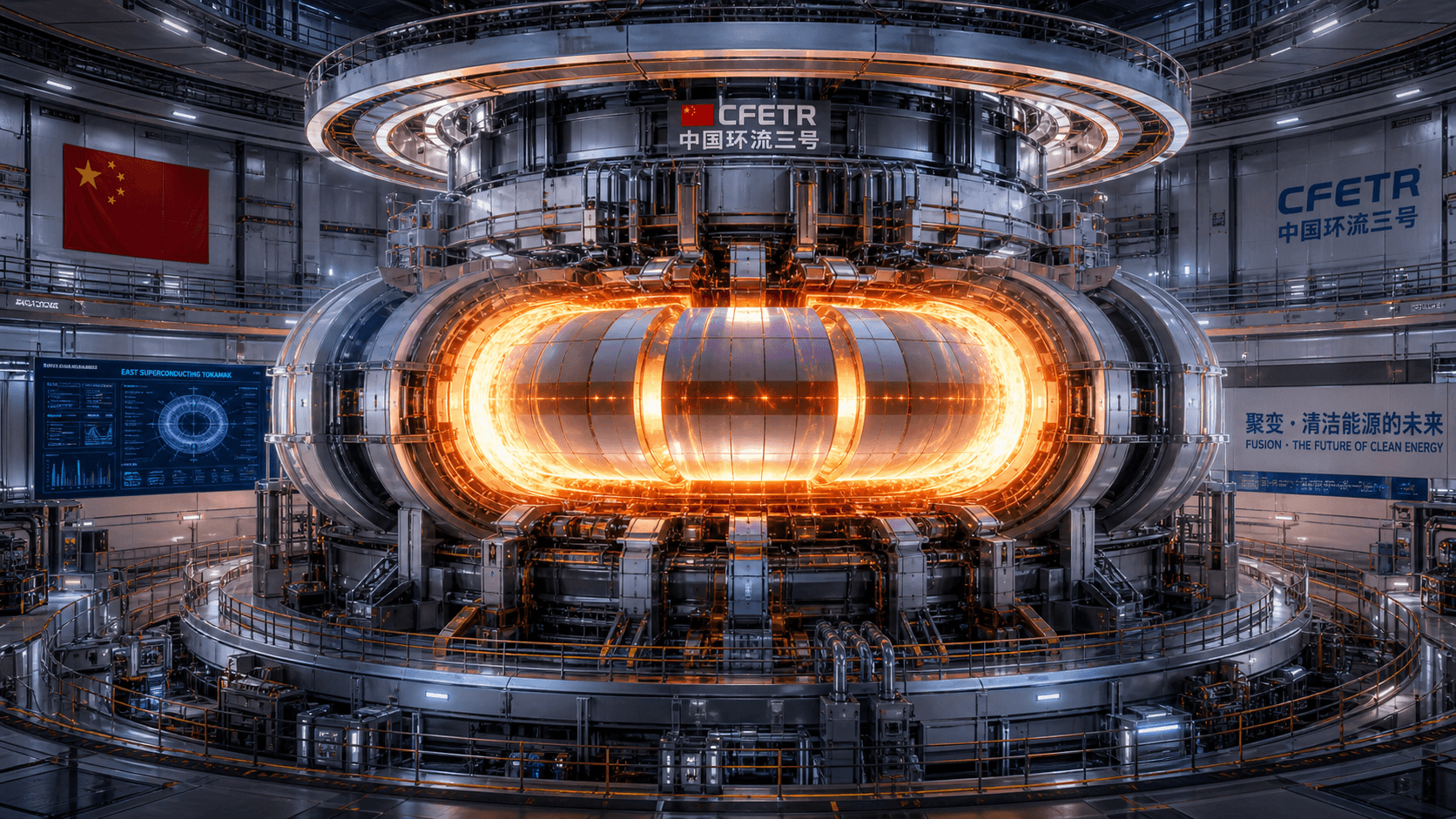
💡Fusion energy is the endgame for AI power demands; China's 2030 timeline marks a critical milestone for future scaling.
⚡ 30-Second TL;DR
What Changed
Achieved 100% domestic production of superconducting magnets
Why It Matters
Stable fusion energy would fundamentally transform the energy landscape for massive AI data centers, providing a sustainable, high-capacity power source.
What To Do Next
Track energy infrastructure trends, as fusion breakthroughs will eventually dictate the scaling limits of future large-scale AI compute clusters.
Key Points
- •Achieved 100% domestic production of superconducting magnets
- •Set a firm timeline for fusion power generation by 2030
- •Advancing the CFETR (China Fusion Engineering Test Reactor) project
🧠 Deep Insight
AI-generated analysis for this event — not the original article.
🔑 Enhanced Key Takeaways
- •The CFETR project is designed as a bridge between the experimental ITER reactor and a future commercial demonstration fusion power plant (DEMO).
- •China's domestic superconducting magnet breakthrough utilizes high-performance Nb3Sn (Niobium-Tin) strands, reducing reliance on international supply chains.
- •The CFETR facility is located at the Hefei Institutes of Physical Science, Chinese Academy of Sciences, leveraging the existing EAST (Experimental Advanced Superconducting Tokamak) infrastructure.
- •The project aims to achieve a fusion power output of 200 megawatts (MW) during its initial operational phase, scaling up significantly in subsequent iterations.
- •China has integrated a 'tritium self-sufficiency' research program into the CFETR roadmap to address the critical fuel cycle challenge inherent in fusion energy.
📊 Competitor Analysis▸ Show
| Feature | CFETR (China) | ITER (International) | SPARC (Commonwealth Fusion Systems) |
|---|---|---|---|
| Primary Goal | Engineering Test/Power Gen | Scientific Feasibility | Compact Commercial Pilot |
| Magnet Tech | Domestic Nb3Sn | International Nb3Sn/NbTi | High-Temperature Superconductors (REBCO) |
| Timeline | 2030 (Target) | 2030s (Plasma) | Late 2020s (Target) |
🛠️ Technical Deep Dive
- Reactor Type: Tokamak with a major radius of approximately 5.7 meters.
- Magnetic Field Strength: Designed to operate with a toroidal field of 5.7 Tesla at the plasma center.
- Plasma Current: Target operational current of 10-15 Mega-amperes (MA).
- Magnet Technology: Utilization of advanced superconducting materials capable of handling high-neutron flux environments.
- Tritium Breeding: Implementation of a liquid lithium-lead blanket module to test fuel regeneration capabilities.
🔮 Future ImplicationsAI analysis grounded in cited sources
⏳ Timeline
Weekly AI Recap
Read this week's curated digest of top AI events →
👉Related Updates


AI-curated news aggregator. All content rights belong to original publishers.
Original source: Pandaily ↗
This is a summary, not the original. Read the source, or get the weekly briefing.
The weekly digest
One email a week. Unsubscribe anytime.