China showcases AI ambitions at World AI Conference
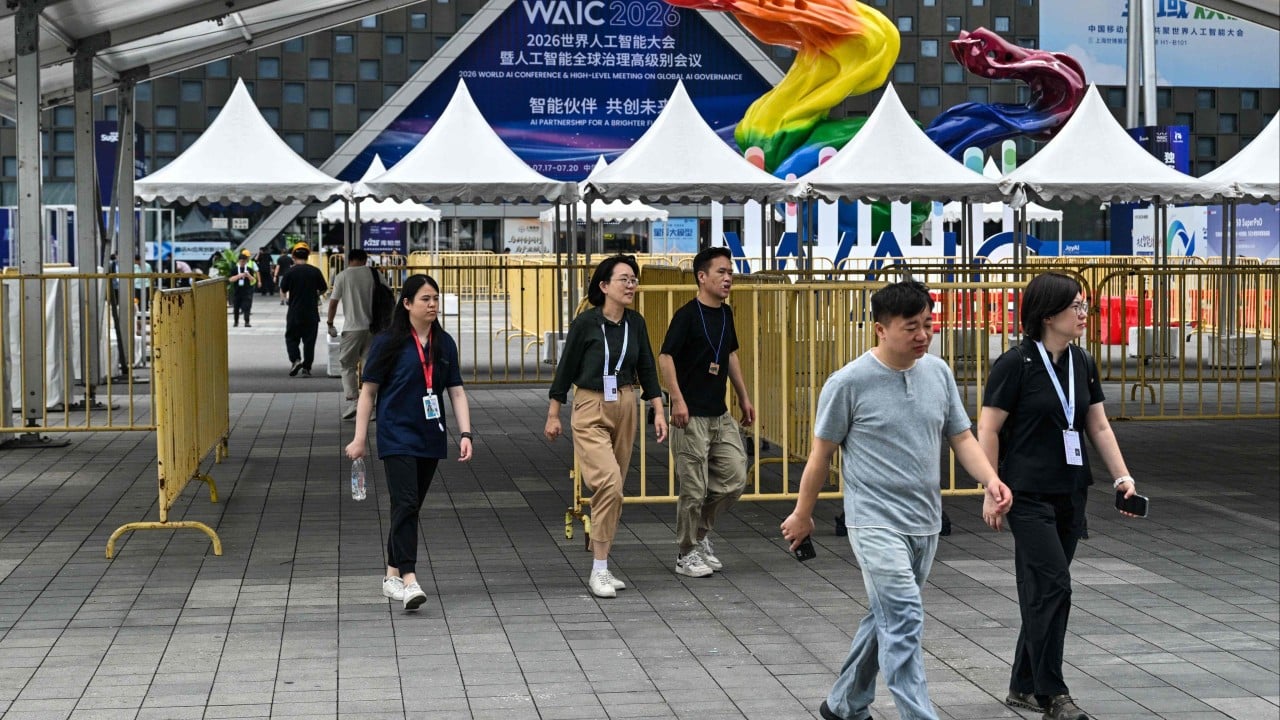
💡Understand China's strategic shift toward embodied AI and autonomous agents amidst US chip restrictions.
⚡ 30-Second TL;DR
What Changed
China is shifting focus from foundation models to autonomous agents and embodied AI.
Why It Matters
The conference signals a pivot toward hardware-integrated AI, which could accelerate the deployment of humanoid robots in industrial settings. Practitioners should monitor these developments for potential shifts in the global AI supply chain and research standards.
What To Do Next
Monitor the WAIC technical sessions for new open-source frameworks or hardware-software integration standards released by Chinese research labs.
Key Points
- •China is shifting focus from foundation models to autonomous agents and embodied AI.
- •WAIC serves as a showcase for domestic advancements in humanoid robotics and scientific research.
- •The conference highlights China's strategy to bypass US chip export restrictions through local innovation.
- •Huawei and other major tech firms are central to China's AI ecosystem development.
🧠 Deep Insight
AI-generated analysis for this event.
🔑 Enhanced Key Takeaways
- •The 2026 WAIC emphasized the integration of 'AI for Science' (AI4S) in drug discovery and material science, with new benchmarks released for domestic large language models (LLMs) specifically optimized for Chinese linguistic nuances.
- •Shanghai municipal authorities announced a new 'AI Industry Fund' during the conference, aimed at providing direct subsidies for startups focusing on embodied AI hardware components like actuators and sensors.
- •Major Chinese cloud providers, including Alibaba Cloud and Tencent, unveiled new 'model-as-a-service' (MaaS) platforms designed to allow enterprises to fine-tune models on localized, heterogeneous compute clusters to mitigate reliance on high-end GPUs.
- •The conference featured a dedicated track on 'AI Governance and Safety' that introduced a new national standard for watermarking AI-generated content, reflecting China's push for regulatory leadership alongside technological growth.
- •Academic institutions at the event showcased breakthroughs in neuromorphic computing architectures, which aim to achieve high-performance AI inference with significantly lower power consumption than traditional silicon-based chips.
📊 Competitor Analysis▸ Show
| Feature | China (WAIC Ecosystem) | USA (Silicon Valley Ecosystem) |
|---|---|---|
| Primary Focus | Embodied AI & Industrial Integration | Foundation Models & AGI Research |
| Compute Strategy | Heterogeneous/Domestic Clusters | High-end GPU (H100/B200) Scaling |
| Regulatory Stance | State-led Governance/Standardization | Market-driven/Self-regulation |
| Key Hardware | Huawei Ascend/Custom Silicon | NVIDIA/Custom TPU/LPU |
🛠️ Technical Deep Dive
- Implementation of heterogeneous computing frameworks that allow LLM training across mixed-vendor GPU/NPU clusters to bypass single-source hardware bottlenecks.
- Development of lightweight, high-efficiency transformer architectures optimized for edge-based humanoid robotics, reducing parameter counts while maintaining reasoning capabilities.
- Integration of multimodal sensory fusion algorithms in humanoid platforms, enabling real-time spatial awareness and object manipulation in unstructured environments.
- Utilization of synthetic data generation pipelines to train models on specialized scientific datasets, compensating for the scarcity of high-quality public training data.
🔮 Future ImplicationsAI analysis grounded in cited sources
⏳ Timeline
Weekly AI Recap
Read this week's curated digest of top AI events →
👉Related Updates

AI-curated news aggregator. All content rights belong to original publishers.
Original source: SCMP Technology ↗