China recovers orbital rocket booster using cable net system
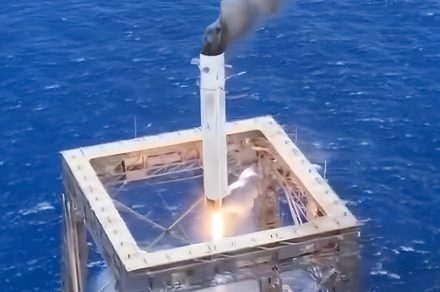
💡A major shift in aerospace robotics: China's new net-based booster recovery challenges SpaceX's vertical landing model.
⚡ 30-Second TL;DR
What Changed
China successfully recovered an orbital rocket booster at sea.
Why It Matters
This development signals a shift in aerospace engineering competition, potentially lowering the cost of access to space. It challenges the current dominance of SpaceX's vertical landing paradigm.
What To Do Next
Monitor advancements in autonomous precision navigation and control systems, as these are critical for the success of non-traditional landing mechanisms.
Key Points
- •China successfully recovered an orbital rocket booster at sea.
- •The recovery mechanism utilized a cable net system rather than traditional landing legs.
- •This achievement positions China as a major competitor in the reusable space launch industry.
🧠 Deep Insight
AI-generated analysis for this event — not the original article.
🔑 Enhanced Key Takeaways
- •The recovery operation was conducted by the Chinese commercial space firm Deep Blue Aerospace, utilizing their Nebula-1 rocket.
- •The cable net system is designed to catch the booster mid-air or upon descent, potentially reducing the structural weight penalty associated with heavy landing legs and grid fins.
- •This recovery method is part of China's broader strategy to lower launch costs for its burgeoning commercial satellite constellation market.
- •The test specifically focused on the vertical takeoff and vertical landing (VTVL) capabilities of the Nebula-1, which is powered by liquid oxygen and kerosene (kerolox) engines.
- •Unlike SpaceX's propulsive landing which requires high-precision engine throttling and landing legs, the net system acts as a passive or semi-active safety capture mechanism to mitigate landing errors.
📊 Competitor Analysis▸ Show
| Feature | Deep Blue Aerospace (Net) | SpaceX (Legs/Catch) | Rocket Lab (Parachute) |
|---|---|---|---|
| Recovery Method | Cable Net System | Propulsive Landing / Mechazilla | Mid-air Helicopter Catch |
| Primary Benefit | Reduced booster weight | High precision/reusability | Low-cost for small sats |
| Maturity | Testing Phase | Operational (High) | Operational (Limited) |
🛠️ Technical Deep Dive
- The Nebula-1 rocket utilizes a 3D-printed engine architecture to optimize mass and production speed.
- The cable net recovery system involves a ship-based array of high-tension cables designed to arrest the booster's descent velocity.
- The guidance, navigation, and control (GNC) system for the landing phase relies on real-time sensor fusion to align the booster with the net's capture zone.
- The booster employs grid fins for aerodynamic stability during the atmospheric reentry phase before the final capture sequence.
🔮 Future ImplicationsAI analysis grounded in cited sources
⏳ Timeline
📰 Event Coverage
Weekly AI Recap
Read this week's curated digest of top AI events →
👉Related Updates
AI-curated news aggregator. All content rights belong to original publishers.
Original source: Digital Trends ↗
This is a summary, not the original. Read the source, or get the weekly briefing.
The weekly digest
One email a week. Unsubscribe anytime.