China Pioneers Sea-Based Net Recovery for Reusable Rockets
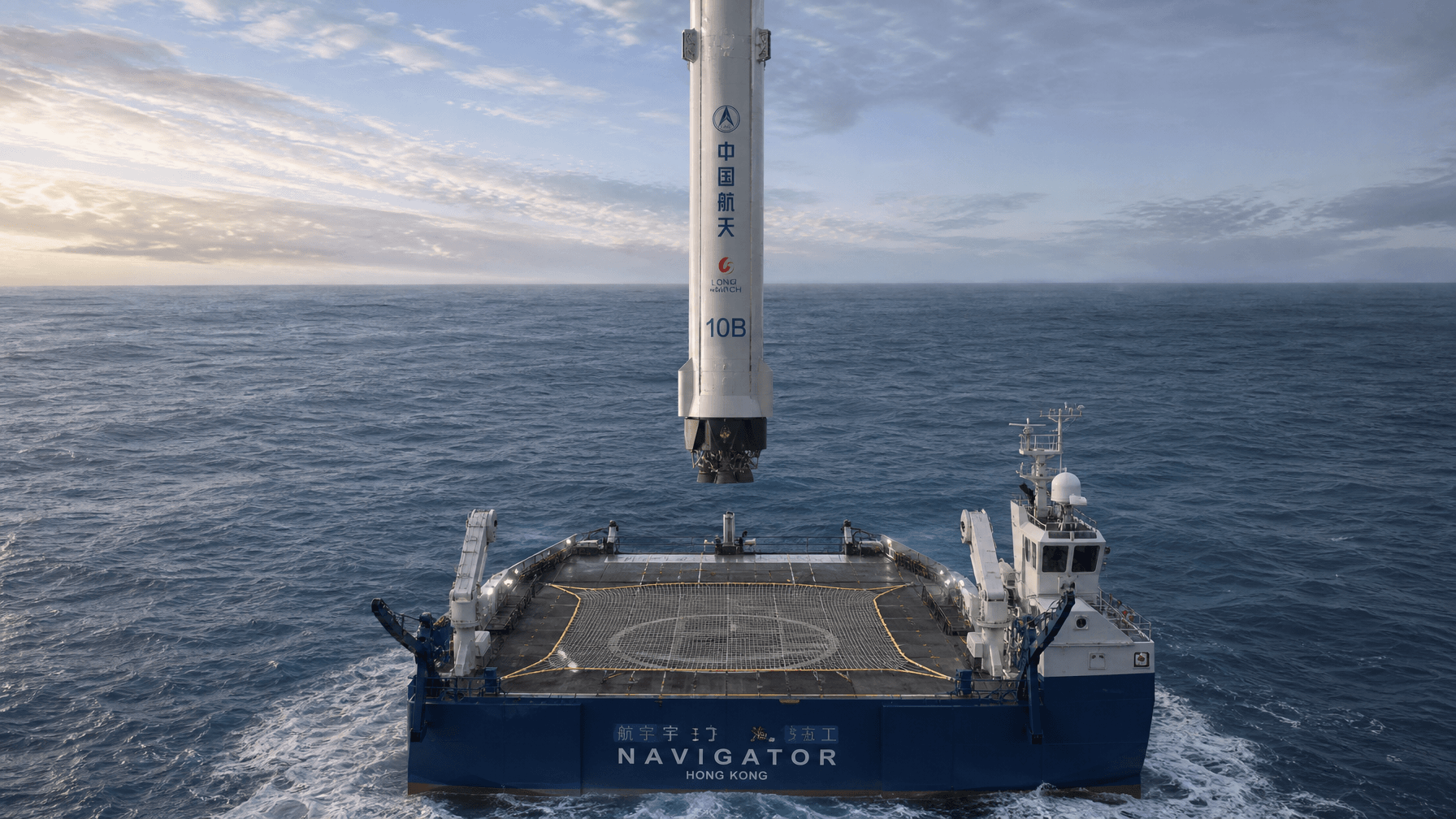
💡New net-based rocket recovery tech offers a radical alternative to propulsive landing for autonomous systems.
⚡ 30-Second TL;DR
What Changed
World-first sea-based net recovery system for orbital rockets
Why It Matters
This innovation challenges traditional SpaceX-style propulsive landing methods. It demonstrates a novel approach to hardware reuse that could redefine cost-efficiency in aerospace.
What To Do Next
Investigate the sensor fusion and real-time control algorithms used for high-precision ship-based landing maneuvers.
Key Points
- •World-first sea-based net recovery system for orbital rockets
- •Elimination of landing legs significantly increases payload efficiency
- •Utilizes a 144m recovery ship with 0.5m positioning accuracy
🧠 Deep Insight
AI-generated analysis for this event — not the original article.
🔑 Enhanced Key Takeaways
- •The Long March 10B is a variant of China's next-generation crewed launch vehicle, specifically optimized for high-frequency, low-cost commercial satellite deployment.
- •The recovery ship employs a specialized 'net-capture' mechanism that utilizes high-tension synthetic fibers designed to absorb the kinetic energy of the descending booster upon impact.
- •This recovery method is intended to support the rapid turnaround of the first stage, with the China Aerospace Science and Technology Corporation (CASC) targeting a refurbishment cycle of under 30 days.
- •The 0.5m positioning accuracy is achieved through a combination of BeiDou satellite navigation and differential GPS, integrated with active fin control on the rocket stage during the terminal descent phase.
- •By removing landing legs, the design reduces the dry mass of the first stage by approximately 3-5%, which directly translates into a proportional increase in orbital payload capacity.
📊 Competitor Analysis▸ Show
| Feature | Long March 10B (Net Recovery) | SpaceX Falcon 9 (Legs) | Rocket Lab Electron (Parachute) |
|---|---|---|---|
| Recovery Method | Sea-based Net Capture | Propulsive Landing (Legs) | Mid-air Helicopter Catch |
| Payload Efficiency | High (No leg mass) | Moderate (Leg mass penalty) | Low (Small-sat focus) |
| Reusability Focus | Rapid Turnaround | Proven Flight Heritage | Niche/Experimental |
🛠️ Technical Deep Dive
- Recovery Ship: 144-meter vessel equipped with a dynamic positioning system (DP-3 class) to maintain stability in sea state 4-5 conditions.
- Capture Mechanism: Multi-layered high-strength net array designed to distribute impact loads across the booster's airframe to prevent structural deformation.
- Guidance System: Terminal guidance utilizes a combination of inertial measurement units (IMU) and optical sensors to align the booster with the net's center point.
- Propulsion: The first stage utilizes liquid oxygen/kerosene (LOX/RP-1) engines capable of deep throttling to manage descent velocity for the net capture.
🔮 Future ImplicationsAI analysis grounded in cited sources
⏳ Timeline
📰 Event Coverage
Weekly AI Recap
Read this week's curated digest of top AI events →
👉Related Updates


AI-curated news aggregator. All content rights belong to original publishers.
Original source: Pandaily ↗
This is a summary, not the original. Read the source, or get the weekly briefing.
The weekly digest
One email a week. Unsubscribe anytime.