China Quant Funds Face a Systemic Drawdown
A 22% drawdown shows why AI trading models need regime-shift and crowding tests beyond backtests.
30-Second TL;DR
What Changed
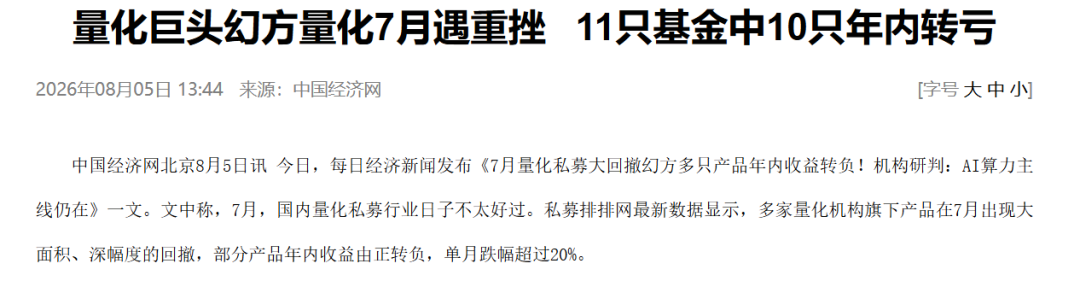
Huanfang's CSI 500 quantitative product fell 22.15% in July, while eight of nine products posted negative year-to-date returns.
Why It Matters
The episode challenges the assumption that AI-based quantitative investing provides stable, insurance-like returns. For AI researchers and founders building financial models, it highlights the need to evaluate regime shifts, crowding, factor correlation, and live out-of-sample robustness rather than relying solely on backtests.
What To Do Next
Run a walk-forward stress test that injects July-style factor correlations and regime shifts before deploying any AI trading model.
Key Points
- •Huanfang's CSI 500 quantitative product fell 22.15% in July, while eight of nine products posted negative year-to-date returns.
- •The average excess return of 1,236 index-enhancement products fell to 3.11 percentage points from 14.17% a year earlier.
- •Momentum, residual volatility, liquidity, and short-term reversal factors reportedly declined together during the July selloff.
- •Rapid industry growth and similar data, models, and trading signals increased the risk of synchronized deleveraging.
- •The article warns that AI-driven quantitative models are not immune to regimes outside their historical training data.
Deep Insight
AI-generated analysis for this event — not the original article.
Enhanced Key Takeaways
- •Regulatory scrutiny in China has intensified following the drawdown, with the CSRC reportedly increasing oversight on high-frequency trading (HFT) and quantitative strategy reporting requirements.
- •The July selloff triggered a 'crowded trade' unwinding, where multiple large-scale quant funds were forced to liquidate positions simultaneously to meet margin calls, exacerbating the market impact.
- •Industry data indicates that the 'Small Cap' factor, which historically drove significant alpha for Chinese quant funds, experienced a sharp reversal as market liquidity shifted toward large-cap state-owned enterprises.
- •Several major Chinese quant firms have begun transitioning from pure 'black-box' deep learning models to hybrid architectures that incorporate human-defined risk constraints to prevent out-of-sample failures.
- •The drawdown has led to a significant shift in investor sentiment, with institutional capital in China moving away from high-leverage quantitative products toward more conservative, low-volatility multi-asset strategies.
Competitor Analysis
- Huanfang Quant
- Deep Learning/AI
- Lingjun Investment
- Multi-Factor/HFT
- High-Flyer Quant
- Statistical Arbitrage
- Huanfang Quant
- CSI 500/1000
- Lingjun Investment
- CSI 500
- High-Flyer Quant
- CSI 500/1000
- Huanfang Quant
- Model-Driven
- Lingjun Investment
- Rule-Based/Hybrid
- High-Flyer Quant
- Dynamic Exposure
- Huanfang Quant
- -22.15% (Worst)
- Lingjun Investment
- Reported Drawdown
- High-Flyer Quant
- Reported Drawdown
| Feature | Huanfang Quant | Lingjun Investment | High-Flyer Quant |
|---|---|---|---|
| Primary Strategy | Deep Learning/AI | Multi-Factor/HFT | Statistical Arbitrage |
| Typical Benchmark | CSI 500/1000 | CSI 500 | CSI 500/1000 |
| Risk Management | Model-Driven | Rule-Based/Hybrid | Dynamic Exposure |
| 2026 July Performance | -22.15% (Worst) | Reported Drawdown | Reported Drawdown |
Technical Deep Dive
- Models primarily utilize Convolutional Neural Networks (CNNs) and Long Short-Term Memory (LSTM) networks to process high-frequency order book data.
- The failure was linked to 'feature drift' where the correlation between historical price patterns and future returns collapsed due to unprecedented market intervention.
- Implementation relies on distributed computing clusters for real-time signal generation, which suffered from latency issues during the high-volume July selloff.
- Strategy homogeneity stems from the widespread use of similar open-source feature engineering libraries and common training datasets provided by domestic data vendors.
Future ImplicationsAI analysis grounded in cited sources
Timeline
- 2021-09Huanfang Quant assets under management surpass 60 billion RMB milestone.
- 2023-02Firm implements upgraded AI model architecture to capture alpha in volatile CSI 500 markets.
- 2024-05Huanfang faces initial public scrutiny regarding strategy capacity limits.
- 2026-07Systemic drawdown occurs as AI models fail to adapt to rapid market regime shifts.
Weekly AI Recap
Read this week's curated digest of top AI events →
AI-curated news aggregator. All content rights belong to original publishers.
Original source: 虎嗅 ↗
This is a summary, not the original. Read the source, or get the weekly briefing.
The weekly digest
One email a week. Unsubscribe anytime.