China Launches World's First Space-Based Photonic Computing Satellite
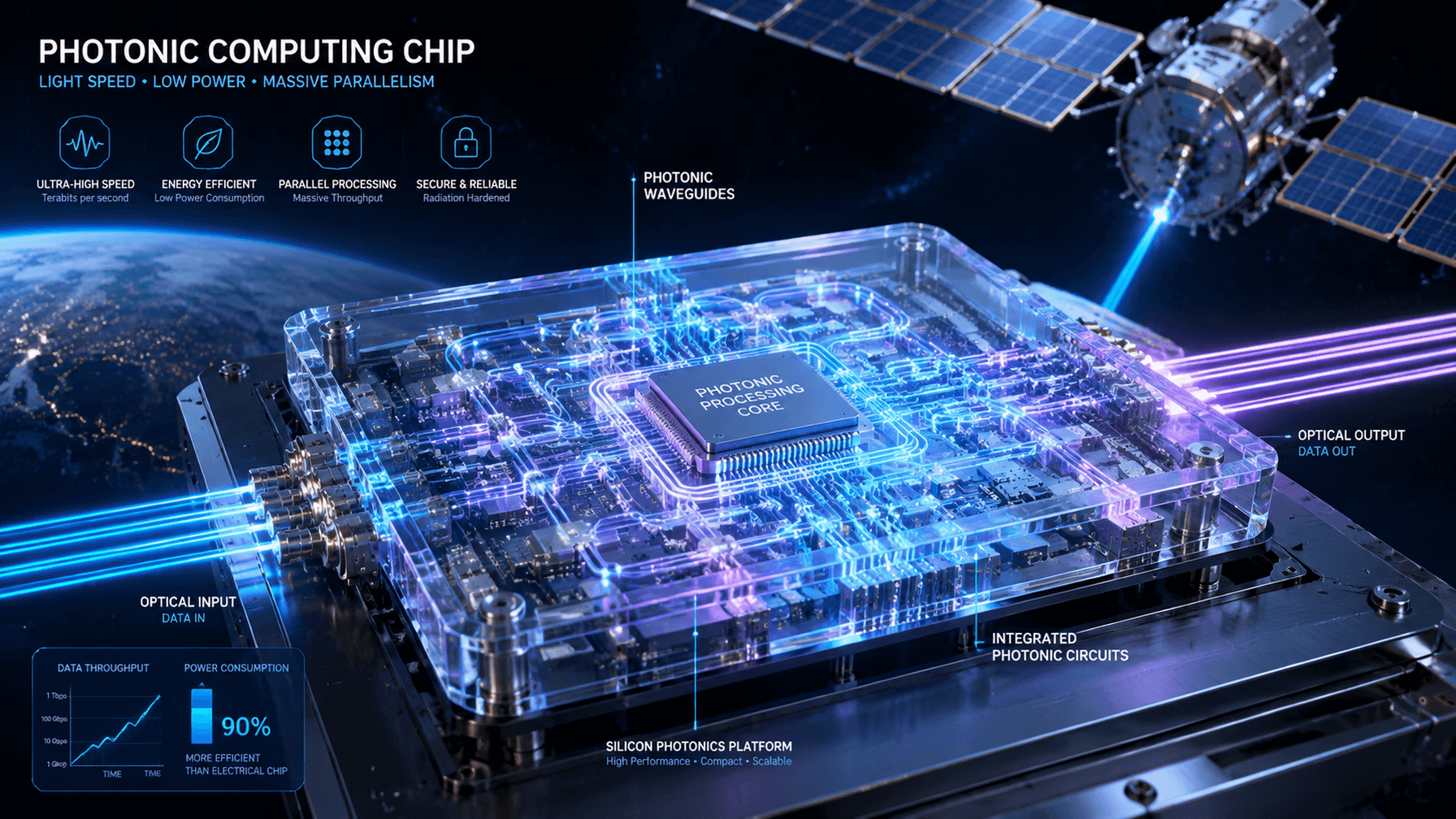
💡Photonic computing could replace traditional silicon in space, enabling high-performance AI in extreme environments.
⚡ 30-Second TL;DR
What Changed
First-ever deployment of photonic computing in a space-based satellite.
Why It Matters
This breakthrough could revolutionize edge computing in space, allowing for more complex AI models to run on satellites without the need for massive cooling or radiation shielding.
What To Do Next
Monitor the performance metrics of photonic vs. electronic edge AI chips to prepare for future low-power, high-radiation deployment scenarios.
Key Points
- •First-ever deployment of photonic computing in a space-based satellite.
- •Photonic chips offer inherent immunity to space radiation compared to silicon.
- •Significant reduction in heat generation and power consumption for orbital computing.
- •Joint development by Guangbenwei Technology and Dongfang Tianxuan.
🧠 Deep Insight
AI-generated analysis for this event — not the original article.
🔑 Enhanced Key Takeaways
- •The satellite utilizes a specialized photonic processor architecture designed to perform high-speed matrix-vector multiplications, which are fundamental to AI inference tasks in orbit.
- •The photonic chip integration addresses the 'von Neumann bottleneck' by performing computation directly within the optical domain, significantly reducing data movement latency.
- •Guangbenwei Technology's proprietary 'light-speed' interconnects allow for reconfigurable optical pathways, enabling the satellite to adapt its processing logic post-launch.
- •The mission serves as a critical testbed for China's 'Space-Based Information Infrastructure' initiative, aiming to decentralize AI processing from ground stations to edge-computing satellites.
- •The optical computing module is paired with a radiation-hardened control unit, creating a hybrid system that leverages photonic speed for data processing and electronic reliability for system management.
🛠️ Technical Deep Dive
- Architecture: Employs a Mach-Zehnder Interferometer (MZI) mesh array to manipulate light phases for parallel computing operations.
- Processing Capability: Capable of performing optical matrix-vector multiplication (MVM) at speeds exceeding 10 TOPS/W (Tera-Operations Per Watt).
- Thermal Management: Passive cooling design utilizing the photonic chip's low-loss characteristics, eliminating the need for active liquid or heavy heat-sink systems.
- Data Interface: High-speed optical-to-electrical (O/E) converters facilitate seamless integration with existing satellite bus communication protocols.
🔮 Future ImplicationsAI analysis grounded in cited sources
⏳ Timeline
Weekly AI Recap
Read this week's curated digest of top AI events →
👉Related Updates

AI-curated news aggregator. All content rights belong to original publishers.
Original source: Pandaily ↗
This is a summary, not the original. Read the source, or get the weekly briefing.
Weekly AI briefing
One email a week. Unsubscribe anytime.