China Humanoid Robots Await ChatGPT Moment
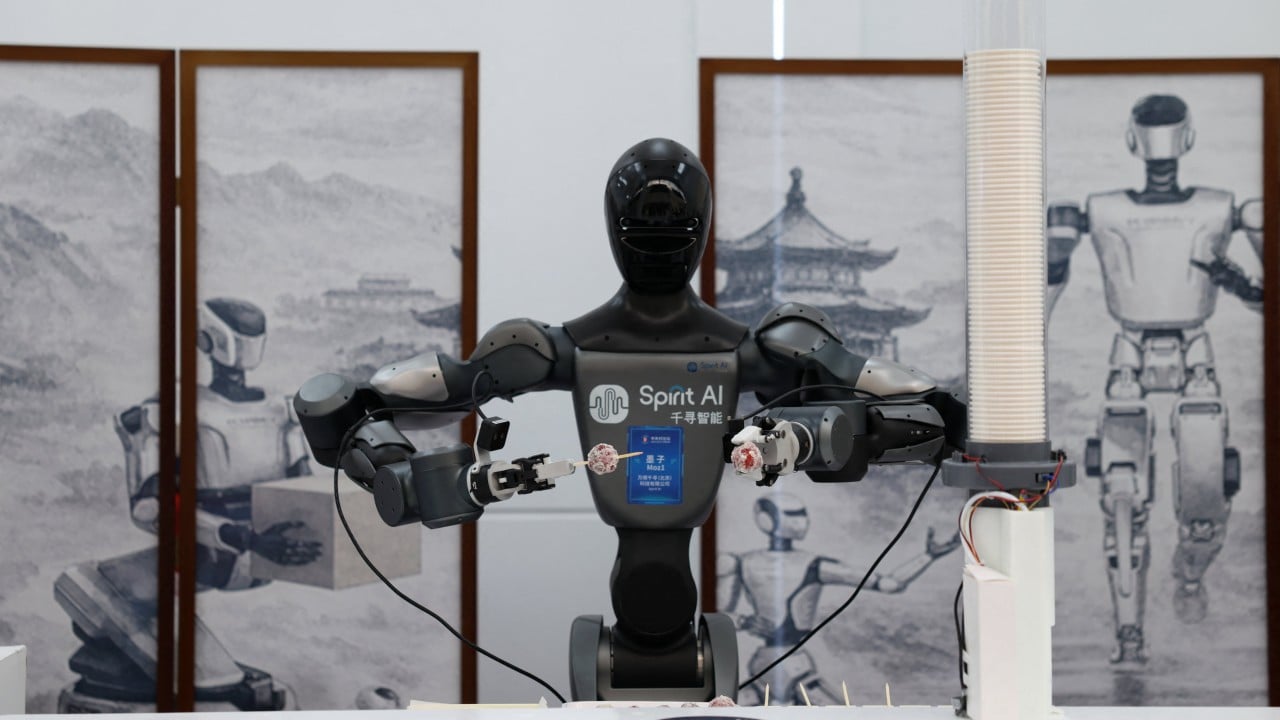
💡Why China's robots lag ChatGPT: task adaptation & training hurdles revealed
⚡ 30-Second TL;DR
What Changed
Years away from widespread usability tipping point
Why It Matters
Highlights embodied AI hurdles in China, potentially slowing global robotics commercialization. Practitioners may redirect efforts to software innovations for task generalization.
What To Do Next
Benchmark RL algorithms like PPO for humanoid task adaptation improvements.
Key Points
- •Years away from widespread usability tipping point
- •Challenges in adapting to new tasks persist
- •Training efficiency remains a key bottleneck
- •Hardware and software limitations unresolved
🧠 Deep Insight
AI-generated analysis for this event — not the original article.
🔑 Enhanced Key Takeaways
- •Chinese humanoid developers are increasingly pivoting toward 'embodied AI' foundation models that integrate multimodal perception with motor control, moving away from traditional rule-based programming.
- •Supply chain constraints, specifically the high cost and limited domestic production capacity for high-torque actuators and harmonic drives, remain a primary barrier to achieving the economies of scale necessary for mass-market adoption.
- •Government-backed initiatives, such as the 'Robot + Application' action plan, are shifting focus from pure R&D to industrial pilot programs in automotive manufacturing and hazardous environment inspection to generate real-world training data.
📊 Competitor Analysis▸ Show
| Feature | Chinese Humanoids (e.g., Unitree, Fourier) | US/Global Humanoids (e.g., Tesla, Figure) |
|---|---|---|
| Primary Focus | Industrial/Manufacturing & Cost Efficiency | General Purpose/Household & AI Scaling |
| Pricing Strategy | Aggressive (targeting <$20k-$50k) | Premium/Unknown (early stage) |
| Benchmark Focus | Task-specific throughput & durability | Foundation model reasoning & autonomy |
🛠️ Technical Deep Dive
- Embodied AI Architecture: Transitioning from hierarchical control systems to end-to-end neural networks where visual-language models (VLMs) directly output joint torque commands.
- Sim-to-Real Transfer: Heavy reliance on NVIDIA Isaac Gym and similar physics engines to train reinforcement learning (RL) policies in virtual environments before deployment to physical hardware.
- Actuation Systems: Integration of quasi-direct drive (QDD) actuators to improve back-drivability and force control, essential for safe human-robot interaction.
🔮 Future ImplicationsAI analysis grounded in cited sources
⏳ Timeline
Weekly AI Recap
Read this week's curated digest of top AI events →
👉Related Updates

AI-curated news aggregator. All content rights belong to original publishers.
Original source: SCMP Technology ↗
This is a summary, not the original. Read the source, or get the weekly briefing.
The weekly digest
One email a week. Unsubscribe anytime.