來源SCMP Technology•較早收集於 16m
中國人形機器人仍等待「ChatGPT時刻」
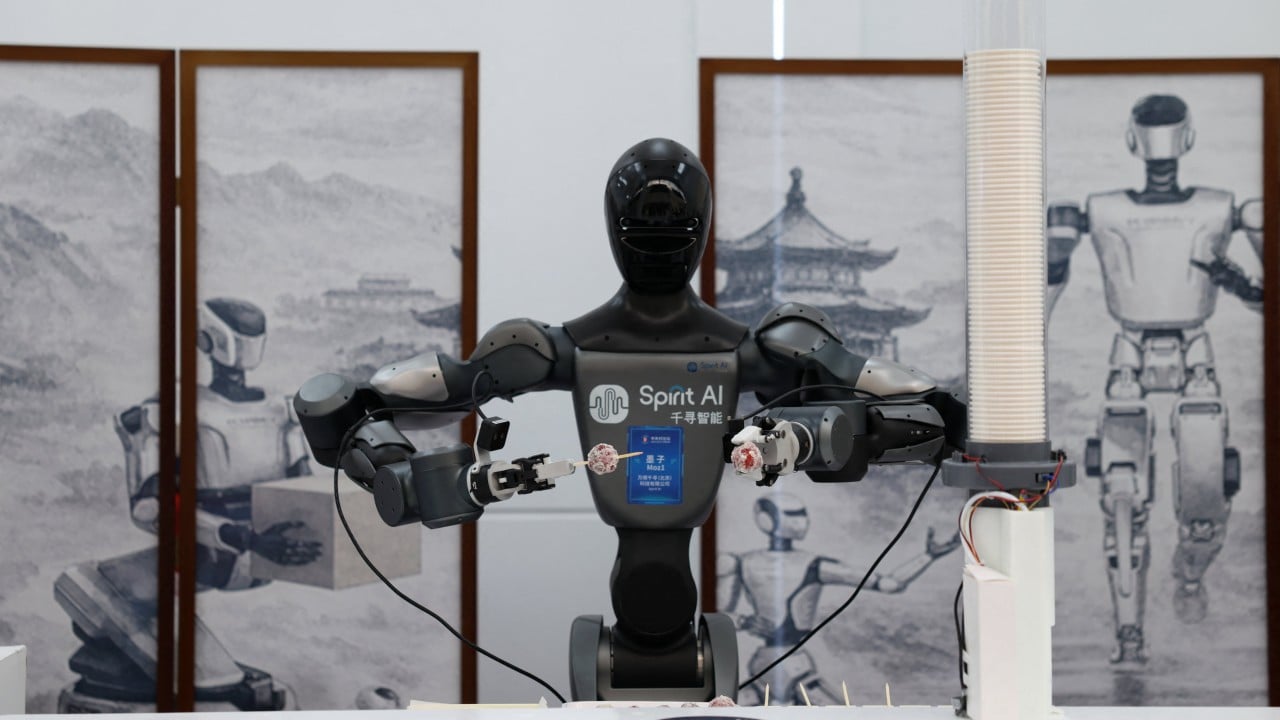
💡中國機器人落後ChatGPT原因:任務適應與訓練障礙揭曉(24字)
⚡ 30 秒速覽
有什麼變化
距離廣泛可用性轉捩點仍需數年
為什麼重要
凸顯中國具身AI障礙,或延緩全球機器人商業化。從業人員可轉向任務泛化軟體創新。
下一步行動
基準測試如PPO的RL演算法以改善人形機器人任務適應。
誰應關注:Researchers & Academics
關鍵要點
- •距離廣泛可用性轉捩點仍需數年
- •適應新任務挑戰持續
- •訓練效率為主要瓶頸
- •硬體與軟體限制未解
🧠 深度解析
本篇為 AI 生成分析,非原文內容。
🔑 增強重點摘要
- •Chinese humanoid developers are increasingly pivoting toward 'embodied AI' foundation models that integrate multimodal perception with motor control, moving away from traditional rule-based programming.
- •Supply chain constraints, specifically the high cost and limited domestic production capacity for high-torque actuators and harmonic drives, remain a primary barrier to achieving the economies of scale necessary for mass-market adoption.
- •Government-backed initiatives, such as the 'Robot + Application' action plan, are shifting focus from pure R&D to industrial pilot programs in automotive manufacturing and hazardous environment inspection to generate real-world training data.
📊 競品分析▸ Show
| Feature | Chinese Humanoids (e.g., Unitree, Fourier) | US/Global Humanoids (e.g., Tesla, Figure) |
|---|---|---|
| Primary Focus | Industrial/Manufacturing & Cost Efficiency | General Purpose/Household & AI Scaling |
| Pricing Strategy | Aggressive (targeting <$20k-$50k) | Premium/Unknown (early stage) |
| Benchmark Focus | Task-specific throughput & durability | Foundation model reasoning & autonomy |
🛠️ 技術深入
- Embodied AI Architecture: Transitioning from hierarchical control systems to end-to-end neural networks where visual-language models (VLMs) directly output joint torque commands.
- Sim-to-Real Transfer: Heavy reliance on NVIDIA Isaac Gym and similar physics engines to train reinforcement learning (RL) policies in virtual environments before deployment to physical hardware.
- Actuation Systems: Integration of quasi-direct drive (QDD) actuators to improve back-drivability and force control, essential for safe human-robot interaction.
🔮 前景展望基於引用來源的 AI 分析
Domestic Chinese humanoid manufacturers will achieve a 30% reduction in unit production costs by 2027.
The rapid localization of high-precision component supply chains and government subsidies for industrial robotics will drive down the bill of materials.
The first large-scale deployment of humanoid robots in Chinese automotive assembly lines will occur before 2028.
Automotive manufacturing provides the structured, high-volume environment necessary to overcome current limitations in task adaptation and training efficiency.
⏳ 時間線
2023-10
China's Ministry of Industry and Information Technology (MIIT) releases guidelines to mass-produce humanoid robots by 2025.
2024-05
Unitree Robotics launches the G1 humanoid, signaling a shift toward lower-cost, mass-market humanoid hardware.
2025-01
Major Chinese tech firms begin integrating proprietary large language models (LLMs) into humanoid control stacks for improved semantic understanding.
📰
AI 週報
閱讀本週精選 AI 大事摘要 →
👉相關動態

AI 策展新聞聚合。所有內容版權歸原始發布者所有。
原始來源: SCMP Technology ↗
每週電子報
每週一封,可隨時退訂。