China Commercial Space Achieves Rocket Recovery Milestone
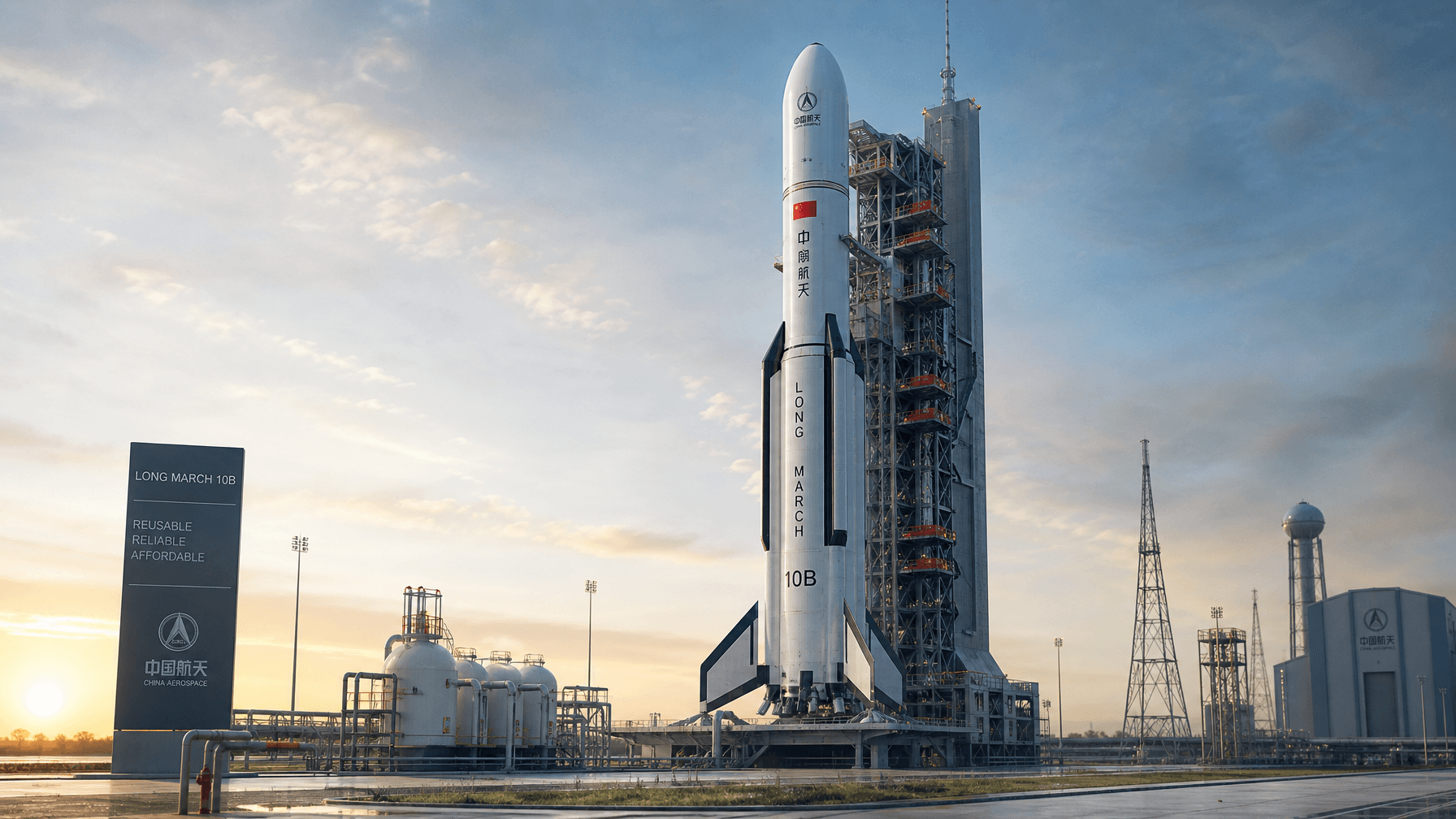
💡Lower launch costs from reusable rockets will accelerate the deployment of global AI-enabled satellite networks.
⚡ 30-Second TL;DR
What Changed
Long March 10B first-flight recovery success validates domestic recovery capabilities.
Why It Matters
The successful recovery of rockets significantly lowers the cost of orbital launches, which is critical for deploying large-scale satellite constellations that support global AI and IoT networks.
What To Do Next
Monitor the launch schedules of LandSpace to assess potential cost reductions for future edge-computing satellite deployments.
Key Points
- •Long March 10B first-flight recovery success validates domestic recovery capabilities.
- •LandSpace Zhuque-3 is accelerating development for year-end reflight testing.
- •JianYuan YX-1 joins the race to achieve commercial orbital reusability.
🧠 Deep Insight
AI-generated analysis for this event — not the original article.
🔑 Enhanced Key Takeaways
- •The Long March 10B recovery test utilized a grid fin control system and high-precision vertical landing guidance, marking a significant shift toward reusable launch vehicle (RLV) architecture for the China Aerospace Science and Technology Corporation (CASC).
- •LandSpace's Zhuque-3 utilizes stainless steel construction, similar to SpaceX's Starship, to reduce manufacturing costs and improve thermal resistance during atmospheric reentry.
- •The Chinese government has integrated commercial space development into its 14th and 15th Five-Year Plans, providing direct subsidies and infrastructure access to private firms like LandSpace and Deep Blue Aerospace.
- •JianYuan YX-1 (Deep Blue Aerospace) has successfully completed 'hop' tests, utilizing liquid oxygen/kerosene (kerolox) engines to demonstrate low-altitude vertical takeoff and landing (VTVL) capabilities.
- •China's National Space Administration (CNSA) has established new regulatory frameworks for commercial launch site safety and debris mitigation to accommodate the increased frequency of recovery-focused test flights.
📊 Competitor Analysis▸ Show
| Feature | LandSpace (Zhuque-3) | Deep Blue Aerospace (YX-1) | SpaceX (Falcon 9) |
|---|---|---|---|
| Material | Stainless Steel | Aluminum Alloy | Aluminum-Lithium Alloy |
| Propellant | Methalox | Kerolox | Kerolox |
| Status | Prototype/Testing | Prototype/Testing | Operational (Flight Proven) |
| Recovery Method | VTVL | VTVL | VTVL |
🛠️ Technical Deep Dive
- Zhuque-3 Engine: TQ-12A methalox engine features a high-thrust-to-weight ratio and deep throttling capability (down to 60%) essential for soft landing maneuvers.
- Landing Legs: Implementation of multi-stage shock absorption systems to handle landing impact loads on autonomous drone ships or ground pads.
- Guidance System: Integration of inertial navigation units (INU) combined with laser radar (LiDAR) for real-time terrain relative navigation during the terminal descent phase.
- Reusability Target: Design goal of 20+ flights per booster with minimal refurbishment between missions.
🔮 Future ImplicationsAI analysis grounded in cited sources
⏳ Timeline
Weekly AI Recap
Read this week's curated digest of top AI events →
👉Related Updates


AI-curated news aggregator. All content rights belong to original publishers.
Original source: Pandaily ↗
This is a summary, not the original. Read the source, or get the weekly briefing.
The weekly digest
One email a week. Unsubscribe anytime.