China Claims 97% of Humanoid Robot Shipments
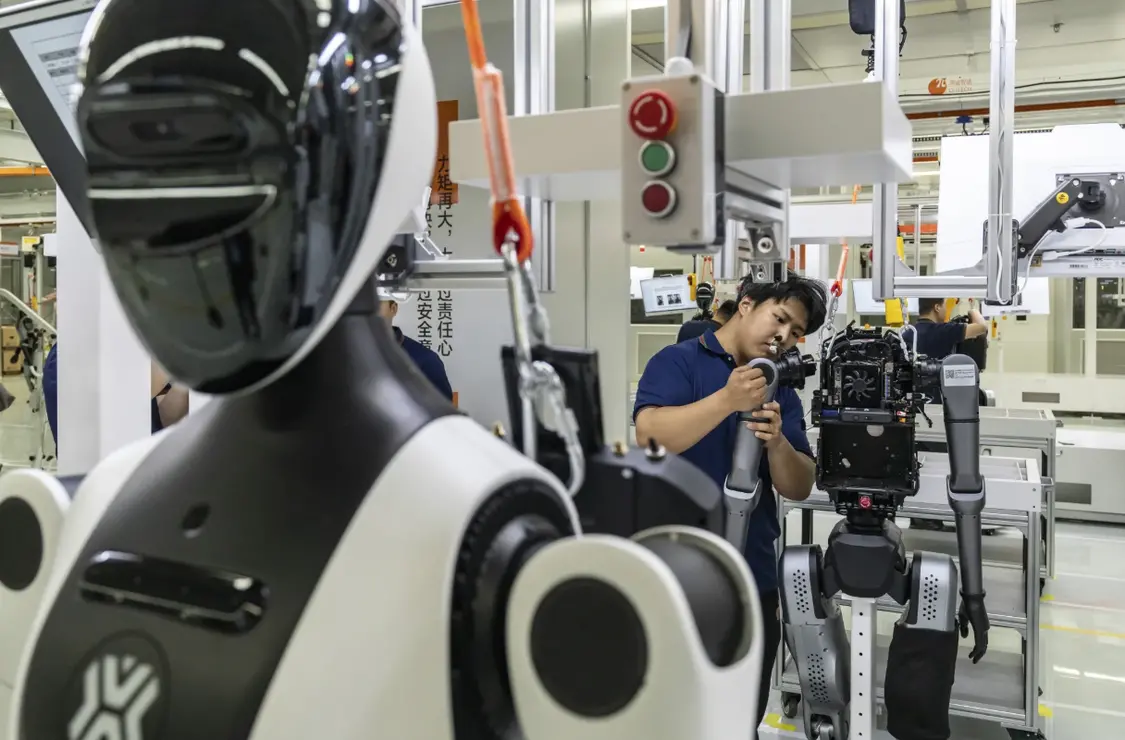
China reportedly controls over 97% of humanoid-robot shipments—an important signal for embodied-AI builders.
30-Second TL;DR
What Changed
Chinese manufacturers reportedly represented over 97% of global humanoid-robot shipments in H1 2026.
Why It Matters
A dominant shipment share could accelerate China’s access to real-world deployment data, component economies of scale, and developer adoption. AI startups may need to evaluate Chinese hardware platforms more seriously when building embodied-AI applications.
What To Do Next
Benchmark the SDKs, sensor stacks, and deployment costs of leading Chinese humanoid-robot platforms before selecting hardware for an embodied-AI prototype.
Key Points
- •Chinese manufacturers reportedly represented over 97% of global humanoid-robot shipments in H1 2026.
- •The data indicates a substantial early lead for China over U.S. competitors.
- •The finding highlights China’s manufacturing scale and supply-chain advantage in embodied AI hardware.
Deep Insight
AI-generated analysis for this event — not the original article.
Enhanced Key Takeaways
- •The 97% shipment figure is largely driven by the mass production of low-cost, task-specific humanoid units deployed in Chinese automotive and electronics assembly lines, rather than general-purpose research robots.
- •Chinese government subsidies under the 'Robot + Application' action plan have significantly lowered the barrier to entry for domestic manufacturers, allowing for rapid scaling of hardware production.
- •While China leads in shipment volume, U.S.-based firms like Tesla and Figure AI maintain a lead in high-level reasoning capabilities and foundation model integration for embodied AI.
- •The surge in shipments is heavily concentrated in the 'industrial humanoid' category, which prioritizes mechanical durability and cost-efficiency over the human-like dexterity found in Western prototypes.
- •Supply chain dominance in critical components, specifically harmonic drives and high-torque actuators, has allowed Chinese firms to bypass global component shortages that have slowed U.S. production timelines.
Competitor Analysis
- Chinese Industrial Humanoids (H1 2026)
- Task-specific assembly/logistics
- U.S. General-Purpose Humanoids
- General-purpose reasoning/autonomy
- Chinese Industrial Humanoids (H1 2026)
- $20,000 - $45,000
- U.S. General-Purpose Humanoids
- $80,000 - $150,000+
- Chinese Industrial Humanoids (H1 2026)
- High (Thousands of units)
- U.S. General-Purpose Humanoids
- Low (Pilot programs/R&D)
- Chinese Industrial Humanoids (H1 2026)
- Supply chain & manufacturing cost
- U.S. General-Purpose Humanoids
- Software stack & AI model maturity
| Feature | Chinese Industrial Humanoids (H1 2026) | U.S. General-Purpose Humanoids |
|---|---|---|
| Primary Focus | Task-specific assembly/logistics | General-purpose reasoning/autonomy |
| Avg. Unit Price | $20,000 - $45,000 | $80,000 - $150,000+ |
| Deployment Scale | High (Thousands of units) | Low (Pilot programs/R&D) |
| Key Advantage | Supply chain & manufacturing cost | Software stack & AI model maturity |
Technical Deep Dive
- Utilization of modular actuator designs that integrate motor, driver, and encoder into a single unit to reduce assembly complexity.
- Adoption of lightweight carbon-fiber reinforced polymer frames to optimize power-to-weight ratios for extended battery life in factory settings.
- Implementation of localized edge-computing modules for real-time kinematic control, reducing latency compared to cloud-dependent architectures.
- Integration of multi-modal sensor fusion suites combining LiDAR, depth cameras, and tactile force sensors in hands for basic object manipulation.
Future ImplicationsAI analysis grounded in cited sources
Timeline
- 2023-10China's Ministry of Industry and Information Technology releases development goals for humanoid robotics by 2025.
- 2024-01Launch of the Beijing Humanoid Robot Innovation Center to standardize hardware interfaces.
- 2025-06Major Chinese automotive manufacturers begin large-scale integration of humanoid robots into assembly lines.
- 2026-02Chinese manufacturers report a 300% year-over-year increase in actuator production capacity.
Weekly AI Recap
Read this week's curated digest of top AI events →
Related Updates


AI-curated news aggregator. All content rights belong to original publishers.
Original source: cnBeta (Full RSS) ↗
This is a summary, not the original. Read the source, or get the weekly briefing.
The weekly digest
One email a week. Unsubscribe anytime.