ChatGPT Threat Report Triggers Arrest
💡A real-world test of whether AI chats are private—and how threat detection can cross into law enforcement.
⚡ 30-Second TL;DR
What Changed
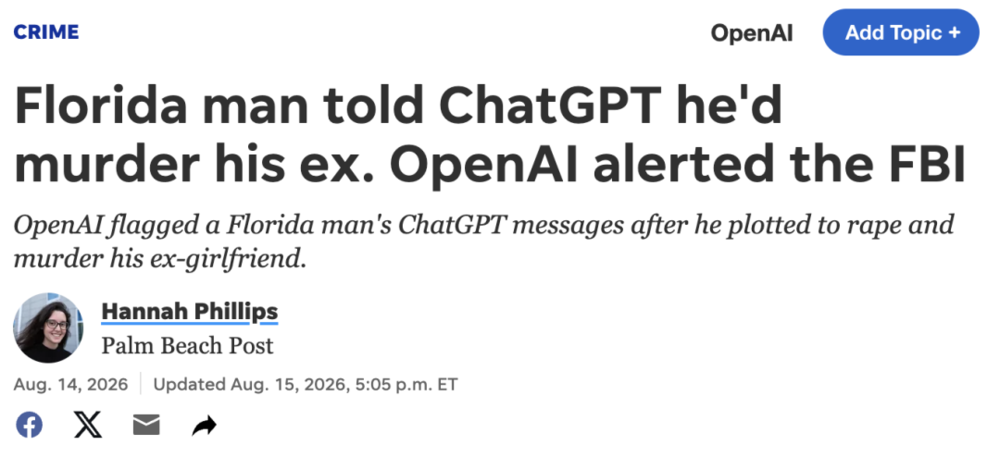
OpenAI’s automated safety systems flagged conversations describing a planned murder, a timeline, and a specific target.
Why It Matters
This is a significant safety and governance example for AI products that process sensitive user conversations. Developers may need clear escalation policies, audit trails, human review procedures, and privacy disclosures for credible threats involving identifiable third parties.
What To Do Next
Review your OpenAI moderation and escalation workflow to log credible third-party threats, route them to human review, and document disclosure criteria.
Key Points
- •OpenAI’s automated safety systems flagged conversations describing a planned murder, a timeline, and a specific target.
- •The records were reviewed by humans and reported to the FBI, which later shared them with local Florida investigators.
- •The suspect pleaded guilty to stalking and electronic threats and received eight years of probation with monitoring and no-contact restrictions.
- •OpenAI distinguishes imminent threats to others from self-harm content, applying different reporting policies.
- •The case raises legal questions because U.S. law permits, but generally does not require, platforms to disclose data during emergencies.
🧠 Deep Insight
Background and context from public sources — not the original article. 11 sources cited.
🔑 Enhanced Key Takeaways
- •OpenAI differentiates between self-harm and violence, utilizing a 'Trusted Contact' feature for the former while escalating the latter to law enforcement.
- •Florida's Attorney General initiated a separate criminal investigation into OpenAI in 2026 regarding the platform's potential influence on users' violent intent.
- •Federal authorities have established a precedent by late 2025 for using search warrants to compel OpenAI to provide user conversation logs as evidence in criminal cases.
- •The 2026 surge in anti-AI protests across the U.S. and London has intensified public scrutiny of how AI companies handle user data and social stability.
- •OpenAI has maintained a consistent cadence of publishing threat reports for two years, documenting how malicious actors integrate AI with traditional digital platforms.
🛠️ Technical Deep Dive
- OpenAI employs a multi-layered monitoring architecture that filters user inputs for high-risk indicators of imminent harm.
- The system utilizes a specialized escalation pipeline that triggers human review when automated safety thresholds for violence are breached.
- Data extraction for law enforcement is facilitated through legal compliance protocols that align with federal search warrant requirements for digital service providers.
🔮 Future ImplicationsAI analysis grounded in cited sources
⏳ Timeline
📎 Sources (11)
Factual claims are grounded in the sources below. Forward-looking analysis is AI-generated interpretation.
Weekly AI Recap
Read this week's curated digest of top AI events →
👉Related Updates



AI-curated news aggregator. All content rights belong to original publishers.
Original source: 虎嗅 ↗
This is a summary, not the original. Read the source, or get the weekly briefing.
Weekly AI briefing
One email a week. Unsubscribe anytime.