CATL's dominance faces challenges from supply chain diversification
💡Understand how the shifting EV supply chain is disrupting the battery market leader's dominance.
⚡ 30-Second TL;DR
What Changed
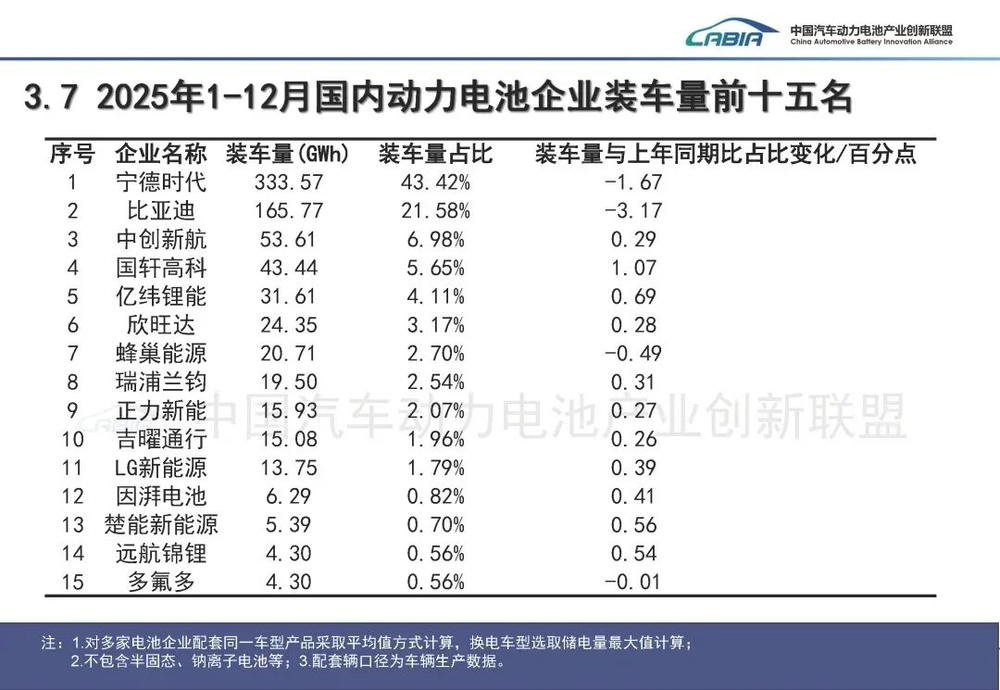
CATL's domestic market share dropped to 43.42% in 2025, with a downward trend.
Why It Matters
The shift toward multi-sourcing in the EV industry suggests that battery suppliers must compete more aggressively on price and integration, potentially narrowing profit margins for dominant players.
What To Do Next
Analyze battery cost-efficiency in your supply chain models to determine if switching to multi-vendor strategies can improve your product's unit economics.
Key Points
- •CATL's domestic market share dropped to 43.42% in 2025, with a downward trend.
- •EV makers are adopting multi-supplier strategies to reduce reliance on CATL and cut costs.
- •Second-tier battery manufacturers like Gotion High-Tech and CALB are gaining significant market share.
- •CATL maintains a strong lead in high-end technology, but faces intense competition in the mass-market segment.
🧠 Deep Insight
AI-generated analysis for this event.
🔑 Enhanced Key Takeaways
- •CATL has increasingly pivoted toward 'CATL Inside' branding partnerships, similar to Intel, to maintain leverage by embedding its brand directly into consumer-facing EV marketing.
- •The rise of in-house battery production by major OEMs, such as BYD's vertical integration and Tesla's 4680 cell manufacturing, has structurally reduced the addressable market for third-party suppliers.
- •Geopolitical trade barriers, specifically the U.S. Inflation Reduction Act (IRA) and EU anti-subsidy investigations, have forced CATL to shift from direct exports to technology licensing models (e.g., the Ford-CATL partnership).
- •CATL is aggressively diversifying into energy storage systems (ESS) to offset slowing growth in the automotive sector, with ESS now representing a significant portion of its revenue mix.
- •The emergence of solid-state and semi-solid-state battery startups is challenging CATL's long-term technological moat, forcing the company to accelerate its 'Shenxing' and 'Qilin' battery iteration cycles.
📊 Competitor Analysis▸ Show
| Feature | CATL | BYD (FinDreams) | Gotion High-Tech | CALB |
|---|---|---|---|---|
| Primary Chemistry | NCM/LFP | LFP (Blade) | LFP/LMFP | NCM/LFP |
| Market Focus | Premium/Global | Vertical Integration | Mass Market | Mid-Range/Export |
| Tech Moat | High (Qilin/Shenxing) | High (Blade/Safety) | Moderate (LMFP) | Moderate (CTP) |
| Pricing Strategy | Premium/Tiered | Cost-Leader | Aggressive | Competitive |
🛠️ Technical Deep Dive
- Qilin Battery: Features third-generation CTP (Cell-to-Pack) technology with a volume utilization efficiency of 72% and energy density up to 255 Wh/kg.
- Shenxing Superfast Charging: Utilizes a 4C charging rate enabled by superconducting electrolyte technology and a multi-gradient layered electrode structure to achieve 400km range in 10 minutes.
- AB Battery Integration: A proprietary structural design that mixes LFP and NCM cells within the same pack to balance cost, energy density, and thermal stability.
- Thermal Management: Advanced liquid cooling systems integrated into the battery pack chassis to support high-power output and rapid charging cycles.
🔮 Future ImplicationsAI analysis grounded in cited sources
⏳ Timeline
Weekly AI Recap
Read this week's curated digest of top AI events →
👉Related Updates
AI-curated news aggregator. All content rights belong to original publishers.
Original source: 虎嗅 ↗