CATL Backs RoboParty’s Open-Source Humanoid Push
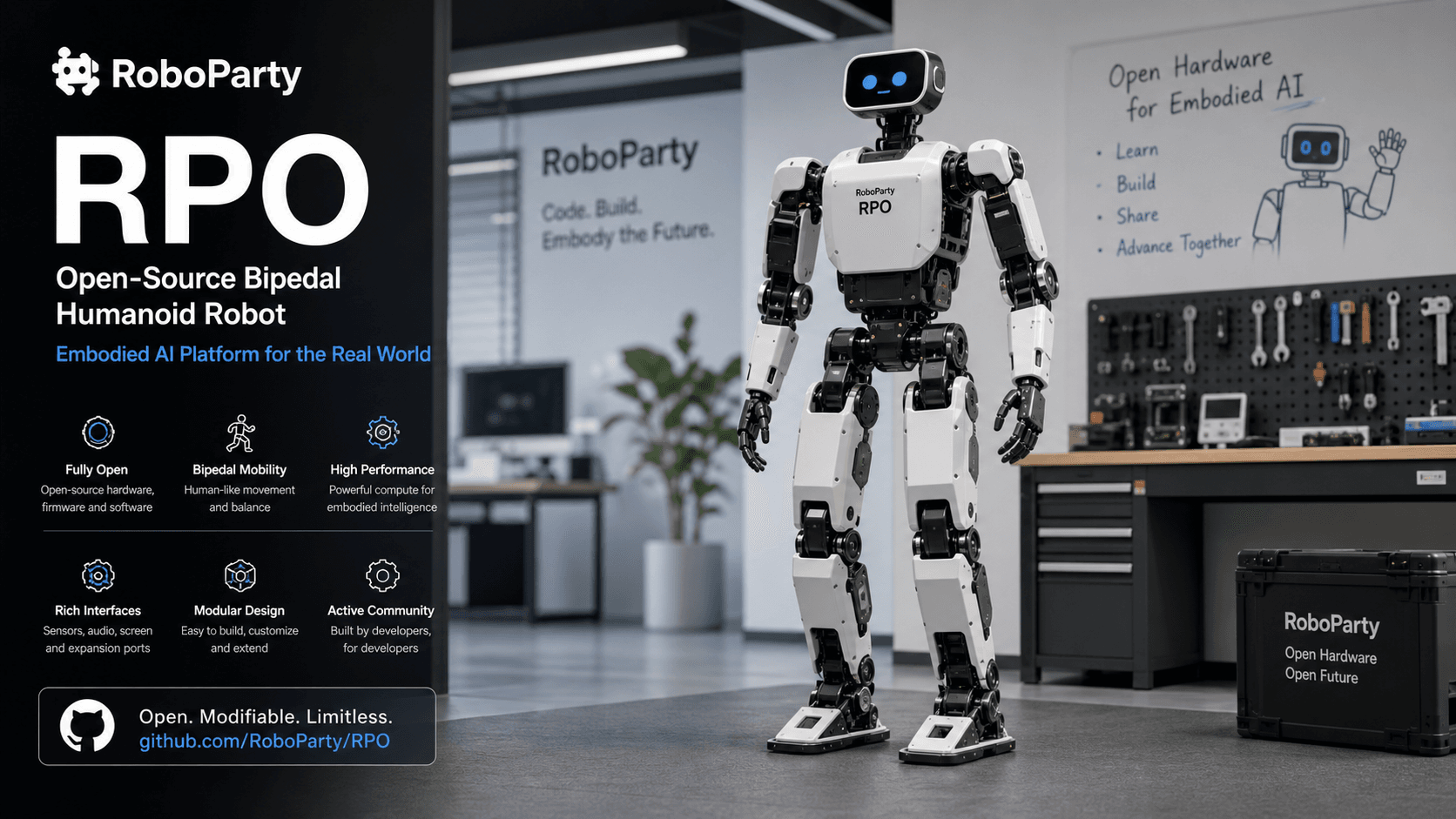
CATL’s backing gives an open-source humanoid startup new momentum in embodied AI.
30-Second TL;DR
What Changed
RoboParty completed nearly 500 million yuan in angel-plus and Pre-A financing.
Why It Matters
CATL’s investment signals growing strategic interest in embodied AI and humanoid robotics from a major battery and manufacturing player. RoboParty’s open-source positioning could help attract developers and accelerate experimentation around its robot platform.
What To Do Next
Monitor RoboParty’s open-source channels and evaluate whether the RPO platform exposes usable robot-control interfaces for simulation or hardware prototyping.
Key Points
- •RoboParty completed nearly 500 million yuan in angel-plus and Pre-A financing.
- •CATL was the exclusive investor in RoboParty’s Pre-A round.
- •Founder Huang Yi, a 22-year-old Harbin Institute of Technology graduate, leads the company.
- •The startup is building an open-source, full-stack bipedal humanoid platform around the RPO robot.
- •RoboParty’s valuation reportedly increased twentyfold during its financing progression.
Deep Insight
AI-generated analysis for this event — not the original article.
Enhanced Key Takeaways
- •RoboParty's open-source strategy focuses on lowering the entry barrier for humanoid development by providing modular hardware and software stacks that allow third-party developers to contribute to the RPO ecosystem.
- •The partnership with CATL suggests a strategic alignment where RoboParty may integrate CATL's advanced battery management systems or high-density energy storage solutions specifically optimized for humanoid locomotion and extended operational time.
- •Huang Yi gained significant industry attention prior to RoboParty through his viral open-source robotics projects on platforms like GitHub and Bilibili, which served as the technical foundation for the RPO robot.
- •The 500 million yuan funding is earmarked for scaling the RPO robot's production capacity and establishing a dedicated R&D center focused on embodied AI and motor control algorithms.
- •RoboParty is positioning itself as a 'Linux of Humanoids,' aiming to standardize the underlying architecture for bipedal robots to accelerate commercial adoption in industrial and service sectors.
Competitor Analysis
- RoboParty (RPO)
- Open-Source Platform
- Unitree (G1/H1)
- Commercial Hardware
- Fourier Intelligence (GR-1)
- Medical/Rehab Focus
- RoboParty (RPO)
- Developers/Research
- Unitree (G1/H1)
- Industrial/Consumer
- Fourier Intelligence (GR-1)
- Healthcare/Service
- RoboParty (RPO)
- Full-stack open source
- Unitree (G1/H1)
- High-speed agility
- Fourier Intelligence (GR-1)
- Force-feedback control
| Feature | RoboParty (RPO) | Unitree (G1/H1) | Fourier Intelligence (GR-1) |
|---|---|---|---|
| Primary Strategy | Open-Source Platform | Commercial Hardware | Medical/Rehab Focus |
| Target Market | Developers/Research | Industrial/Consumer | Healthcare/Service |
| Key Differentiator | Full-stack open source | High-speed agility | Force-feedback control |
Technical Deep Dive
- RPO robot utilizes a proprietary high-torque density actuator design aimed at improving energy efficiency during bipedal walking.
- The software stack is built on a modular ROS 2 (Robot Operating System) foundation, enabling seamless integration with various AI models and simulation environments like NVIDIA Isaac Gym.
- Employs a distributed control architecture that separates low-level motor control from high-level perception and path planning tasks.
- The hardware design emphasizes a lightweight carbon-fiber and aluminum alloy chassis to optimize the power-to-weight ratio for extended battery life.
Future ImplicationsAI analysis grounded in cited sources
Timeline
- 2024-05Huang Yi begins public development of the RPO humanoid project.
- 2025-02RoboParty officially incorporates following viral success of initial prototypes.
- 2025-09Company secures angel-plus funding round to expand R&D team.
- 2026-06RoboParty closes Pre-A round led exclusively by CATL.
Weekly AI Recap
Read this week's curated digest of top AI events →
Related Updates




AI-curated news aggregator. All content rights belong to original publishers.
Original source: Pandaily ↗
This is a summary, not the original. Read the source, or get the weekly briefing.
The weekly digest
One email a week. Unsubscribe anytime.