Cate Blanchett launches registry to protect likeness from AI
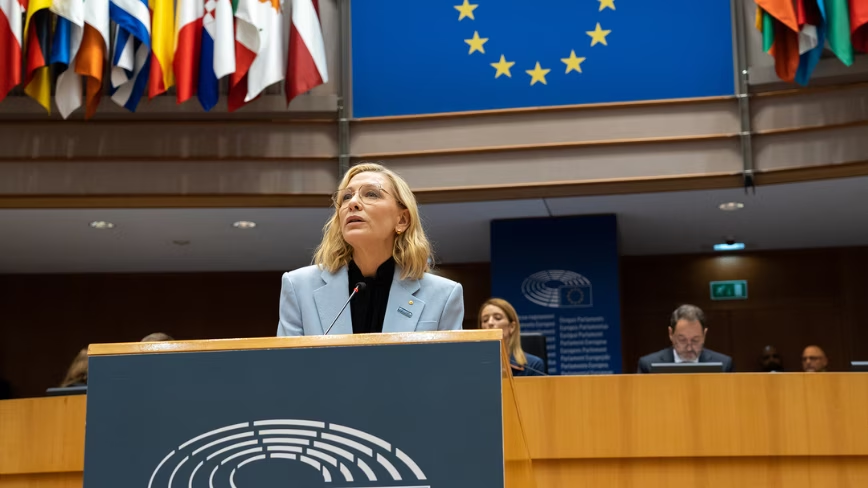
A new legal-tech tool for managing digital likeness rights that could impact how AI models are trained on human data.
30-Second TL;DR
What Changed
The registry treats personal identity (face, voice, name) as licensable property.
Why It Matters
This registry could set a precedent for how AI companies handle training data and synthetic media, potentially forcing a shift toward explicit consent models.
What To Do Next
If you are building generative AI models, evaluate your data pipeline to ensure it can accommodate opt-out or licensing signals from registries like this.
Key Points
- •The registry treats personal identity (face, voice, name) as licensable property.
- •Users can set specific terms for AI usage, allowing them to withhold or grant consent.
- •The initiative aims to establish a framework for digital rights in the age of generative AI.
Deep Insight
AI-generated analysis for this event — not the original article.
Enhanced Key Takeaways
- •The Human Consent Registry is built upon the 'Human Intelligence' (HI) protocol, which utilizes blockchain-based smart contracts to automate the enforcement of usage rights.
- •The initiative is specifically designed to align with the EU AI Act's transparency requirements, providing a standardized machine-readable format for AI developers to check consent status.
- •Cate Blanchett has partnered with the non-profit organization 'Humanity Intelligence' to manage the registry, ensuring it remains independent from major tech conglomerates.
- •The registry includes a 'Right to Revoke' feature, allowing individuals to retroactively withdraw consent for their likeness to be used in future training cycles of generative models.
- •Early pilot programs for the registry are being integrated into major European creative agencies to streamline the licensing of digital twins for advertising and film production.
Competitor Analysis
- Human Consent Registry
- Individual (Self-Sovereign)
- Traditional Talent Agencies
- Agency-Managed
- AI Data Licensing Platforms
- Platform-Managed
- Human Consent Registry
- Free (Public Utility)
- Traditional Talent Agencies
- Commission-Based
- AI Data Licensing Platforms
- Subscription/Revenue Share
- Human Consent Registry
- Smart Contracts
- Traditional Talent Agencies
- Manual Negotiation
- AI Data Licensing Platforms
- API-Driven
- Human Consent Registry
- High (Blockchain)
- Traditional Talent Agencies
- Low
- AI Data Licensing Platforms
- Variable
| Feature | Human Consent Registry | Traditional Talent Agencies | AI Data Licensing Platforms |
|---|---|---|---|
| Control | Individual (Self-Sovereign) | Agency-Managed | Platform-Managed |
| Pricing | Free (Public Utility) | Commission-Based | Subscription/Revenue Share |
| Automation | Smart Contracts | Manual Negotiation | API-Driven |
| Transparency | High (Blockchain) | Low | Variable |
Technical Deep Dive
- The registry utilizes a decentralized identifier (DID) framework to link biometric and personal data to a unique cryptographic key owned by the individual.
- It employs a RESTful API that allows AI training pipelines to perform 'Consent Verification' checks before ingesting datasets.
- The system uses a zero-knowledge proof (ZKP) mechanism to verify that a user has granted consent without exposing the underlying personal identity data to the AI developer.
- Smart contracts are deployed on a permissioned ledger to ensure that terms of use are immutable and legally binding across jurisdictions.
Future ImplicationsAI analysis grounded in cited sources
Timeline
- 2025-09Cate Blanchett begins public advocacy for digital likeness protections at international film forums.
- 2026-02Initial collaboration between Blanchett and MEP Eva Maydell announced to draft policy frameworks.
- 2026-06Official launch of the Human Consent Registry at the European Parliament.
Weekly AI Recap
Read this week's curated digest of top AI events →
Related Updates


AI-curated news aggregator. All content rights belong to original publishers.
Original source: The Next Web (TNW) ↗
This is a summary, not the original. Read the source, or get the weekly briefing.
The weekly digest
One email a week. Unsubscribe anytime.