Canva Code 2.0 simplifies app building with natural language
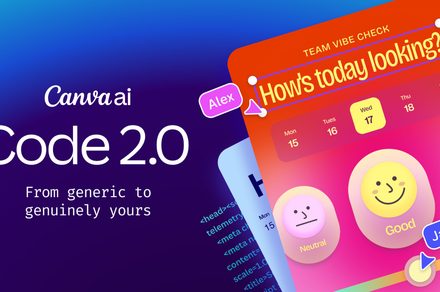
💡See how Canva is integrating LLM-driven 'vibe coding' to turn non-technical users into app builders.
⚡ 30-Second TL;DR
What Changed
Enables app and website creation using plain language instructions.
Why It Matters
This update democratizes software development by allowing creators to prototype functional apps without traditional coding skills. It positions Canva as a serious contender in the low-code/no-code application development space.
What To Do Next
Experiment with Canva Code 2.0 to prototype a simple interactive tool and evaluate if it can replace manual boilerplate coding for your design-heavy projects.
Key Points
- •Enables app and website creation using plain language instructions.
- •Seamlessly integrated into the familiar Canva editor interface.
- •Designed to make 'vibe coding' accessible to non-technical users.
- •Supports the development of interactive digital experiences.
🧠 Deep Insight
AI-generated analysis for this event.
🔑 Enhanced Key Takeaways
- •Canva Code 2.0 utilizes a proprietary multimodal LLM fine-tuned specifically on Canva's design system and component library to ensure generated code adheres to brand guidelines.
- •The update introduces 'Live Preview' capabilities, allowing users to interact with functional app components within the editor before publishing to Canva's hosting environment.
- •Canva has implemented a new 'Safety Guardrail' layer that sanitizes natural language prompts to prevent the generation of malicious code or insecure API calls.
- •The platform now supports one-click deployment to Canva's cloud infrastructure, removing the need for external hosting or complex configuration for basic web apps.
- •Code 2.0 includes an 'Explain My Code' feature that provides natural language documentation for the generated logic, aiding users in learning basic programming concepts.
📊 Competitor Analysis▸ Show
| Feature | Canva Code 2.0 | Framer AI | Webflow Logic |
|---|---|---|---|
| Primary User | Non-technical Creators | Designers | Developers/Designers |
| Natural Language | High (Vibe Coding) | High (Layout focus) | Low (Logic focus) |
| Pricing | Freemium/Pro | Tiered Subscription | Tiered Subscription |
| Benchmarks | Rapid Prototyping | High-fidelity UI | Complex Backend |
🛠️ Technical Deep Dive
- Architecture: Utilizes a transformer-based model optimized for React-based component generation.
- Integration: Operates as a plugin within the Canva App SDK, allowing direct manipulation of the DOM-like structure of Canva designs.
- Output: Generates modular JavaScript/TypeScript code snippets that map directly to Canva's internal design tokens.
- Latency: Optimized for sub-second inference times using edge-computing nodes to minimize delay during the 'vibe coding' process.
🔮 Future ImplicationsAI analysis grounded in cited sources
⏳ Timeline
Weekly AI Recap
Read this week's curated digest of top AI events →
👉Related Updates


AI-curated news aggregator. All content rights belong to original publishers.
Original source: Digital Trends ↗