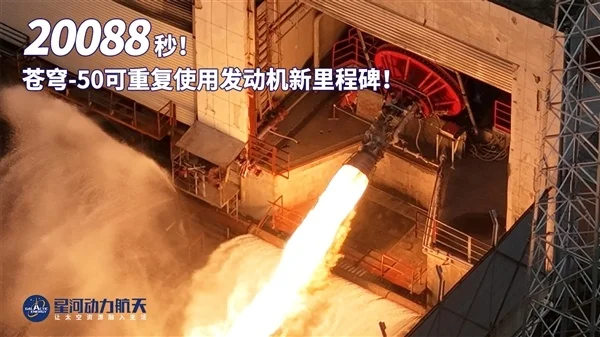
Cangqiong-50 engine completes 20,088 seconds of testing
💡Reusable rocket tech is the backbone for future global AI infrastructure and satellite connectivity.
⚡ 30-Second TL;DR
What Changed
Cangqiong-50 engine achieved 20,088 seconds of cumulative test time
Why It Matters
Advances in reusable engine technology significantly lower the cost of orbital access, impacting the infrastructure for satellite-based AI and edge computing.
What To Do Next
Monitor aerospace infrastructure costs as they directly correlate to the feasibility of large-scale satellite AI deployments.
Key Points
- •Cangqiong-50 engine achieved 20,088 seconds of cumulative test time
- •Engine supports over 25 reuses for Nebula-1 rocket
- •Validated performance through 57 full-system ignition tests
🧠 Deep Insight
AI-generated analysis for this event — not the original article.
🔑 Enhanced Key Takeaways
- •The Cangqiong-50 engine utilizes an open-cycle gas generator cycle, a common architecture for cost-effective reusable launch vehicles.
- •Deep Blue Aerospace has integrated 3D printing technology for major engine components to reduce manufacturing lead times and part counts.
- •The engine features a deep throttling capability, which is critical for the vertical take-off and vertical landing (VTVL) maneuvers required by the Nebula-1 rocket.
- •Testing was conducted at Deep Blue Aerospace's dedicated propulsion test facility, which supports high-frequency hot-fire campaigns to simulate rapid turnaround cycles.
- •The 20,088-second cumulative test duration includes multiple 'mission duty cycle' simulations that mimic the thermal and vibration stresses of actual flight profiles.
📊 Competitor Analysis▸ Show
| Feature | Cangqiong-50 (Deep Blue) | Merlin 1D (SpaceX) | BE-4 (Blue Origin) |
|---|---|---|---|
| Propellant | LOX/Kerosene | LOX/Kerosene | LOX/LNG |
| Cycle | Gas Generator | Gas Generator | Staged Combustion |
| Reusability Target | 25+ flights | 20+ flights | 25+ flights |
| Status | Operational/Testing | Flight Proven | Flight Proven |
🛠️ Technical Deep Dive
- Engine Type: Liquid Oxygen/Kerosene (RP-1) gas generator cycle engine.
- Thrust Class: Designed for the Nebula-1 first stage, typically operating in the 50-ton thrust class.
- Throttling: Supports wide-range thrust modulation for precise landing control.
- Materials: Extensive use of additive manufacturing (3D printing) for complex combustion chamber and injector geometries.
- Durability: Designed for rapid refurbishment, focusing on minimizing thermal fatigue during high-frequency reuse cycles.
🔮 Future ImplicationsAI analysis grounded in cited sources
⏳ Timeline
Weekly AI Recap
Read this week's curated digest of top AI events →
👉Related Updates



AI-curated news aggregator. All content rights belong to original publishers.
Original source: cnBeta (Full RSS) ↗
This is a summary, not the original. Read the source, or get the weekly briefing.
Weekly AI briefing
One email a week. Unsubscribe anytime.