Cambridge team uses AI to develop universal coronavirus vaccine
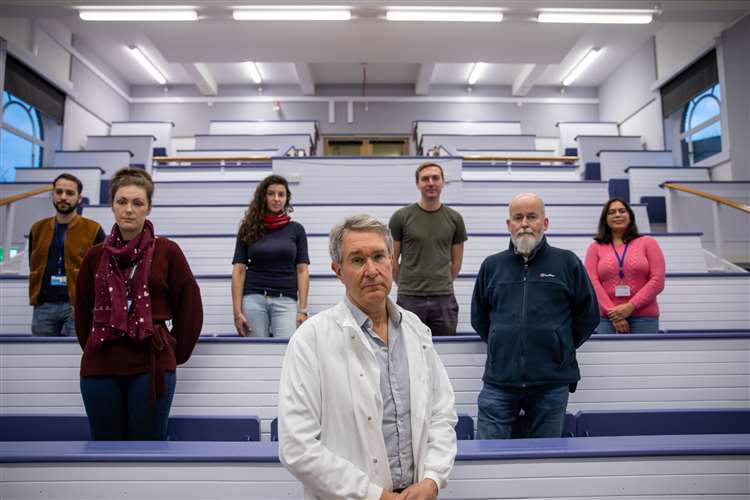
💡First-ever human trial for an AI-designed vaccine antigen—a major breakthrough in generative biology.
⚡ 30-Second TL;DR
What Changed
First human trial of an AI-designed vaccine antigen
Why It Matters
This marks a milestone in generative biology, demonstrating that AI can successfully navigate complex protein folding and antigen design for medical applications.
What To Do Next
Explore protein design frameworks like AlphaFold 3 or ProteinMPNN to understand how generative models are transforming drug discovery pipelines.
Key Points
- •First human trial of an AI-designed vaccine antigen
- •Focuses on broad-spectrum protection against multiple coronaviruses
- •Targets both existing variants and potential future zoonotic outbreaks
🧠 Deep Insight
Background and context from public sources — not the original article. 13 sources cited.
🔑 Enhanced Key Takeaways
- •The vaccine, named pEVAC-PS, is a DNA plasmid-based vaccine developed by the University of Cambridge and its spin-out company DIOSynVax (DVX) Ltd.
- •The Phase 1 human clinical trial involved 39 healthy volunteers aged 18-50 and demonstrated the vaccine's safety and triggered immune responses to SARS-CoV-2, SARS-CoV-1, and related bat viruses.
- •The AI-designed 'super-antigen' was created by analyzing all available genetic sequence data of Sarbeco coronaviruses to identify common features, including those of viruses that haven't yet emerged, and is delivered via a needle-free microfluidic jet system.
🛠️ Technical Deep Dive
- AI Platform: DIOSynVax's proprietary platform utilizes machine learning and computational modeling for vaccine antigen design.
- Antigen Design Principle: The platform analyzes the structure and evolution of viruses to achieve broad (cross-family) and deep (mutation countering) protection.
- 'Super-antigen' Creation: Machine learning algorithms analyze genetic sequence data from past and current outbreaks of Sarbeco coronaviruses to identify essential features for virus survival and common antigen characteristics, including those of potential future emergent viruses.
- Computational Modeling: This technique is employed to graft epitope-rich regions from key immune targets into a single antigen structure.
- Self-improving Algorithms: The system's data reservoir continuously grows, using machine learning to predict how key viral areas are likely to change and to generate vaccine candidates that offer long-term protection.
- Vaccine Type: The specific vaccine tested, pEVAC-PS, is a DNA plasmid-based vaccine.
- Delivery Method: It is administered using a needle-free microfluidic jet system, specifically the PharmaJet Tropis® intradermal Needle-free Injection System.
- Vector Agnostic: The Vaccine Antigen Payloads (VAPs) designed by DIOSynVax are compatible with various vaccine vectors, including nucleic acid-based (DNA or mRNA), virus-vectored (e.g., adenovirus), or protein-based platforms.
🔮 Future ImplicationsAI analysis grounded in cited sources
⏳ Timeline
📎 Sources (13)
Factual claims are grounded in the sources below. Forward-looking analysis is AI-generated interpretation.
Weekly AI Recap
Read this week's curated digest of top AI events →
👉Related Updates
AI-curated news aggregator. All content rights belong to original publishers.
Original source: cnBeta (Full RSS) ↗
This is a summary, not the original. Read the source, or get the weekly briefing.
The weekly digest
One email a week. Unsubscribe anytime.