BYD Launches 4nm Xuanji A3 Intelligent Driving Chip
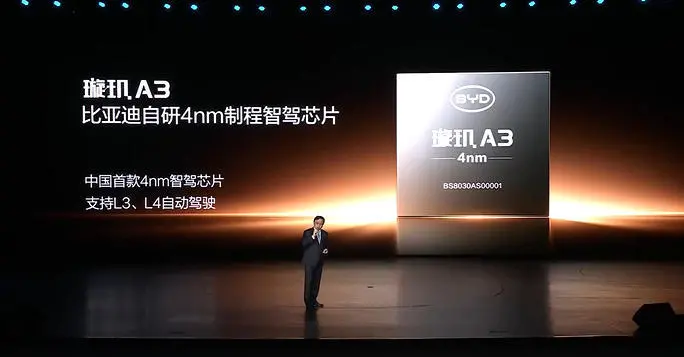
💡Major shift in automotive AI: BYD enters the high-performance 4nm autonomous driving chip market.
⚡ 30-Second TL;DR
What Changed
4nm process technology for high-performance autonomous driving
Why It Matters
This move strengthens BYD's vertical integration in AI-driven automotive intelligence, reducing reliance on foreign silicon providers for autonomous driving.
What To Do Next
If you are developing autonomous driving algorithms, evaluate the performance benchmarks of the Xuanji A3 to see if it fits your edge-AI deployment roadmap.
Key Points
- •4nm process technology for high-performance autonomous driving
- •Supports L3 and L4 level autonomous driving systems
- •2100 TOPS total computing power with a three-chip setup
🧠 Deep Insight
Background and context from public sources — not the original article. 12 sources cited.
🔑 Enhanced Key Takeaways
- •The Xuanji A3 chip has already entered mass production.
- •A single Xuanji A3 chip delivers 700 TOPS of computing power, contributing to the 2100+ TOPS in a three-chip configuration.
- •The chip serves as the core of a new central computing platform that unifies the smart cockpit, driver-assistance system, and core electric propulsion domains within BYD vehicles.
- •BYD claims the Xuanji A3 offers the lowest power consumption per unit of compute in its class, drawing approximately 20% less power than comparable semiconductors.
- •BYD is expanding its 'God's Eye' driver-assistance system, powered by the Xuanji A3, to mass-market EVs like the Seagull, offering advanced features as a 12,000 yuan ($1,770) add-on.
- •BYD has a dedicated chip R&D team of over 7,000 people and operates five wafer fabrication plants, asserting full control over its assisted-driving supply chain and ending its reliance on third-party chips like Horizon Robotics.
📊 Competitor Analysis▸ Show
| Feature/Competitor | BYD Xuanji A3 (single chip) | BYD Xuanji A3 (3-chip config) | Li Auto Mach 100 | Xpeng Turing AI | Huawei (current) | Nvidia Drive Thor (comparable) |
|---|---|---|---|---|---|---|
| Process Node | 4nm | 4nm | N/A | N/A | 7nm | N/A |
| Computing Power | 700 TOPS | 2100+ TOPS | 1280 TOPS | 750 TOPS | N/A | 2000 TOPS (Orin) / 2000 TOPS (Thor) |
| Power Efficiency | ~20% less than comparable | N/A | N/A | N/A | N/A | N/A |
| Functional Safety | ASIL-D | ASIL-D | N/A | N/A | N/A | N/A |
🛠️ Technical Deep Dive
- Process Technology: 4nm automotive-grade chip.
- Computing Power: A single Xuanji A3 chip delivers 700 TOPS; a three-chip configuration achieves over 2100 TOPS.
- Power Efficiency: Claims lowest power consumption per unit of compute in its class, drawing approximately 20% less than comparable semiconductors.
- Architecture: Centerpiece of a new laptop-sized central computing platform that unifies smart cockpit, driver-assistance, and core electric propulsion domains. It runs on BYD's Xuanji Architecture 2.0, which routes raw sensor signals directly to a central brain with an 8-microsecond latency.
- Internal Specifications: Features a 16-core CPU, 420,000 DMIPS of processing performance, and 273 GB/s of bandwidth.
- Sensor Support: Compatible with thousand-line LiDAR sensors, including a previously revealed Robosense sensor with up to 2,160 lines. The upgraded sensor suite includes LiDAR with 1.6 times the angular resolution of the prior generation and a 4D millimeter-wave radar with a 400-meter detection range.
- Functional Safety: Meets ASIL-D, the highest automotive functional-safety rating.
- Software Optimization: Deep algorithm optimization, combined with BYD's proprietary algorithms, reportedly doubles compute-utilization efficiency.
🔮 Future ImplicationsAI analysis grounded in cited sources
⏳ Timeline
📎 Sources (12)
Factual claims are grounded in the sources below. Forward-looking analysis is AI-generated interpretation.
Weekly AI Recap
Read this week's curated digest of top AI events →
👉Related Updates
AI-curated news aggregator. All content rights belong to original publishers.
Original source: cnBeta (Full RSS) ↗
This is a summary, not the original. Read the source, or get the weekly briefing.
The weekly digest
One email a week. Unsubscribe anytime.