Build Multimodal RAG with Multi-Vector Retrieval
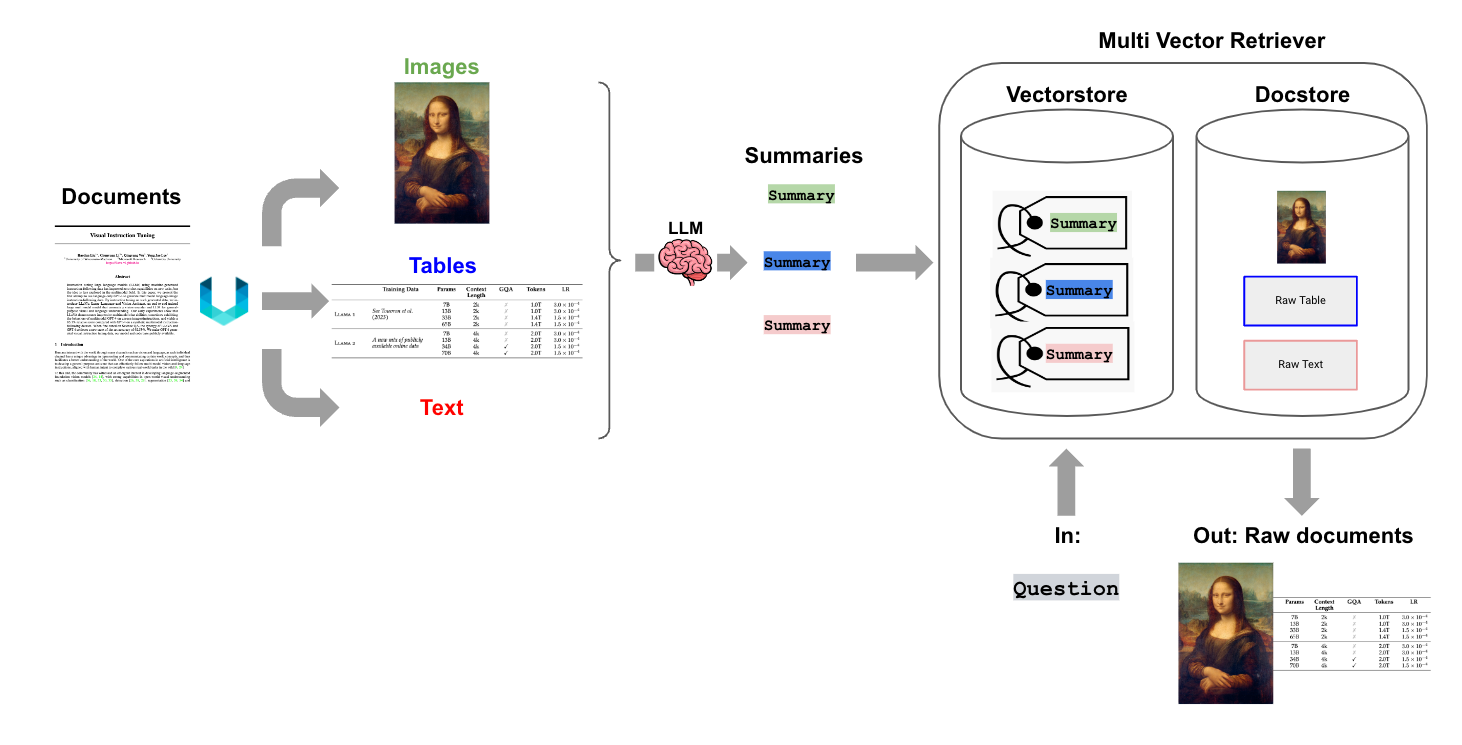
💡Learn a practical path to retrieve tables, text, and images in one RAG workflow.
⚡ 30-Second TL;DR
What Changed
Supports RAG retrieval across tables, text, and images
Why It Matters
This approach can help practitioners build RAG pipelines that handle heterogeneous enterprise documents instead of text alone. It may reduce the need to design separate retrieval workflows for tables, prose, and images.
What To Do Next
Prototype a LangChain RAG pipeline with the Multi-Vector Retriever using one table-heavy document set and one image-rich document set.
Key Points
- •Supports RAG retrieval across tables, text, and images
- •Includes implementation guidance for a Multi-Vector Retriever
- •Provides cookbooks for semi-structured and multimodal data retrieval
🧠 Deep Insight
Background and context from public sources — not the original article. 9 sources cited.
🔑 Enhanced Key Takeaways
- •Multi-vector retrieval architectures decouple the retrieval index from the generation content, allowing for the storage of high-fidelity source data while indexing lightweight summaries or hypothetical questions.
- •The industry has shifted toward patch-level embeddings, such as ColPali-style late interaction, which significantly outperform traditional single-vector document representations in figure-heavy or complex multimodal queries.
- •The ViDoRe v3 benchmark, established in January 2026, serves as the primary standard for evaluating multimodal document retrieval across 10 enterprise-relevant corpora.
- •Implementation of these advanced RAG architectures is being driven by the EU AI Act (effective August 2026), which mandates higher levels of transparency and verifiable evidence for AI-generated outputs.
- •Open-weights models like Nomic Embed Multimodal, built on a Qwen2.5-VL backbone, now provide enterprise-grade alternatives to proprietary models for private, multi-vector retrieval deployments.
📊 Competitor Analysis▸ Show
| Feature | LangChain (Multi-Vector) | LlamaIndex (Multi-Modal) | Haystack (Multimodal) |
|---|---|---|---|
| Core Approach | Decoupled indexing/retrieval | Unified data agents | Pipeline-based components |
| Benchmark Support | ViDoRe v3 compatible | ViDoRe v3 compatible | ViDoRe v3 compatible |
| Pricing | Open Source (Apache 2.0) | Open Source (MIT) | Open Source (Apache 2.0) |
| Best For | Flexible, modular workflows | Structured data orchestration | Production-ready pipelines |
🛠️ Technical Deep Dive
- Utilizes late interaction mechanisms where document patches are embedded separately to preserve spatial and structural information of tables and images.
- Employs a dual-stage retrieval process: indexing high-level summaries or synthetic queries to point to high-fidelity raw document chunks.
- Supports integration with vision-language models (VLMs) to generate textual descriptions of images, which are then indexed alongside raw text.
- Leverages specialized embedding models like nemotron-colembed-vl-8b-v2 for high-precision vector space mapping of multimodal inputs.
- Implements document partitioning strategies to isolate tables and figures from narrative text to prevent context fragmentation during vectorization.
🔮 Future ImplicationsAI analysis grounded in cited sources
⏳ Timeline
📎 Sources (9)
Factual claims are grounded in the sources below. Forward-looking analysis is AI-generated interpretation.
Weekly AI Recap
Read this week's curated digest of top AI events →
👉Related Updates
AI-curated news aggregator. All content rights belong to original publishers.
Original source: LangChain Blog ↗
This is a summary, not the original. Read the source, or get the weekly briefing.
Weekly AI briefing
One email a week. Unsubscribe anytime.