Build financial document processing with Pulse AI and Bedrock
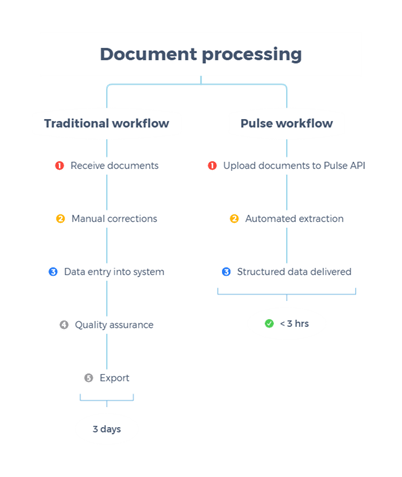
💡Learn how to combine Pulse AI and Amazon Bedrock to automate complex financial document extraction at scale.
⚡ 30-Second TL;DR
What Changed
Integrates Pulse AI document understanding with Amazon Bedrock's AI services
Why It Matters
This integration helps financial institutions automate complex document workflows, significantly reducing manual data entry errors. It provides a blueprint for developers to handle unstructured financial data using managed cloud services.
What To Do Next
Review the Pulse AI documentation and test the fine-tuning workflow on Amazon Bedrock using your own labeled financial document dataset.
Key Points
- •Integrates Pulse AI document understanding with Amazon Bedrock's AI services
- •Implements a specialized pipeline for complex financial document extraction
- •Utilizes model fine-tuning to improve accuracy for domain-specific financial data
- •Enables enterprise-grade document processing at scale
🧠 Deep Insight
Web-grounded analysis with 14 cited sources.
🔑 Enhanced Key Takeaways
- •Pulse AI employs a unique five-stage pipeline for document processing, which includes layout understanding, low-latency OCR, reading order analysis, table recognition, and fine-tuned vision-language models, specifically designed to convert complex PDFs and scans into structured data for financial documents.
- •The platform has processed over 600 million pages for Fortune 100 enterprises, global banks, private-equity firms, and AI startups, demonstrating its capability to handle high volumes of financial and operational documents with enterprise-grade security certifications like SOC 2 Type II, GDPR, ISO 27001, and HIPAA.
- •Pulse AI claims to outperform general-purpose document AI tools like Unstructured, Amazon Textract, and OpenAI's o1 model, particularly on complex financial and technical data, maintaining over 90% accuracy where other systems might drop to 70-80%.
- •The integration with Amazon Bedrock provides fully managed model customization with zero machine learning operations (ML ops) overhead and on-demand deployment, simplifying the scaling and management of specialized AI models for financial document processing.
- •Amazon Bedrock Data Automation, launched in March 2025, further streamlines intelligent document processing by automating extraction, transformation, and insight generation from unstructured multimodal content, offering features like visual grounding with confidence scores and built-in hallucination mitigation.
📊 Competitor Analysis▸ Show
Competitor Analysis: Financial Document Processing Platforms
| Feature / Platform | Pulse AI (with Amazon Bedrock) | Rossum | DocuClipper | Hebbia |
|---|---|---|---|---|
| Primary Focus | Specialized financial document understanding, enterprise-grade accuracy, scalable pipeline. | AI-driven transactional document processing (invoices, receipts, etc.). | Financial data extraction (bank statements, invoices, receipts, tax forms). | Purpose-built AI for financial analysis, multi-document processing. |
| Key Technology | Five-stage pipeline: layout, OCR, reading order, table recognition, fine-tuned VLMs; hybrid architecture separating layout from language modeling. Leverages Bedrock FMs, customization, agents. | Unique deep neural networks reflecting human reading patterns. | Pre-trained AI for financial documents; no GCP setup required. | Iterative Source Decomposition (ISD) for scalable multi-document processing; large context window. |
| Accuracy Claims | 90%+ accuracy on complex financial documents where general-purpose tools drop to 70-80%. | Human-level accuracy for data capture. | 99.9% field-level accuracy on digital PDFs for financial documents. | Unparalleled precision for deep multi-file analysis. |
| Deployment/Integration | AWS Machine Learning Blog tutorial demonstrates integration with Amazon Bedrock. | Integrates with ERP systems; supports document approvals. | Direct QuickBooks/Xero export; no GCP project, IAM, or custom training. | Integrates with internal and public data sources. |
| Target Users | Fortune 100 enterprises, global banks, private-equity firms, AI startups. | Companies handling transactional documents. | Accountants and finance teams. | Investment banks, asset managers, private equity. |
| Pricing Model | Not explicitly detailed in search results, likely enterprise-focused. | Not explicitly detailed in search results. | One predictable plan from $20/month; per-processor per-page for Google Document AI. | Custom. |
| Unique Features | Semantic awareness, generates improved supervised fine-tuning datasets, deployment of custom LLMs. | Reduces manual implementation costs. | Built-in finance workflows (cash flow analysis, transaction categorization, fraud signals). | In-line citations, full audit trail, grid interface for bulk analysis, integrated triage. |
🛠️ Technical Deep Dive
Pulse AI's Document Understanding Architecture
- Five-Stage Pipeline: Pulse AI processes documents through a specialized five-stage pipeline: layout understanding, low-latency Optical Character Recognition (OCR), reading order analysis, table recognition, and fine-tuned Vision-Language Models (VLMs) for charts and figures.
- Separation of Concerns: Unlike general-purpose generative models that treat document understanding as a single step, Pulse AI separates layout analysis from language modeling. This approach aims to enhance accuracy, especially for dense financial data.
- Structured Representation: Documents are normalized into structured representations that preserve hierarchy and table relationships before any schema mapping occurs. Extracted values are linked back to their source locations, allowing for inspection of uncertainty.
- Component Detection Models: These models identify document structure, regions, and element types, forming the initial step in understanding the document's visual layout.
- Optimized OCR Engine: A low-latency OCR engine is specifically optimized for text extraction from individual components identified in the previous stage.
- Advanced Reading Order Algorithms: These algorithms determine the logical flow of content across complex multi-column and non-linear layouts common in financial documents.
- Robust Table Structure Recognition: The platform handles intricate table structures, including nested headers, merged cells, and complex column relationships, which are prevalent in financial statements and reports.
- Fine-tuned Vision-Language Models (VLMs): These models are specifically fine-tuned for converting charts, tables, and figures into structured data, crucial for comprehensive financial analysis.
Amazon Bedrock's Role in the Integration
- Foundation Model Access: Amazon Bedrock provides a unified API to access a variety of high-performing foundation models (FMs) from leading AI companies, which can be leveraged for generative AI applications.
- Managed Customization: Bedrock offers fully managed model customization, allowing for fine-tuning of models with domain-specific financial data without requiring extensive machine learning operations (ML ops) overhead.
- Scalable Deployment: It enables on-demand deployment of custom large language models (LLMs) trained on specific financial data, eliminating the need for capacity planning.
- Generative AI Capabilities: Bedrock's FMs can orchestrate sophisticated workflows for handling multi-page documents with mixed content types, utilizing tool use capabilities via the Converse API for tasks like data validation and content transformation.
- Data Automation Features: Amazon Bedrock Data Automation (BDA) streamlines document processing by automating extraction, transformation, and insight generation from unstructured multimodal content, incorporating visual grounding with confidence scores and built-in hallucination mitigation for trustworthy insights.
🔮 Future ImplicationsAI analysis grounded in cited sources
⏳ Timeline
📎 Sources (14)
Factual claims are grounded in the sources below. Forward-looking analysis is AI-generated interpretation.
Weekly AI Recap
Read this week's curated digest of top AI events →
👉Related Updates
AI-curated news aggregator. All content rights belong to original publishers.
Original source: AWS Machine Learning Blog ↗