Fine-tune LLMs with Databricks Unity Catalog and SageMaker
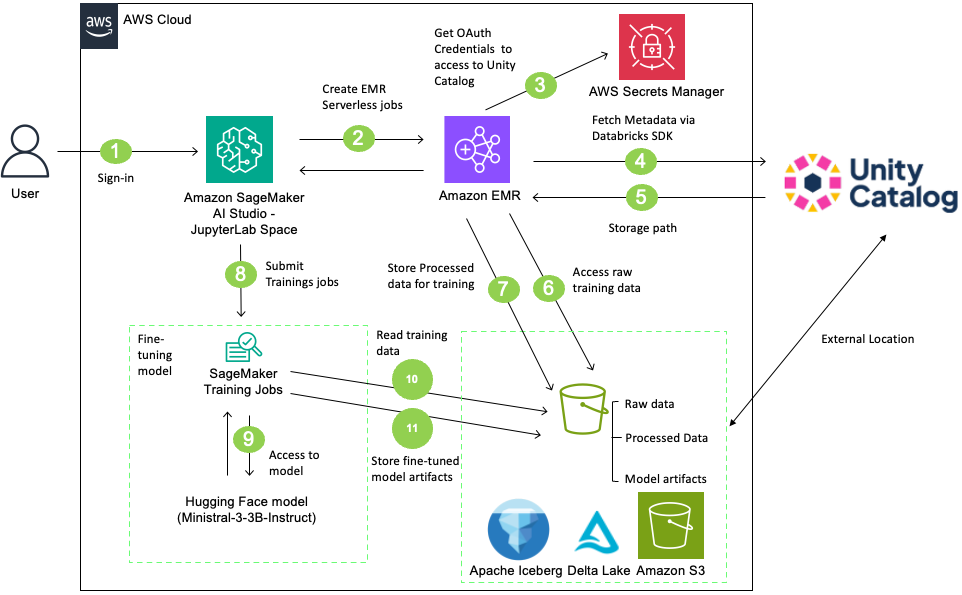
💡Learn how to build a secure, governed LLM fine-tuning pipeline using Databricks and AWS infrastructure.
⚡ 30-Second TL;DR
What Changed
Securely connect Databricks Unity Catalog with Amazon SageMaker AI for governed fine-tuning.
Why It Matters
This integration enables enterprises to leverage cloud-native AI training tools without sacrificing data security or compliance. It bridges the gap between governed data lakes and high-performance model training environments.
What To Do Next
Review the integration documentation to map your Unity Catalog data assets to SageMaker training jobs for your next fine-tuning project.
Key Points
- •Securely connect Databricks Unity Catalog with Amazon SageMaker AI for governed fine-tuning.
- •Use Amazon EMR Serverless to handle large-scale data preprocessing workflows.
- •Register fine-tuned Ministral-3-3B-Instruct model artifacts back into Unity Catalog for centralized management.
🧠 Deep Insight
Web-grounded analysis with 35 cited sources.
🔑 Enhanced Key Takeaways
- •Databricks Unity Catalog extends beyond just LLM fine-tuning data to provide unified governance for all data and AI assets, including structured and unstructured data, ML models, notebooks, and dashboards, with capabilities for cross-cloud and cross-platform management.
- •Amazon EMR Serverless significantly reduces operational overhead and costs for large-scale data preprocessing by offering a pay-as-you-use model with automatic resource provisioning and scaling, eliminating the need for manual cluster management.
- •Amazon SageMaker AI supports advanced LLM fine-tuning techniques such as supervised fine-tuning, preference alignment, continued pre-training, and re-training, and integrates with open-source libraries like Hugging Face for distributed and parameter-efficient tuning methods (e.g., QLoRA).
- •The integration facilitates comprehensive data and model lineage tracking within Unity Catalog, capturing transformations from source data to trained models and their subsequent usage, which is critical for auditability and regulatory compliance.
- •The Mistral-3-3B-Instruct model is a 3-billion parameter, instruction-post-trained model with vision capabilities, designed for efficient edge deployment and capable of running on various hardware with limited VRAM, released under an Apache 2.0 License.
📊 Competitor Analysis▸ Show
| Feature/Platform | Databricks (Lakehouse Platform with Unity Catalog) | Amazon SageMaker AI | Google Vertex AI |
|---|---|---|---|
| Core Focus | Unified Data & AI Platform (Lakehouse) with strong data governance | End-to-end ML platform for building, training, deploying models | Unified ML platform, strong GenAI and MLOps capabilities |
| Data Governance | Centralized, fine-grained access control, automated lineage, PII discovery, Delta Sharing, open standards (Delta Lake, Iceberg) | Project-based governance, access controls, audit-friendly architecture | Integrated data governance within GCP ecosystem |
| LLM Fine-tuning | Supports various fine-tuning methods (LoRA, SFT), integrates with libraries like Axolotl, Unsloth, Mosaic LLM Foundry, and offers AI Runtime for LLMs | Supports supervised fine-tuning, preference alignment, QLoRA, Hugging Face integration, managed training jobs | AutoML, custom training, hyperparameter tuning, managed notebooks, pipelines, scalable deployment |
| Data Preprocessing | Native Apache Spark integration, Delta Live Tables, EMR Serverless integration for large-scale ETL | Integrates with AWS services like EMR Serverless, S3 for data preparation | Integrates with BigQuery, Dataflow for large-scale data processing |
| Ecosystem | Open Lakehouse, integrates with AWS, Azure, GCP, open-sourced Unity Catalog API | Deeply integrated with AWS services (S3, EMR, etc.) | Deeply integrated with Google Cloud ecosystem |
| Pricing Model | Consumption-based, tiered plans (Premium, Enterprise) | Pay-as-you-go for services, instance-based for compute | Pay-as-you-go for services, instance-based for compute |
| Benchmarks | Focus on performance for Spark workloads, LLM fine-tuning efficiency | Optimized compute and storage for GPU utilization in training | Focus on model performance and continuous updates |
🛠️ Technical Deep Dive
Databricks Unity Catalog
- Unified Governance Layer: Provides a single interface for managing permissions, auditing, and lineage across all data and AI assets (tables, views, volumes, functions, models, notebooks, dashboards, files).
- Securable Objects: Assets are modeled as securable objects within a hierarchical object model rooted at a metastore, allowing for consistent policy enforcement across workspaces and clouds.
- Fine-Grained Access Control: Utilizes open ANSI SQL standard functions to define row filters and column masks, enabling granular control over data access.
- Automated Lineage Tracking: Automatically captures runtime data lineage across queries (SQL, Python, Scala, R) and models, down to the column level, visible in the Catalog Explorer.
- Open Standards: Built on open standards, supporting data in open formats like Delta Lake, Apache Iceberg, Hudi, and Parquet, and enabling secure data sharing via Delta Sharing.
- Model Registration: Allows registration of fine-tuned model artifacts for centralized management and deployment.
Amazon SageMaker AI
- Managed ML Platform: A cloud-based platform for the entire ML lifecycle: building, training, and deploying models.
- Fine-tuning Techniques: Supports various methods including supervised fine-tuning (SFT), preference alignment, continued pre-training, and re-training to adapt LLMs to specific domains.
- Parameter-Efficient Fine-Tuning (PEFT): Integrates techniques like Quantized Low-Rank Adaptation (QLoRA) which uses 4-bit quantization to significantly reduce memory usage (up to 75%) while maintaining performance comparable to full fine-tuning.
- Distributed Training: Offers built-in support for distributed fine-tuning jobs, often integrating with Hugging Face libraries for optimized compute and GPU utilization.
- Development Interfaces: Provides managed Jupyter Notebook instances, web APIs, and SDKs (e.g., Python SDK) for interactive development and programmatic control.
- Model Deployment: Enables deployment of fine-tuned models to real-time endpoints for interactive testing and inference.
Amazon EMR Serverless
- Serverless Runtime Environment: A deployment option for Amazon EMR that allows running big data analytics applications (e.g., Apache Spark, Apache Hive) without managing servers or clusters.
- Automatic Scaling: Automatically provisions and scales compute and memory resources based on workload demands, resizing resources in seconds.
- Cost-Efficiency: Charges only for the actual compute and memory resources consumed (vCPU-seconds and GB-seconds), avoiding costs for idle resources.
- Integration: Seamlessly integrates with other AWS services like Amazon S3 for data storage and Amazon Athena for data exploration.
- Application Model: EMR Serverless applications function as reusable cluster templates that instantiate when jobs are submitted, reducing startup latency for recurring workloads.
Mistral-3-3B-Instruct Model
- Model Family: Part of the Mistral 3 family, which includes 3B, 8B, and 14B parameter models.
- Parameters & Precision: A 3-billion parameter model, instruct post-trained, typically in FP8 precision.
- Capabilities: Offers vision capabilities, allowing it to analyze images in addition to text.
- Deployment: Designed for edge deployment and capable of running on a wide range of hardware, including locally with as little as 8GB of VRAM (in FP8).
- License: Released under the Apache 2.0 License.
🔮 Future ImplicationsAI analysis grounded in cited sources
⏳ Timeline
📎 Sources (35)
Factual claims are grounded in the sources below. Forward-looking analysis is AI-generated interpretation.
- Google Search Source
- Google Search Source
- Google Search Source
- Google Search Source
- Google Search Source
- Google Search Source
- Google Search Source
- Google Search Source
- Google Search Source
- Google Search Source
- Google Search Source
- Google Search Source
- Google Search Source
- Google Search Source
- Google Search Source
- Google Search Source
- Google Search Source
- Google Search Source
- Google Search Source
- Google Search Source
- Google Search Source
- Google Search Source
- Google Search Source
- Google Search Source
- Google Search Source
- Google Search Source
- Google Search Source
- Google Search Source
- Google Search Source
- Google Search Source
- Google Search Source
- Google Search Source
- Google Search Source
- Google Search Source
- Google Search Source
Weekly AI Recap
Read this week's curated digest of top AI events →
👉Related Updates
AI-curated news aggregator. All content rights belong to original publishers.
Original source: AWS Machine Learning Blog ↗