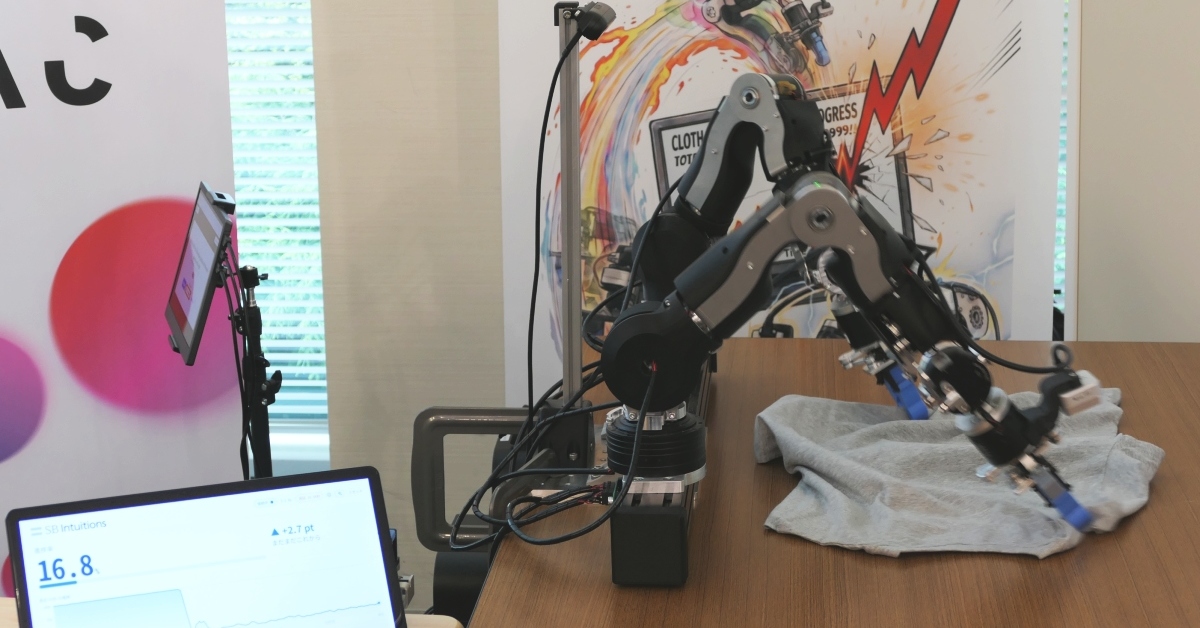
BrainCo demos thought-controlled robotics platform at WAIC 2026

💡See how EEG-based neural control is being applied to humanoid robots and robotic arms in real-world demos.
⚡ 30-Second TL;DR
What Changed
Uses EEG headset to capture neural signals
Why It Matters
This technology bridges the gap between human intent and robotic execution, potentially revolutionizing assistive technology and remote operation interfaces.
What To Do Next
Explore BCI integration documentation if you are building embodied AI agents for assistive robotics.
Key Points
- •Uses EEG headset to capture neural signals
- •Translates imagined actions into real-time machine operations
- •Compatible with humanoid robots, robotic arms, and robot dogs
🧠 Deep Insight
AI-generated analysis for this event — not the original article.
🔑 Enhanced Key Takeaways
- •The platform leverages BrainCo's proprietary 'FocusOne' and 'BrainRobotics' sensor technology, which utilizes advanced signal processing to filter out motion artifacts common in non-invasive EEG setups.
- •BrainCo has integrated this BCI platform with ROS 2 (Robot Operating System) to ensure low-latency communication between the neural decoder and robotic actuators.
- •The demonstration at WAIC 2026 highlighted a new 'intent-recognition' algorithm that reduces the calibration time for new users from several minutes to under 30 seconds.
- •This iteration of the platform incorporates adaptive machine learning models that personalize signal interpretation based on the user's specific neural firing patterns over time.
- •BrainCo is positioning this technology for industrial and assistive applications, specifically targeting remote operation in hazardous environments where traditional controllers are impractical.
📊 Competitor Analysis▸ Show
| Feature | BrainCo (BCI Platform) | Synchron (Stentrode) | Neuralink (Link) |
|---|---|---|---|
| Invasiveness | Non-invasive (EEG) | Minimally Invasive (Endovascular) | Invasive (Surgical) |
| Primary Use Case | Robotics/Prosthetics | Assistive Communication | Assistive/Neural Interface |
| Latency | Moderate (Software-dependent) | Low | Ultra-low |
| Pricing | Commercial/Enterprise | Medical/Clinical | Research/Clinical |
🛠️ Technical Deep Dive
- Signal Acquisition: Employs high-density dry electrode EEG sensors to capture mu and beta rhythm oscillations associated with motor imagery.
- Signal Processing: Utilizes a custom Convolutional Neural Network (CNN) architecture to classify neural patterns into discrete robotic commands.
- Latency Optimization: Implements a proprietary edge-computing module that processes neural data locally to minimize round-trip time to the robotic hardware.
- Compatibility: Native support for standard industrial communication protocols including CAN bus and EtherCAT for direct robot integration.
🔮 Future ImplicationsAI analysis grounded in cited sources
⏳ Timeline
Weekly AI Recap
Read this week's curated digest of top AI events →
👉Related Updates

AI-curated news aggregator. All content rights belong to original publishers.
Original source: TechNode ↗
This is a summary, not the original. Read the source, or get the weekly briefing.
The weekly digest
One email a week. Unsubscribe anytime.