Beijing Leads in China's Tech and IT Jobs
💡Understand the geographic distribution of China's tech talent to optimize your hiring and expansion strategy.
⚡ 30-Second TL;DR
What Changed
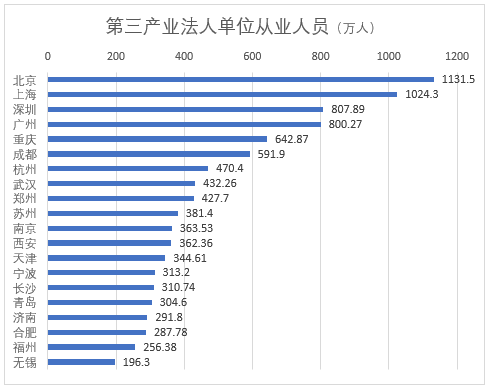
Beijing holds the highest number of jobs in the IT and software services sector.
Why It Matters
Provides insights into the geographic concentration of technical talent and high-value AI/IT roles in China.
What To Do Next
If recruiting for technical roles, prioritize establishing a presence in Beijing, Shanghai, or Shenzhen for talent density.
Key Points
- •Beijing holds the highest number of jobs in the IT and software services sector.
- •Third-industry jobs are highly correlated with a city's administrative status and regional center role.
- •Hangzhou and Chengdu emerge as strong second-tier hubs for high-paying tech and finance roles.
- •Shenzhen remains a key hub for real estate and IT, trailing Beijing and Shanghai.
🧠 Deep Insight
AI-generated analysis for this event — not the original article.
🔑 Enhanced Key Takeaways
- •Beijing's dominance is heavily supported by the concentration of state-owned enterprises (SOEs) and central government research institutes, which provide a stable base for high-end scientific research jobs compared to the more market-driven tech sectors in Shenzhen.
- •The 'North-South' divide in China's job market has intensified, with northern cities like Beijing maintaining a lead in policy-driven and research-heavy sectors, while southern cities like Shenzhen and Guangzhou lead in manufacturing-integrated tech and export-oriented services.
- •Data from 2025-2026 indicates a shift in talent migration patterns, where high-skilled tech workers are increasingly prioritizing 'livability' and lower cost-of-living indices in cities like Chengdu and Hangzhou over the hyper-competitive, high-cost environments of Beijing and Shanghai.
- •The integration of AI and digital transformation initiatives in Beijing has led to a specific surge in demand for 'AI-plus' roles, where traditional industries like finance and energy are hiring tech talent to modernize legacy infrastructure.
- •Recent municipal policy shifts in Beijing have incentivized the relocation of non-capital functions, leading to a 'spillover effect' where secondary tech hubs in the Beijing-Tianjin-Hebei (Jing-Jin-Ji) region are absorbing overflow IT service roles.
🔮 Future ImplicationsAI analysis grounded in cited sources
⏳ Timeline
Weekly AI Recap
Read this week's curated digest of top AI events →
👉Related Updates

AI-curated news aggregator. All content rights belong to original publishers.
Original source: 虎嗅 ↗
This is a summary, not the original. Read the source, or get the weekly briefing.
Weekly AI briefing
One email a week. Unsubscribe anytime.