Baidu’s Kunlunxin targets $50B IPO with unique chip-purchase requirement
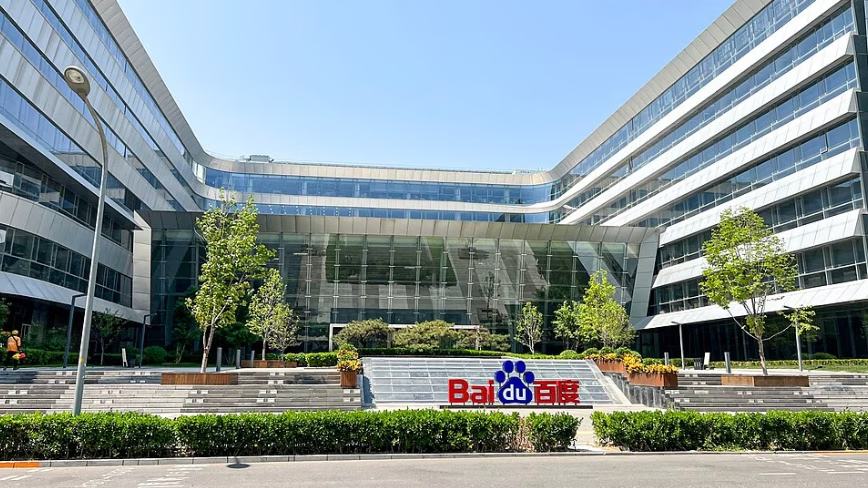
💡A major AI chip player is bundling IPO investment with product sales—a unique strategy for the hardware market.
⚡ 30-Second TL;DR
What Changed
Kunlunxin is seeking a $50 billion valuation for its upcoming Hong Kong IPO.
Why It Matters
This strategy could signal a shift in how AI hardware companies secure long-term demand by leveraging capital markets to lock in enterprise customers.
What To Do Next
Monitor Kunlunxin's hardware specifications and benchmarks if you are building AI infrastructure in the Chinese market to evaluate their viability as an alternative to Nvidia.
Key Points
- •Kunlunxin is seeking a $50 billion valuation for its upcoming Hong Kong IPO.
- •The company is bundling investment with mandatory semiconductor purchase agreements.
- •This move highlights Baidu's aggressive strategy to secure market share for its AI hardware amidst global supply constraints.
🧠 Deep Insight
AI-generated analysis for this event — not the original article.
🔑 Enhanced Key Takeaways
- •Kunlunxin's IPO strategy mirrors a 'customer-as-investor' model, a tactic rarely seen in semiconductor public offerings, designed to guarantee revenue streams amidst US-China chip export restrictions.
- •The company's R&D focus has shifted heavily toward the Kunlun 3 architecture, which is specifically optimized for Baidu's Ernie Bot and large-scale generative AI training workloads.
- •Market analysts suggest the $50 billion valuation target is highly ambitious, representing a significant premium over recent valuations of similar Chinese AI hardware startups.
- •The mandatory purchase requirement is viewed by some institutional investors as a potential regulatory red flag, potentially complicating the listing process with the Hong Kong Stock Exchange (HKEX).
- •Kunlunxin has been aggressively expanding its ecosystem beyond Baidu's internal data centers, targeting third-party cloud providers and enterprise clients to diversify its revenue base.
📊 Competitor Analysis▸ Show
| Feature | Kunlunxin (Kunlun 3) | Huawei (Ascend 910B) | NVIDIA (H20) |
|---|---|---|---|
| Architecture | Proprietary XPU | Da Vinci | Hopper |
| Primary Market | China (Domestic) | China (Domestic) | China (Export-compliant) |
| Interconnect | High-speed proprietary | HCCS | NVLink (Restricted) |
| Ecosystem | PaddlePaddle | MindSpore | CUDA |
🛠️ Technical Deep Dive
- Architecture: Utilizes the proprietary XPU architecture designed for high-throughput AI inference and training.
- Process Node: Manufactured using advanced domestic 7nm-class processes to mitigate impact from international sanctions.
- Memory: Features high-bandwidth memory (HBM) integration to reduce latency in large language model (LLM) processing.
- Software Stack: Deeply integrated with the PaddlePaddle deep learning framework, providing a full-stack hardware-software optimization path.
- Scalability: Supports multi-chip interconnects for large-scale cluster deployments, enabling training of models with hundreds of billions of parameters.
🔮 Future ImplicationsAI analysis grounded in cited sources
⏳ Timeline
Weekly AI Recap
Read this week's curated digest of top AI events →
👉Related Updates



AI-curated news aggregator. All content rights belong to original publishers.
Original source: The Next Web (TNW) ↗
This is a summary, not the original. Read the source, or get the weekly briefing.
Weekly AI briefing
One email a week. Unsubscribe anytime.