NASA hires startup to rescue aging Swift telescope
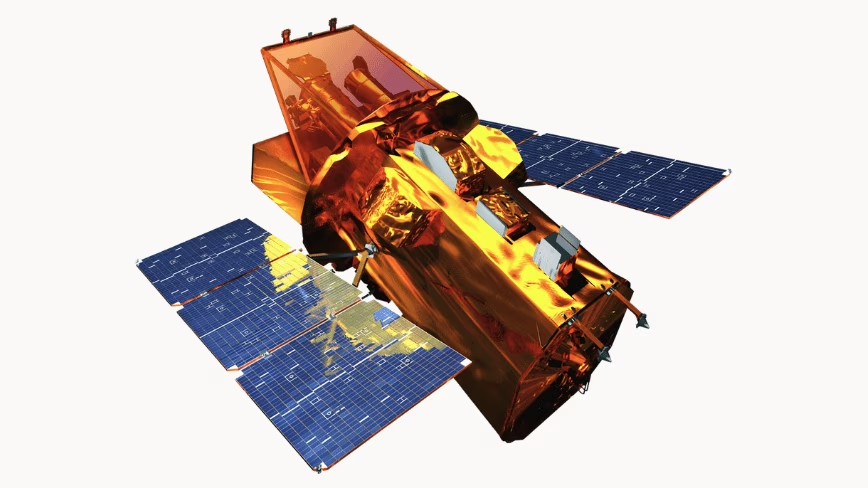
💡A landmark $30mn in-orbit servicing mission that could redefine the lifecycle management of space-based hardware.
⚡ 30-Second TL;DR
What Changed
NASA awards $30mn contract to Katalyst Space Technologies
Why It Matters
This mission highlights the growing viability of in-orbit servicing, a critical infrastructure capability for future space-based AI and data processing platforms.
What To Do Next
Monitor the success of this mission to evaluate the feasibility of autonomous robotic maintenance for your own edge-computing satellite deployments.
Key Points
- •NASA awards $30mn contract to Katalyst Space Technologies
- •Swift satellite has been operational since 2004
- •Mission focuses on orbital stabilization and life extension
- •Demonstrates emerging market for in-orbit satellite servicing
🧠 Deep Insight
AI-generated analysis for this event — not the original article.
🔑 Enhanced Key Takeaways
- •The mission utilizes Katalyst's proprietary 'K-Link' docking interface, designed to attach to legacy spacecraft that lack modern standardized docking ports.
- •The Swift satellite, officially known as the Neil Gehrels Swift Observatory, has experienced significant degradation in its reaction wheel assembly, necessitating external stabilization.
- •This contract is part of NASA's broader 'Commercial Space Capabilities' initiative, which seeks to leverage private sector innovation to reduce the cost of maintaining aging orbital assets.
- •Katalyst Space Technologies plans to deploy a small-satellite servicer that will perform autonomous proximity operations and capture maneuvers using computer vision.
- •The mission will attempt to extend Swift's operational life by an additional five years, allowing it to continue its primary mission of detecting Gamma-Ray Bursts (GRBs).
📊 Competitor Analysis▸ Show
| Feature | Katalyst Space Technologies | Astroscale | Northrop Grumman (MEV) |
|---|---|---|---|
| Target Market | Small/Legacy Satellites | Debris Removal/Servicing | Large Geostationary Satellites |
| Docking Tech | K-Link (Universal) | Magnetic/Robotic Arm | Mechanical Docking (LSA) |
| Primary Focus | Life Extension/Stabilization | Debris Removal/Refueling | Life Extension/Relocation |
🛠️ Technical Deep Dive
- The servicer vehicle employs a multi-sensor suite including LiDAR and stereoscopic cameras for relative navigation during the approach phase.
- The K-Link interface utilizes a mechanical latching mechanism that interfaces with existing structural points on the Swift chassis to provide rigid coupling.
- Stabilization is achieved through an integrated attitude control system that overrides or supplements the host satellite's degraded reaction wheels.
- The mission architecture relies on autonomous guidance, navigation, and control (GNC) algorithms to mitigate latency issues during the docking sequence.
🔮 Future ImplicationsAI analysis grounded in cited sources
⏳ Timeline
Weekly AI Recap
Read this week's curated digest of top AI events →
👉Related Updates



AI-curated news aggregator. All content rights belong to original publishers.
Original source: The Next Web (TNW) ↗
This is a summary, not the original. Read the source, or get the weekly briefing.
Weekly AI briefing
One email a week. Unsubscribe anytime.