Baidu’s Apollo Go robotaxi gains Level 4 approval in Switzerland
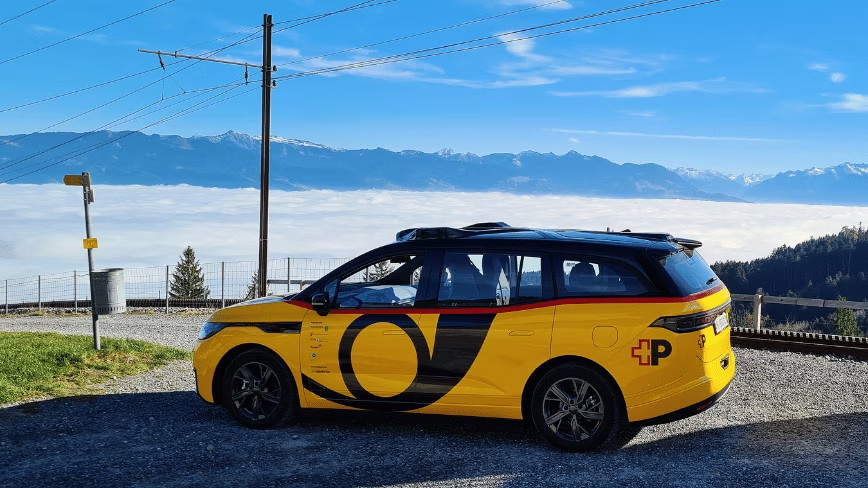
💡Baidu's autonomous tech enters Europe, showcasing the global reach of Chinese AI robotics.
⚡ 30-Second TL;DR
What Changed
AmiGo venture received Level 4 permit from Swiss Federal Roads Office
Why It Matters
This expansion validates the international scalability of Baidu's autonomous driving stack. It signals a shift in European regulatory openness toward Chinese AI-driven robotics.
What To Do Next
Monitor the performance of Apollo Go's sensor fusion algorithms in diverse weather conditions to benchmark against Western competitors.
Key Points
- •AmiGo venture received Level 4 permit from Swiss Federal Roads Office
- •Collaboration involves Swiss Post’s PostBus service
- •Level 4 allows self-driving within a defined geographic area
🧠 Deep Insight
Web-grounded analysis with 24 cited sources.
🔑 Enhanced Key Takeaways
- •The AmiGo service area spans approximately 80 square kilometers across three cantons in Eastern Switzerland: St. Gallen, Appenzell Ausserrhoden, and Appenzell Innerrhoden.
- •Open-road autonomous driving trials with safety operators commenced on June 1, 2026, with regular fully driverless operations anticipated to launch in early 2027, pending further safety and regulatory compliance.
- •The service utilizes Baidu's purpose-built Apollo Go RT6 vehicles, which are fully electric, designed to carry up to three passengers, and equipped with over 30 sensors for comprehensive environmental perception.
- •AmiGo is positioned to become the largest planned automated public transport operation of its kind in Europe, aiming to complement existing public transport networks, especially in rural areas, regions with limited connections, or during off-peak hours.
- •The Swiss Federal Roads Office (FEDRO) permit confirms that AmiGo's vehicles and autonomous driving system meet Switzerland's stringent safety and quality requirements, validating the global readiness of Baidu's autonomous driving technology.
📊 Competitor Analysis▸ Show
| Company/Partnership | Vehicle Model | Autonomy Level | Key Features | European Operational Areas/Plans | Current Status in Europe |
|---|---|---|---|---|---|
| Baidu Apollo Go (AmiGo with PostBus) | Apollo RT6 | Level 4 | Fully electric, 3 passengers, >30 sensors, purpose-built, detachable steering wheel design. | Eastern Switzerland (trials started June 2026, full driverless by early 2027). Also partnering with Lyft for Germany & UK launch in 2026. | Open-road trials with safety operators in Switzerland. Planned launches in Germany and UK. |
| Uber / Wayve | (Likely electric Mustang Mach-E for testing) | Level 4 (trials) | AI-driven 'mapless' system, focuses on complex urban environments. | London, UK (sign-ups started June 2026, trials in 'coming months'). | Accepting sign-ups for upcoming robotaxi service, initial operations likely with safety drivers. |
| Waymo (Alphabet/Google) | (Not specified for Europe) | Level 4 | Multi-modal sensors, established operations in US cities. | Preparing to launch in London in 2026. | Preparing for launch. |
| Pony.ai | (Not specified for Europe) | Level 4 | (Details not specified for Europe) | Luxembourg (pilot program). | Pilot program. |
| ADASTEC | Karsan e-ATAK (bus) | Level 4 | Autonomous bus. | Finland, Germany, Netherlands, Norway. | Ongoing pilots in urban and airport settings. |
🛠️ Technical Deep Dive
- Vehicle Platform: The AmiGo service deploys Baidu's Apollo RT6 vehicles, which are fully electric and built on Xinghe, Baidu's self-developed automotive Electrical/Electronic (E/E) architecture specifically designed for fully autonomous driving.
- Sensor Suite: Each RT6 vehicle is equipped with over 30 sensors, including 8 LiDARs, 12 cameras, radar, and ultrasonic radar, providing highly accurate, long-range 360-degree environmental perception. RoboSense EM4 and E1 LiDARs are specifically used for next-generation Robotaxi models.
- Computing Power: The Apollo RT6 incorporates Baidu's advanced Level 4 autonomous driving system, powered by automotive-grade dual computing units with a processing capability of up to 1200 TOPS (Tera Operations Per Second).
- Redundancy: The vehicle features a 10-layer safety redundancy system and full redundancy throughout both hardware and autonomous driving software, ensuring high reliability.
- Design & Interior: The RT6 is a clean-sheet design, not a retrofitted conventional vehicle, with a detachable steering wheel to allow for flexible interior configurations such as extra seating, vending machines, desktops, or gaming consoles. It also features intelligent electric sliding doors for easy passenger access.
- Perception System: The autonomous perception system leverages sensor fusion technology, Baidu's big data, deep learning technologies, and a vast collection of real-world labeled driving data. Large-scale deep-learning platforms and GPU clusters accelerate model training, with updates deployed via over-the-air (OTA) mechanisms.
- HD Map and Localization: The system utilizes a comprehensive localization solution that achieves centimeter-level accuracy through the integration of GPS, IMU, high-definition (HD) maps, and various sensor inputs.
- Safety Features: The RT6 includes a "super high-strength cage" body design and rear-facing enhanced safety protection, aiming for a five-star safety anti-collision rating.
🔮 Future ImplicationsAI analysis grounded in cited sources
⏳ Timeline
📎 Sources (24)
Factual claims are grounded in the sources below. Forward-looking analysis is AI-generated interpretation.
- streetinsider.com
- stocktitan.net
- thenextweb.com
- prnewswire.com
- swissinfo.ch
- bluewin.ch
- grafa.com
- investing.com
- indexbox.io
- manilatimes.net
- postauto.ch
- saam.swiss
- gasgoo.com
- lyft.com
- eleport.com
- cryptobriefing.com
- brusselssignal.eu
- spglobal.com
- iotm2mcouncil.org
- gasgoo.com
- yolegroup.com
- insideautonomousvehicles.com
- apollo.auto
- enkiai.com
Weekly AI Recap
Read this week's curated digest of top AI events →
👉Related Updates

AI-curated news aggregator. All content rights belong to original publishers.
Original source: The Next Web (TNW) ↗