Baidu Shifts Focus: From Large Models to AI Agents
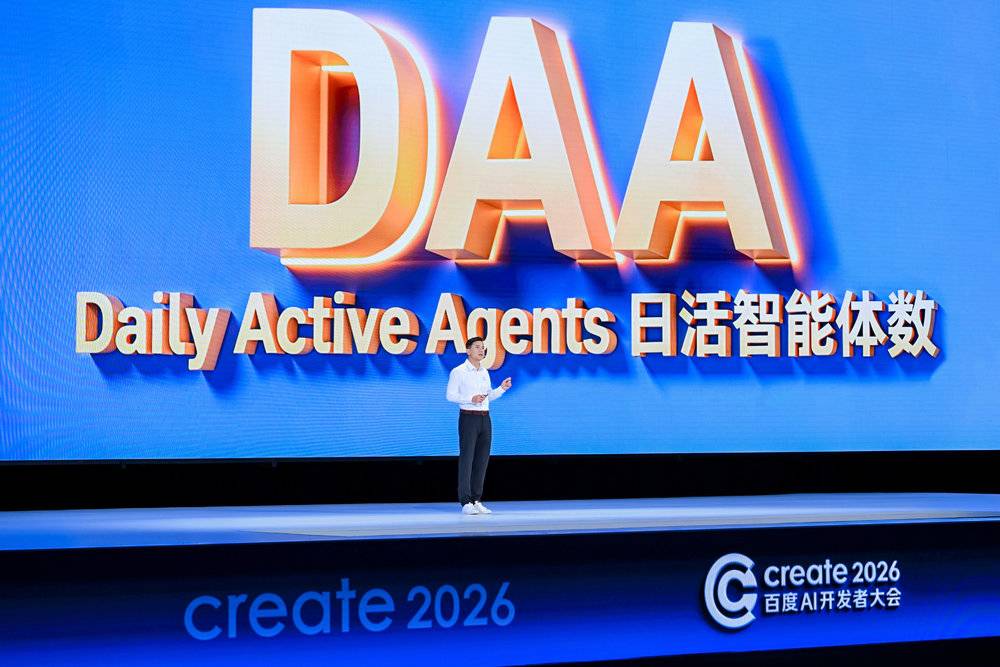
💡Baidu's pivot to 'Daily Active Agents' marks a critical shift in how big tech measures AI success beyond model benchmark
⚡ 30-Second TL;DR
What Changed
Baidu introduces DAA (Daily Active Agents) as the new primary metric for platform prosperity, moving beyond raw model benchmarks.
Why It Matters
This pivot signals a broader industry trend where big tech companies are prioritizing the 'Agent Economy' to solve the commoditization of LLMs.
What To Do Next
Evaluate your current AI stack: are you building on a platform that provides robust 'Agent Infra' for deployment, or just raw model access?
Key Points
- •Baidu introduces DAA (Daily Active Agents) as the new primary metric for platform prosperity, moving beyond raw model benchmarks.
- •The company is rebranding its cloud infrastructure into 'AI Infra' and 'Agent Infra' to support large-scale agent deployment.
- •Baidu's 'MiaoDa' tool is being positioned as a core driver for enterprise efficiency, claiming to reduce development cycles from months to weeks.
- •The strategy aims to move Baidu from a model provider to an 'Agent Platform' provider, capturing the value of the application layer.
🧠 Deep Insight
Web-grounded analysis with 22 cited sources.
🔑 Enhanced Key Takeaways
- •Baidu's CEO Robin Li introduced DAA (Daily Active Agents) as a new metric to measure the output value of AI agents, predicting global DAA could eventually surpass 10 billion, shifting focus from token consumption as a cost input.
- •At Create 2026, Baidu launched a suite of new AI agent products, including the general-purpose agent DuMate, the coding agent Miaoda (with app and enterprise editions), the digital human platform Baidu Yijing, and the self-evolving agent Famou Agent 2.0.
- •The upgraded Baidu AI Cloud, now a full-stack AI cloud purpose-built for large-scale agent applications, features a "Token Factory" for 25% faster agent-first inference and "Harness Engineering" for advanced context management, achieving 95% task success rates in browser/Office scenarios with 23% fewer token consumption compared to OpenAI's offerings.
- •Miaoda, the coding agent, can generate 90% of its own code for its app version, has an international version called MeDo (medo.dev), and has already facilitated the creation of over 1 million applications for more than 10 million users.
- •Baidu's AI-powered business, encompassing AI cloud infrastructure, applications, and AI-native marketing services, reached 52% of its General Business revenue in Q1 2026, marking a significant shift in its revenue composition.
🛠️ Technical Deep Dive
- Baidu's full-stack AI Cloud is specifically designed for large-scale AI agent applications, integrating AI Infra and Agent Infra.
- The "Agent Infra" side features a "Token Factory" (an upgrade from MaaS Model Service) that minimizes token recalculation, leading to approximately 25% faster inference generation compared to market benchmarks. It supports major domestic models including Ernie, DeepSeek, GLM, and MiniMax.
- "Harness Engineering" is a key component covering long-context management, persistent memory, tool calling, sub-agent scheduling, and Runtime capabilities, enabling 95% task success rates in browser and Office scenarios with 23% less token consumption than OpenAI's offerings.
- The "AI Infra" side utilizes a layered pooling architecture for GPU memory, DRAM, and SSD, achieving KV Cache hit rates exceeding 90% and delivering long-chain agent inference performance 3x better than mainstream open-source engines.
- A unified multimodal training framework provides 2x training efficiency compared to community standards.
- Hardware infrastructure includes Baidu's proprietary Kunlun P800 AI chips, deployed in multiple 10,000-GPU clusters with a 97% effective training rate and over 85% linear scaling.
- The Kunlun-based Tianchi 256-card supernode, launching in June 2026, is expected to offer 25% higher throughput and 50% inference efficiency improvement for various models.
- Baidu's AI agents are built with four main blocks: planning, memory, tool, and action, leveraging Retrieval Augmented Generation (RAG), prompt engineering techniques like Chain of Thought (COT), Reasoning and Acting (ReACT), and Autoplan, all controlled by tracing, observability, guardrails, and performance evaluation functions.
- The latest foundation model, ERNIE 5.1, powers these agents and ranks #1 among Chinese models on LMArena's text and search leaderboards.
🔮 Future ImplicationsAI analysis grounded in cited sources
⏳ Timeline
📎 Sources (22)
Factual claims are grounded in the sources below. Forward-looking analysis is AI-generated interpretation.
Weekly AI Recap
Read this week's curated digest of top AI events →
👉Related Updates


AI-curated news aggregator. All content rights belong to original publishers.
Original source: 虎嗅 ↗