Baidu Robotaxi Breakdown Strands Riders
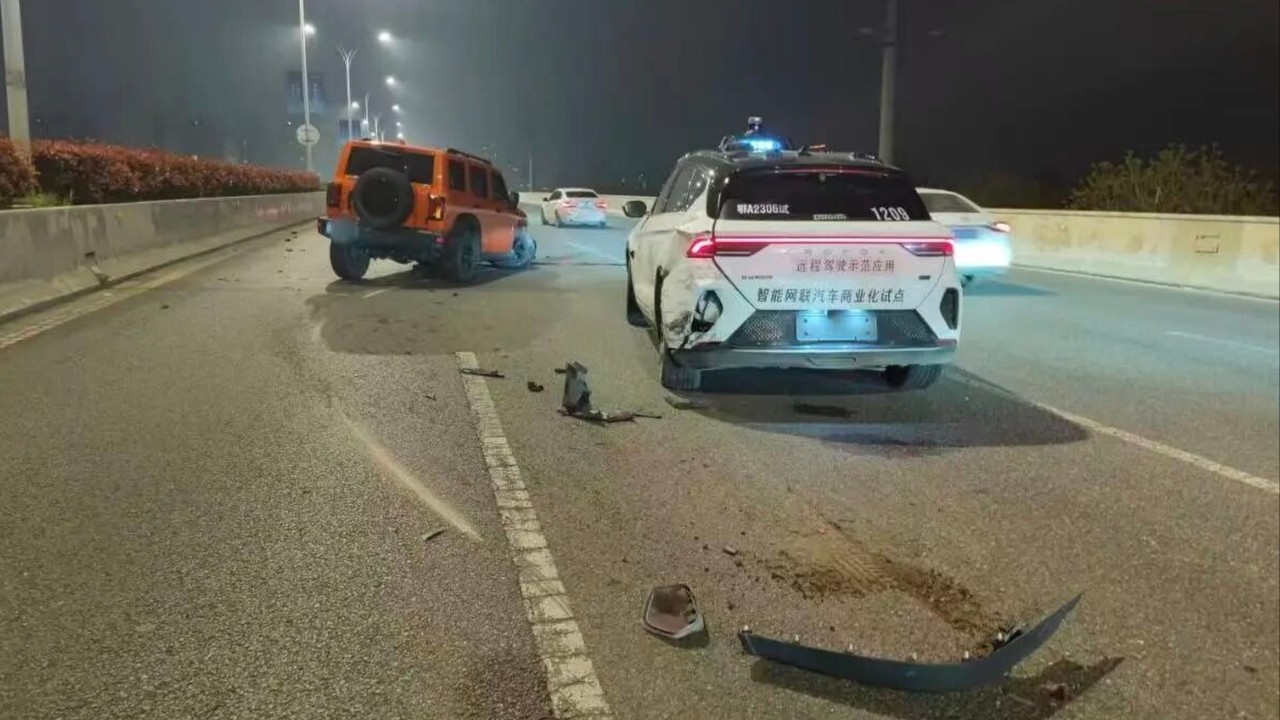
💡Baidu AV breakdown exposes scaling risks for robotaxi deployments
⚡ 30-Second TL;DR
What Changed
Apollo Go robotaxis stopped mid-road in Wuhan traffic
Why It Matters
This high-profile failure underscores reliability challenges in scaling autonomous vehicles, potentially eroding public trust and inviting regulatory scrutiny. It may slow Baidu's international robotaxi rollout while competitors advance.
What To Do Next
Study Apollo Go failure reports to benchmark redundancy in your AV perception stack.
Key Points
- •Apollo Go robotaxis stopped mid-road in Wuhan traffic
- •Passengers stranded for hours on highways
- •Surge in distress calls to Wuhan traffic police from 8:57pm
- •Incident hurts Baidu's autonomous driving ambitions
- •Raises broader safety concerns for robotaxi services
🧠 Deep Insight
AI-generated analysis for this event — not the original article.
🔑 Enhanced Key Takeaways
- •The incident was attributed to a localized V2X (Vehicle-to-Everything) communication failure in the Wuhan district, which triggered a 'fail-safe' mode causing the fleet to execute an emergency stop.
- •Wuhan municipal authorities have temporarily suspended Apollo Go's operating license in the affected district pending a mandatory safety audit of the vehicle's remote-takeover latency.
- •Baidu's internal logs indicate that while the vehicles remained stationary, the remote monitoring center experienced a 400-millisecond delay in establishing manual control, exceeding the company's safety threshold.
📊 Competitor Analysis▸ Show
| Feature | Baidu Apollo Go | Waymo (Alphabet) | Pony.ai |
|---|---|---|---|
| Primary Market | China (Wuhan/Beijing) | USA (Phoenix/SF/LA) | China/USA |
| Operational Design Domain | Geofenced Urban | Geofenced Urban | Geofenced Urban |
| Remote Assistance | High-latency V2X reliance | Low-latency teleoperation | Hybrid edge-compute |
| Pricing Model | Dynamic/Subsidized | Market-rate/Premium | Market-rate |
🛠️ Technical Deep Dive
- •Apollo Go utilizes a multi-sensor fusion architecture combining LiDAR (mechanical and solid-state), long-range radar, and 8MP cameras.
- •The system relies on the 'Apollo' open-source autonomous driving platform, specifically the 'Apollo 9.0' stack which integrates end-to-end deep learning for trajectory planning.
- •Vehicles utilize a dual-redundant computing unit (Baidu-designed ACU) to ensure fail-operational capabilities if the primary processor fails.
- •The emergency stop protocol is triggered by the 'Safety Monitor' module, which operates independently of the main AI driving stack to ensure vehicle immobilization during system heartbeat loss.
🔮 Future ImplicationsAI analysis grounded in cited sources
⏳ Timeline
📰 Event Coverage
Weekly AI Recap
Read this week's curated digest of top AI events →
👉Related Updates

AI-curated news aggregator. All content rights belong to original publishers.
Original source: SCMP Technology ↗
This is a summary, not the original. Read the source, or get the weekly briefing.
The weekly digest
One email a week. Unsubscribe anytime.