Astral Systems raises £23M for fusion-based cancer isotopes
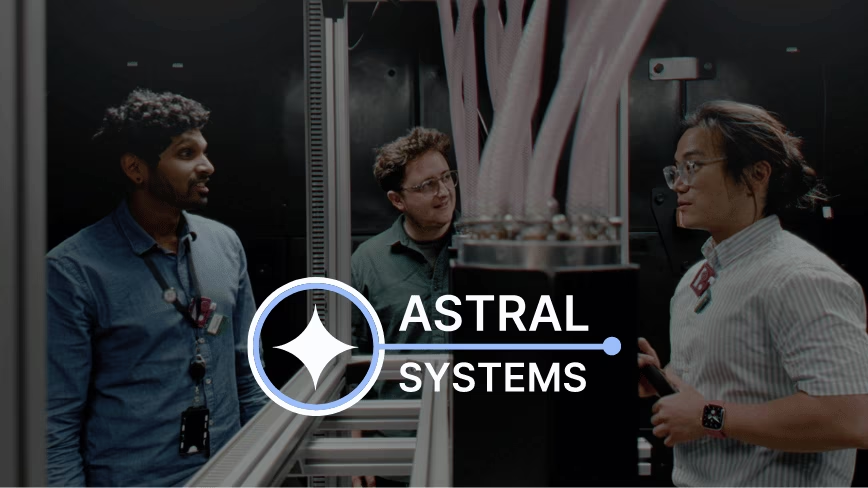
A rare fusion startup that is already profitable by applying reactor tech to medical isotope production.
30-Second TL;DR
What Changed
Astral Systems secured £23 million in new funding.
Why It Matters
This demonstrates a practical, near-term commercial application for fusion technology beyond the long-term goal of clean power generation.
What To Do Next
Monitor the intersection of deep-tech hardware and medical diagnostics, as AI-driven control systems are becoming critical for reactor stability.
Key Points
- •Astral Systems secured £23 million in new funding.
- •The company uses fusion reactors to produce isotopes essential for cancer scans.
- •Unlike energy-focused fusion firms, Astral is already revenue-generating.
Deep Insight
AI-generated analysis for this event — not the original article.
Enhanced Key Takeaways
- •Astral Systems utilizes a proprietary compact fusion reactor design specifically optimized for the production of Technetium-99m, the most widely used medical radioisotope.
- •The funding round was led by deep-tech venture capital firm IQ Capital, with participation from existing investors including Bristol Private Equity Club.
- •The company's technology aims to decentralize isotope production, reducing reliance on aging nuclear research reactors that are prone to supply chain disruptions.
- •Astral Systems plans to use the capital to expand its manufacturing facility in Bristol and obtain regulatory clearance for additional isotope types beyond its initial product line.
- •The startup's fusion-based approach significantly reduces the long-lived radioactive waste typically associated with traditional reactor-based isotope production.
Competitor Analysis
- Astral Systems
- Compact Fusion
- Traditional Nuclear Reactors
- Fission (Nuclear Reactor)
- Cyclotron Facilities
- Particle Acceleration
- Astral Systems
- Low/Short-lived
- Traditional Nuclear Reactors
- High/Long-lived
- Cyclotron Facilities
- Low
- Astral Systems
- High (Modular)
- Traditional Nuclear Reactors
- Low (Centralized)
- Cyclotron Facilities
- Moderate
- Astral Systems
- Competitive/Lower
- Traditional Nuclear Reactors
- High (Maintenance)
- Cyclotron Facilities
- High (Capital Intensive)
| Feature | Astral Systems | Traditional Nuclear Reactors | Cyclotron Facilities |
|---|---|---|---|
| Production Method | Compact Fusion | Fission (Nuclear Reactor) | Particle Acceleration |
| Waste Profile | Low/Short-lived | High/Long-lived | Low |
| Scalability | High (Modular) | Low (Centralized) | Moderate |
| Cost | Competitive/Lower | High (Maintenance) | High (Capital Intensive) |
Technical Deep Dive
- Employs inertial electrostatic confinement (IEC) fusion principles to generate high-flux neutron sources.
- The reactor architecture is designed for modularity, allowing for on-site installation at hospital networks or regional radiopharmacies.
- Utilizes a proprietary target material system that maximizes the cross-section for neutron capture, increasing isotope yield efficiency.
- Integrated automated radiochemistry modules allow for real-time extraction and purification of isotopes directly from the fusion chamber output.
Future ImplicationsAI analysis grounded in cited sources
Timeline
- 2022-09Astral Systems founded in Bristol, UK, focusing on fusion applications.
- 2023-05Successful demonstration of prototype fusion reactor for isotope generation.
- 2024-02Secured seed funding to initiate pilot production runs.
- 2026-06Raised £23 million in Series A funding to scale production.
Weekly AI Recap
Read this week's curated digest of top AI events →
Related Updates


AI-curated news aggregator. All content rights belong to original publishers.
Original source: The Next Web (TNW) ↗
This is a summary, not the original. Read the source, or get the weekly briefing.
The weekly digest
One email a week. Unsubscribe anytime.