AstraBrain Gives Robots a Shared Intelligence Layer
💡See how one intelligence stack is being transferred across humanoid, wheeled, and heavy-load robot bodies.
⚡ 30-Second TL;DR
What Changed
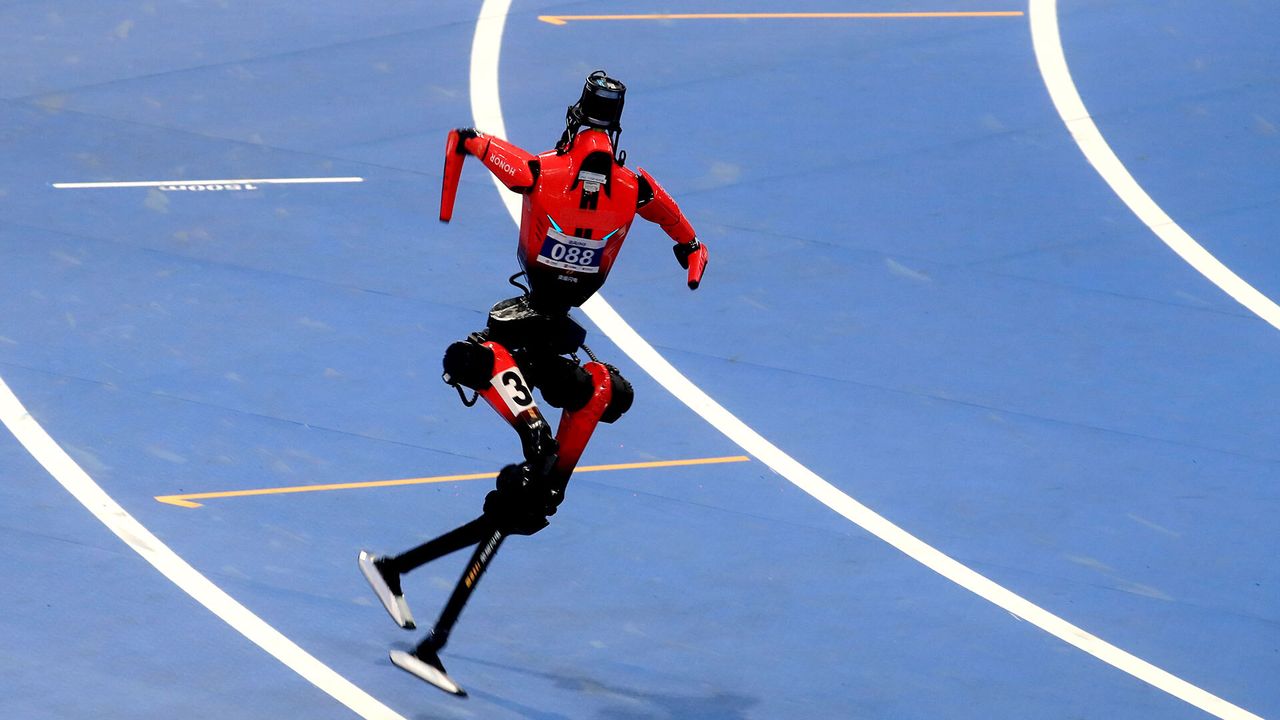
ET1 is a new small bipedal platform capable of dynamic dance movements and continued learning from human actions.
Why It Matters
A shared upper-layer model could let skills and world knowledge transfer across robot bodies, reducing duplicated data collection and model development. The main engineering challenge will be translating common intent into reliable control under very different kinematic, balance, and payload constraints.
What To Do Next
Prototype a shared skill interface that separates task intent from body-specific controllers, then test the same motion command on a bipedal and wheeled robot in simulation.
Key Points
- •ET1 is a new small bipedal platform capable of dynamic dance movements and continued learning from human actions.
- •AstraBrain-WBC 1.0 maps real-time human motion captured through vision onto the robot’s own body rather than replaying fixed motion libraries.
- •The system is trained on roughly 100,000 hours of human motion data from motion capture and internet videos.
- •Galaxy General positions AstraBrain as a shared intelligence layer across ET1, wheeled dual-arm robot G1, heavy-load robot S1, and social robot Xiaogai.
- •Shared intelligence does not eliminate body-specific control systems; each robot still retains its own motion models and low-level controllers.
🧠 Deep Insight
Background and context from public sources — not the original article. 13 sources cited.
🔑 Enhanced Key Takeaways
- •AstraBrain utilizes a proprietary synthetic dataset called AstraSynth, which contains a billion-level scale of embodied intelligence data to supplement real-world training.
- •The architecture integrates the 'brain' for task planning and the 'cerebellum' for whole-body control into a single end-to-end model to minimize information loss between layers.
- •Engineering optimizations in the AstraBrain-WBC 0.5 iteration achieved an inference latency of under 1.5 milliseconds, critical for high-dynamic stability.
- •Galaxea has deployed AstraBrain-powered units in commercial environments including smart pharmacies and CATL production lines for material handling.
- •During the August 2026 World Robot Conference, the system demonstrated real-time tactical recovery and decision-making during a live tennis match.
📊 Competitor Analysis▸ Show
| Feature | Galaxy General (AstraBrain) | Unitree (G1/H1) | Tesla (Optimus) |
|---|---|---|---|
| Core Strategy | Shared intelligence layer across diverse morphologies | Hardware-first, specialized control | End-to-end neural network (FSD-based) |
| Data Source | AstraSynth (Synthetic + Real) | Real-world motion capture | Real-world human teleoperation |
| Deployment | Industrial/Retail/Pharmacy | Research/Consumer/Industrial | Internal/Factory Pilot |
🛠️ Technical Deep Dive
- Architecture: End-to-end neural model merging task planning (brain) and whole-body control (cerebellum).
- Latency: Inference latency < 1.5ms; total motion capture link latency < 20ms.
- Data Scale: 100,000 hours of human motion data combined with a 10-billion scale synthetic dataset (AstraSynth).
- Control Logic: AstraBrain-WBC (Whole-Body Control) enables dynamic recovery and non-pre-programmed motion execution.
🔮 Future ImplicationsAI analysis grounded in cited sources
⏳ Timeline
📎 Sources (13)
Factual claims are grounded in the sources below. Forward-looking analysis is AI-generated interpretation.
Weekly AI Recap
Read this week's curated digest of top AI events →
👉Related Updates



AI-curated news aggregator. All content rights belong to original publishers.
Original source: 极客公园 ↗
This is a summary, not the original. Read the source, or get the weekly briefing.
Weekly AI briefing
One email a week. Unsubscribe anytime.