Armed forces explore humanoid robots for battlefield use
💡Understand the current maturity of embodied AI in high-stakes defense applications and its future trajectory.
⚡ 30-Second TL;DR
What Changed
Military forces are actively testing humanoid robots for potential defense applications.
Why It Matters
The integration of embodied AI into defense systems could redefine logistics and reconnaissance, though it raises significant ethical and reliability concerns. Practitioners should monitor how these systems handle unstructured, high-stakes environments.
What To Do Next
Review current research on embodied AI navigation in unstructured environments to understand the limitations of current humanoid hardware.
Key Points
- •Military forces are actively testing humanoid robots for potential defense applications.
- •Current technology is still in the experimental phase for battlefield scenarios.
- •Deployment is currently limited by technical and operational maturity constraints.
🧠 Deep Insight
Background and context from public sources — not the original article. 20 sources cited.
🔑 Enhanced Key Takeaways
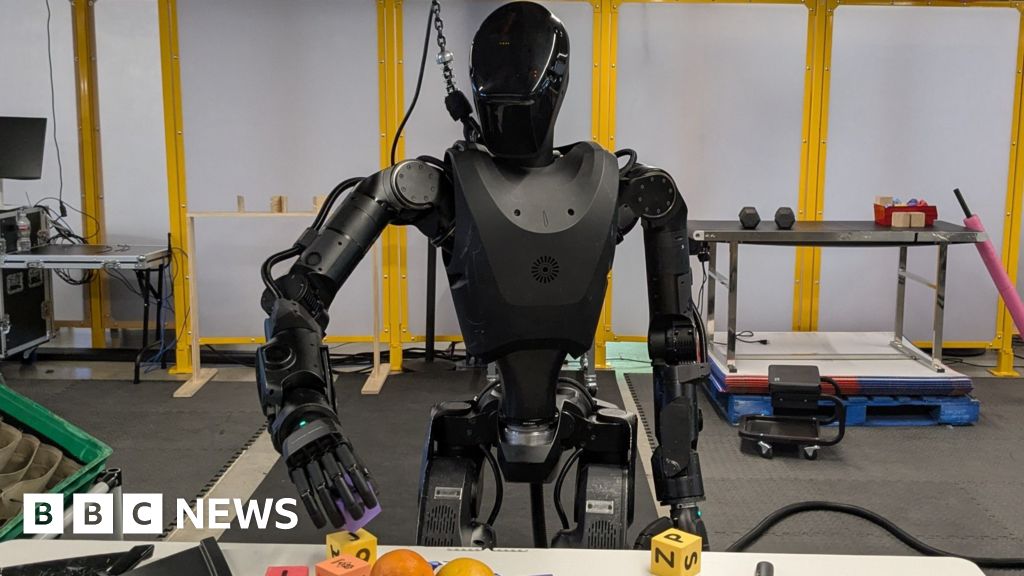
- •The U.S. Army is actively testing humanoid robots, such as the Phantom MK1, for high-risk tasks like 'breaching operations' and reconnaissance, with two units already deployed for field testing in Ukraine.
- •Humanoid robots are primarily envisioned for roles that reduce human casualties, acting as 'bullet sponges' or performing logistics and casualty evacuation, rather than serving as autonomous 'killing machines' in the immediate future.
- •Their bipedal design offers a critical advantage over wheeled or tracked Uncrewed Ground Vehicles (UGVs) by enabling navigation through complex urban terrain, including climbing stairs and opening doors.
- •The U.S. Army's xTechHumanoid competition highlights a focus on developing robots capable of operating in hazardous environments such as chemical, biological, radiological, nuclear (CBRN) contaminated zones, and for ordnance disposal.
- •China is also a significant player in this emerging field, showcasing humanoid military robots that can mimic remote operators, carry various weapons, and are supported by a robust domestic robotics industry.
📊 Competitor Analysis▸ Show
markdown
| Feature/Company | Foundation (Phantom MK1) | Unitree Robotics (Chinese Military Applications) | Tesla (Optimus) |
|---|---|---|---|
| Primary Focus | Defense applications (breaching, reconnaissance, logistics) | Consumer robot dogs, weaponized for military by China | Industrial/consumer humanoid, potential for military at low cost |
| Cost per Unit | ~$150,000 | Consumer robot dogs as low as $1,600; military variants unspecified | Projected below $20,000 (Musk's ambition) |
| Production Goals | ~50,000 units by end of 2027 | China aims for mass production; Unitree has similar ambitions | ~50,000 units in 2026 (Musk's ambition) |
| Key Capabilities | Traverse urban terrain, climb stairs, open doors, carry 20kg payload, wield standard weaponry | Quadrupedal locomotion, weaponized with rifles/grenade launchers, drone-deployed | General-purpose humanoid, high volume, low cost (projected) |
| Current Status | Field testing in Ukraine, U.S. military contracts | Deployed as robot dogs by China's PLA in exercises | In development, industrial applications, military potential discussed |
🛠️ Technical Deep Dive
- Foundation Phantom MK1 Specifications: The robot stands approximately 5 feet 9 inches (175 cm) tall and weighs around 176 pounds (80 kg). It can carry a payload of up to 44 pounds (20 kg) and move at speeds of up to 6 km/h.
- Actuation System: It utilizes proprietary cycloid actuators designed to deliver high torque, precision, and efficiency within a compact electric design.
- AI and Control: The Phantom MK1 is powered by Foundation's foundational AI model, named "Skynet," which integrates perception, world modeling, task planning, and full-body control. Early battlefield humanoids are expected to be primarily remotely operated by human controllers.
- Power Source: Humanoid robots predominantly rely on lithium-ion batteries, which are a critical bottleneck due to demands for high energy density, robust power output, and thermal management within strict mass and volume constraints. A typical power architecture often starts with a 48V, 52V, or 72V battery bus.
- Locomotion and Navigation: The bipedal form factor is crucial for navigating human-engineered environments like staircases, rubble, and doorways. Research is ongoing to develop adaptive locomotion autonomy cores that enable robots to recover from slips, obstacles, or entanglements in complex and uncertain terrains without human intervention.
- Sensors: Humanoid robots incorporate various sensors for environmental understanding, including cameras, LiDAR, joint position and force sensors, ground contact sensors, gyroscopes, and stereo vision systems.
- Durability Challenges: Significant technical hurdles remain in areas such as battery life, waterproofing, and overall durability, which are critical for sustained operation in harsh battlefield conditions.
- Fall Mitigation: The inherent instability of humanoid robots necessitates advanced safe falling and recovery systems to minimize damage, operational downtime, and ensure graceful recovery.
🔮 Future ImplicationsAI analysis grounded in cited sources
⏳ Timeline
📎 Sources (20)
Factual claims are grounded in the sources below. Forward-looking analysis is AI-generated interpretation.
Weekly AI Recap
Read this week's curated digest of top AI events →
👉Related Updates



AI-curated news aggregator. All content rights belong to original publishers.
Original source: BBC Technology ↗
This is a summary, not the original. Read the source, or get the weekly briefing.
The weekly digest
One email a week. Unsubscribe anytime.