Are Frontier Models Becoming Disposable?
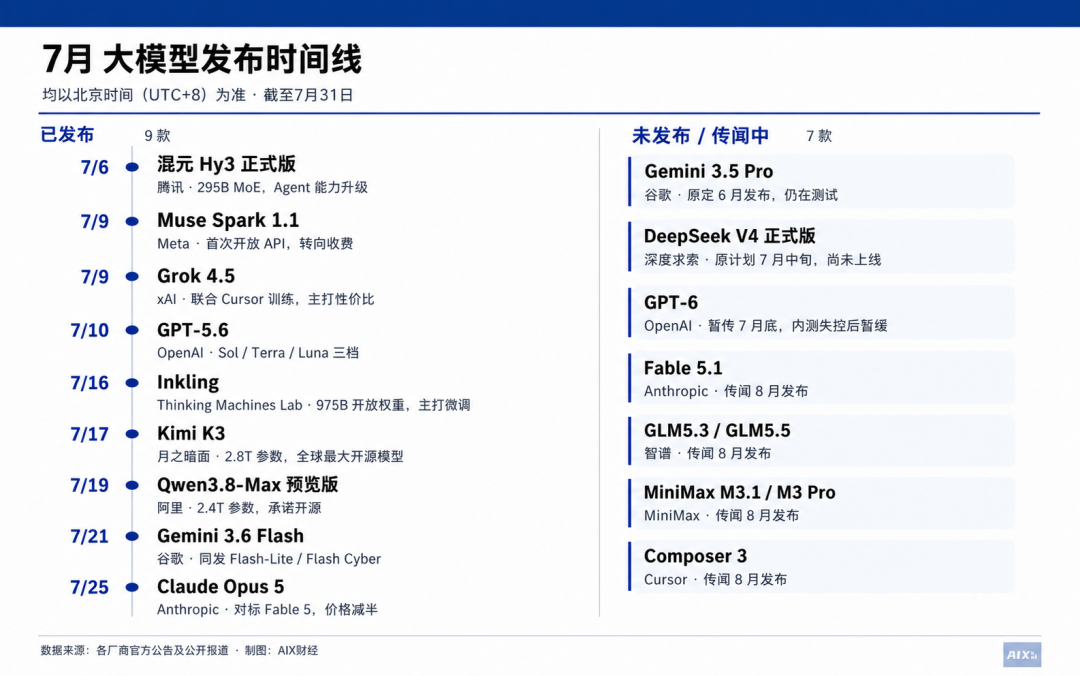
Model rankings now expire faster, making continuous evaluation essential for every AI product team.
30-Second TL;DR
What Changed
Nine flagship models reportedly appeared within a single month.
Why It Matters
Rapid model turnover makes it harder for teams to standardize on a single provider or benchmark. AI builders will need stronger abstraction layers, regression testing, and cost-performance monitoring to avoid expensive migrations.
What To Do Next
Set up a monthly evaluation harness that compares your production model with at least two alternatives on quality, latency, token cost, and failure rate.
Key Points
- •Nine flagship models reportedly appeared within a single month.
- •The competitive status of the strongest model is becoming less durable.
- •Frequent releases may increase evaluation, migration, and infrastructure costs for adopters.
- •Model selection is shifting from one-time ranking to continuous benchmarking and replacement.
Deep Insight
AI-generated analysis for this event — not the original article.
Enhanced Key Takeaways
- •The 'model churn' phenomenon is driven by the commoditization of pre-training recipes, where architectural innovations like Mixture-of-Experts (MoE) are now standard across open-weights and proprietary models.
- •Enterprises are increasingly adopting 'Model Agnostic' architectures, utilizing abstraction layers like LLM gateways to switch between providers without refactoring application code.
- •The rapid release cycle has led to 'benchmark saturation,' where traditional metrics like MMLU no longer effectively differentiate model performance, forcing a shift toward domain-specific and agentic evaluation frameworks.
- •Cloud providers are responding to the disposable model trend by offering 'Model-as-a-Service' (MaaS) platforms that prioritize low-latency inference and rapid deployment over long-term model stability.
- •The economic burden of frequent model updates is shifting from R&D to 'Continuous Fine-Tuning' (CFT) pipelines, where companies must automate the retraining of adapters (LoRA/QLoRA) every time a new base model is released.
Competitor Analysis
- Proprietary Frontier Models (e.g., GPT-5, Claude 4)
- API-only (Managed)
- Open-Weights Models (e.g., Llama 4, Mistral)
- Self-hosted or Managed
- Specialized/Vertical Models
- Hybrid/On-prem
- Proprietary Frontier Models (e.g., GPT-5, Claude 4)
- High (Continuous)
- Open-Weights Models (e.g., Llama 4, Mistral)
- Moderate (Release-based)
- Specialized/Vertical Models
- Low (Stable)
- Proprietary Frontier Models (e.g., GPT-5, Claude 4)
- High per-token
- Open-Weights Models (e.g., Llama 4, Mistral)
- Infrastructure/Compute
- Specialized/Vertical Models
- High initial training
- Proprietary Frontier Models (e.g., GPT-5, Claude 4)
- Proprietary/Closed
- Open-Weights Models (e.g., Llama 4, Mistral)
- Community-driven (LMSYS)
- Specialized/Vertical Models
- Domain-specific metrics
| Feature | Proprietary Frontier Models (e.g., GPT-5, Claude 4) | Open-Weights Models (e.g., Llama 4, Mistral) | Specialized/Vertical Models |
|---|---|---|---|
| Deployment | API-only (Managed) | Self-hosted or Managed | Hybrid/On-prem |
| Update Cycle | High (Continuous) | Moderate (Release-based) | Low (Stable) |
| Cost Structure | High per-token | Infrastructure/Compute | High initial training |
| Benchmarking | Proprietary/Closed | Community-driven (LMSYS) | Domain-specific metrics |
Technical Deep Dive
- Shift toward modular architectures: Models are increasingly designed as 'pluggable' components where the core reasoning engine can be swapped while maintaining the same system prompt and tool-use interface.
- Rise of distillation pipelines: Newer, smaller models are being trained via synthetic data generated by larger frontier models, accelerating the release of high-performance, low-parameter variants.
- Standardized adapter interfaces: Increased use of PEFT (Parameter-Efficient Fine-Tuning) allows developers to maintain a library of task-specific adapters that can be hot-swapped onto new base models.
- Inference optimization: Widespread adoption of speculative decoding and KV-cache compression techniques to mitigate the latency costs associated with switching models frequently.
Future ImplicationsAI analysis grounded in cited sources
Timeline
- 2023-11Introduction of GPT-4 Turbo, signaling the start of rapid, iterative model updates.
- 2024-05Release of GPT-4o, emphasizing multi-modal speed and setting a new industry standard for latency.
- 2025-02Widespread industry adoption of 'Model-as-a-Service' (MaaS) platforms to handle rapid model rotation.
- 2026-06Peak of the 'Model Churn' cycle, with major labs releasing flagship updates in sub-weekly intervals.
Weekly AI Recap
Read this week's curated digest of top AI events →
AI-curated news aggregator. All content rights belong to original publishers.
Original source: 钛媒体 ↗
This is a summary, not the original. Read the source, or get the weekly briefing.
The weekly digest
One email a week. Unsubscribe anytime.