April 2026 AI Trends in Product Design and Engineering
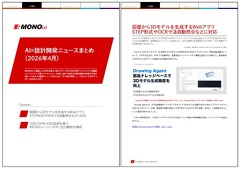
💡Get a curated summary of how AI is reshaping product design and engineering workflows in April 2026.
⚡ 30-Second TL;DR
What Changed
Curated collection of AI-driven design and analysis news from April 2026
Why It Matters
Provides engineers with a consolidated view of AI adoption in manufacturing, helping them identify emerging tools for design optimization.
What To Do Next
Download the PDF booklet to identify which AI-driven design tools are currently gaining traction in the Japanese manufacturing sector.
Key Points
- •Curated collection of AI-driven design and analysis news from April 2026
- •Focuses on practical applications of AI in industrial product development
- •Available in a convenient PDF booklet format for professional reference
🧠 Deep Insight
Background and context from public sources — not the original article. 20 sources cited.
🔑 Enhanced Key Takeaways
- •Generative design, including LLM-native CAD generation and topology optimization, is transitioning from prototyping to production use in industrial product engineering by 2026, enabling the exploration of thousands of design options based on specified parameters.
- •AI-powered simulations and digital twins are crucial for virtual prototyping, allowing engineers to test durability, measure stress, and identify failure scenarios without physical testing, significantly reducing development time and costs.
- •The emergence of agentic AI systems, capable of reasoning, using tools, and adapting, is enhancing design efficiency and lowering innovation barriers by automating complex tasks in product development.
- •AI is streamlining various stages of product development, from ideation and material selection to quality control and supply chain optimization, by providing predictive analytics, real-time insights, and automated anomaly detection.
🛠️ Technical Deep Dive
- Generative design algorithms: Create numerous design options based on functional requirements, material limitations, and performance goals, moving beyond human CAD designers.
- AI-powered simulation tools: Utilize machine learning and 3D deep learning for virtual prototyping, stress tests, thermal analysis, and predicting product performance (e.g., Finite Element Analysis (FEA) and Computational Fluid Dynamics (CFD)).
- Agentic AI systems: Designed to reason, use tools, and adapt like humans, automating complex tasks and making design work more efficient.
- Natural Language Processing (NLP): Applied for analyzing customer feedback, generating human language descriptions of design concepts, and enabling LLM-native CAD generation.
- AI-enhanced CAD software: Integrates predictive modeling, real-time feedback, and auto-correction features to streamline design workflows.
- Digital Twin technology: Creates virtual replicas of physical products or systems to simulate real-world behavior and optimize performance.
- Computer Vision: Used for quality control and anomaly detection in manufacturing processes.
🔮 Future ImplicationsAI analysis grounded in cited sources
⏳ Timeline
📎 Sources (20)
Factual claims are grounded in the sources below. Forward-looking analysis is AI-generated interpretation.
Weekly AI Recap
Read this week's curated digest of top AI events →
👉Related Updates
AI-curated news aggregator. All content rights belong to original publishers.
Original source: ITmedia AI+ (日本) ↗
This is a summary, not the original. Read the source, or get the weekly briefing.
The weekly digest
One email a week. Unsubscribe anytime.