🇨🇳cnBeta (Full RSS)•Stalecollected in 5h
Apple Watch Eyes Battery, Health Boosts Sans Touch ID
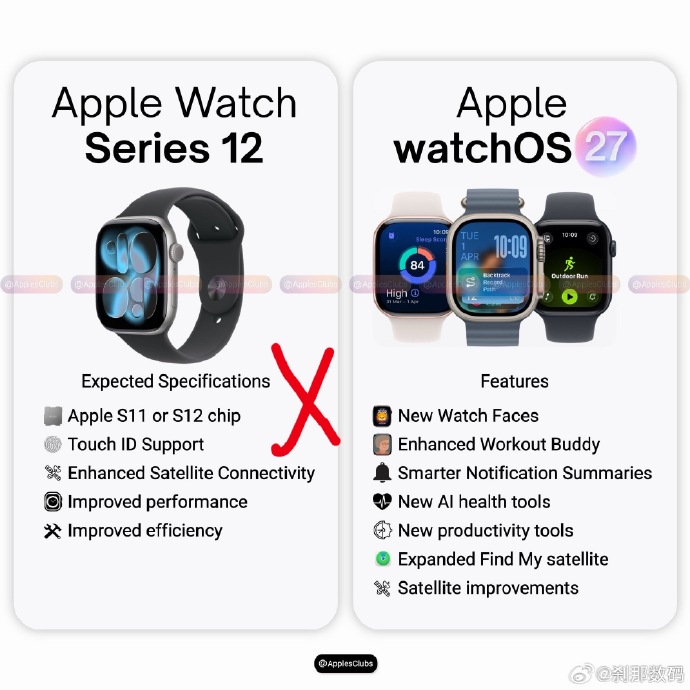
💡Apple's Watch strategy advances health sensors ripe for AI/ML integration in fitness apps
⚡ 30-Second TL;DR
What Changed
Prioritizes battery endurance enhancements
Why It Matters
Shifts Apple Watch development toward user-centric battery and health improvements, potentially boosting ML-driven health analytics in wearables ecosystem.
What To Do Next
Test Apple HealthKit API updates for new sensor data integration in your wearable ML models.
Who should care:Developers & AI Engineers
Key Points
- •Prioritizes battery endurance enhancements
- •Focuses on advanced health sensor upgrades
- •No short-term plans for Touch ID integration
- •Relies on iPhone pairing for seamless unlocking
🧠 Deep Insight
AI-generated analysis for this event.
🔑 Enhanced Key Takeaways
- •Apple is reportedly prioritizing the transition to micro-LED display technology for future Apple Watch models, which is expected to significantly improve power efficiency and brightness compared to current OLED panels.
- •Development efforts are heavily focused on non-invasive glucose monitoring technology, utilizing short-wave infrared absorption spectroscopy to track blood sugar levels without skin penetration.
- •The decision to bypass Touch ID is driven by the physical constraints of the watch chassis, where the internal volume required for biometric sensors is being reallocated to larger battery cells to support multi-day usage.
📊 Competitor Analysis▸ Show
| Feature | Apple Watch (Future) | Samsung Galaxy Watch (Current) | Garmin Fenix Series |
|---|---|---|---|
| Battery Life | Focus on multi-day optimization | 40-80 hours (model dependent) | 14-30+ days |
| Health Sensors | Non-invasive glucose (R&D) | BioActive Sensor (BIA/ECG) | Advanced HRV/Pulse Ox |
| Biometrics | iPhone-paired unlocking | PIN/Pattern/Wrist Detection | PIN/Gesture |
| Display Tech | Micro-LED (Expected) | Super AMOLED | MIP / AMOLED |
🛠️ Technical Deep Dive
- •Micro-LED implementation: Utilizing a self-emissive inorganic compound structure that eliminates the need for a backlight, reducing power consumption by approximately 20-30% compared to LTPO OLED.
- •Glucose Monitoring Architecture: Integration of a silicon photonics chip that emits specific wavelengths of light into the interstitial fluid to measure glucose concentration via optical absorption.
- •Battery Density: Transitioning to high-silicon anode materials to increase energy density by 10-15% within the same physical footprint.
🔮 Future ImplicationsAI analysis grounded in cited sources
Apple will achieve a 3-day battery life standard by 2027.
The combination of micro-LED efficiency gains and high-silicon anode battery chemistry provides a clear path to exceeding the current 18-hour baseline.
Non-invasive glucose monitoring will remain a 'wellness' feature rather than a medical-grade diagnostic tool.
Regulatory hurdles with the FDA regarding accuracy thresholds for non-invasive blood glucose tracking necessitate a conservative, non-diagnostic marketing approach.
⏳ Timeline
2015-04
Launch of the first-generation Apple Watch.
2018-09
Introduction of ECG capabilities with Apple Watch Series 4.
2021-10
Apple Watch Series 7 introduces faster charging and larger display area.
2022-09
Apple Watch Ultra launches, focusing on extended battery life and rugged design.
2024-09
Apple Watch Series 10 introduces sleep apnea detection and thinner design.
📰
Weekly AI Recap
Read this week's curated digest of top AI events →
👉Related Updates


AI-curated news aggregator. All content rights belong to original publishers.
Original source: cnBeta (Full RSS) ↗