Apple Turns Mac mini Into a Local AI Node
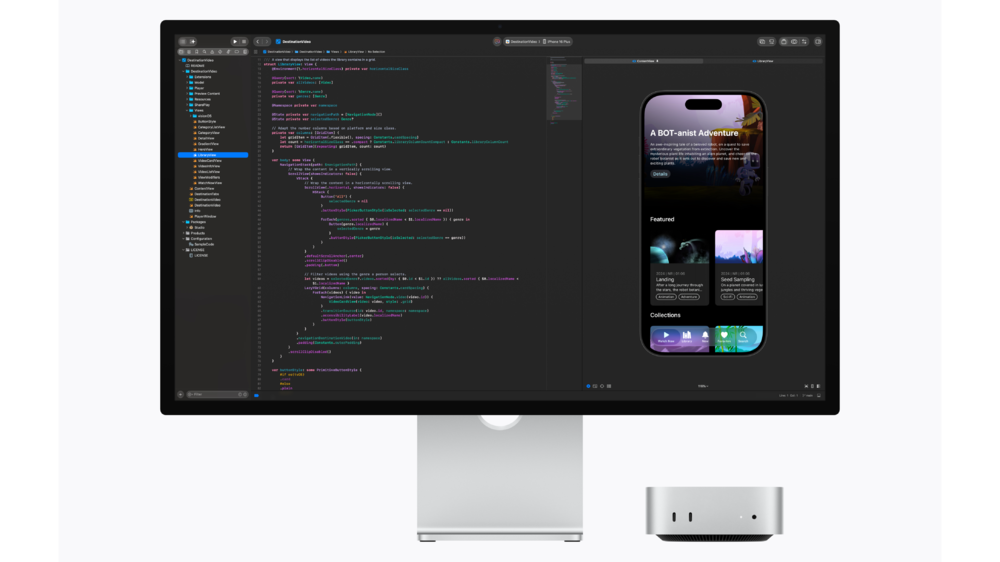
💡Apple's new Mac mini previews a local-AI strategy built on 2nm chips, huge memory, and Mac clustering.
⚡ 30-Second TL;DR
What Changed
M6 is described as Apple's first 2nm chip, with 12 CPU cores, 12 GPU cores, and up to 170GB/s unified-memory bandwidth.
Why It Matters
Apple is positioning its hardware portfolio as a tiered local-AI platform rather than simply a range of personal computers. This could make private, always-on inference more accessible, while high memory prices, limited CUDA compatibility, and immature cluster management remain significant constraints.
What To Do Next
Prototype a private RAG or agent workload with MLX, LM Studio, or Ollama on a 48GB-plus Apple Silicon system, then benchmark latency and memory usage against your current cloud GPU setup.
Key Points
- •M6 is described as Apple's first 2nm chip, with 12 CPU cores, 12 GPU cores, and up to 170GB/s unified-memory bandwidth.
- •Every M6 GPU core reportedly includes a neural-network accelerator, alongside dual 16-core neural engines.
- •M5 Ultra uses a four-die design, up to 512GB of unified memory, and 1.2TB/s memory bandwidth for larger local models.
- •Multiple Mac Studio systems can reportedly connect through Thunderbolt 5 and RDMA, reaching up to three times the AI inference performance of one system.
- •Mac mini pricing reportedly ranges from RMB 6,999 to over RMB 50,000 depending on chip, memory, and storage.
🧠 Deep Insight
Background and context from public sources — not the original article. 5 sources cited.
🔑 Enhanced Key Takeaways
- •The Mac mini's starting price was increased from $599 to $799 in May 2026, driven by high demand for local AI hardware.
- •macOS 26.2, released in December 2025, introduced critical low-latency communication protocols for Thunderbolt 5, enabling the distributed AI inference capabilities mentioned.
- •The MLX framework has become the primary software driver for these Mac-based AI clusters, allowing developers to optimize model execution across Apple Silicon.
- •A global memory shortage in early 2026, characterized by a 100% quarter-over-quarter increase in PC DRAM contract prices, has significantly inflated the cost of high-memory Mac configurations.
- •Industry analysis indicates a discrepancy between hardware sales and actual local model usage, as many users utilize these machines for orchestration frameworks that still rely on cloud-based API calls.
📊 Competitor Analysis▸ Show
| Feature | Apple Mac mini (M6) | NVIDIA Jetson AGX Orin | Intel NUC (Core Ultra) |
|---|---|---|---|
| Architecture | Unified Memory (ARM) | Integrated GPU/NPU | Discrete/Integrated Hybrid |
| Max Memory | 512GB (M5 Ultra) | 64GB LPDDR5 | 96GB DDR5 |
| AI Focus | Local Inference/Dev | Edge Robotics/AI | General Purpose/AI |
| Pricing | $799 - $5,000+ | ~$2,000 | $600 - $1,500 |
🛠️ Technical Deep Dive
- Thunderbolt 5 integration allows for 120Gbps bandwidth, facilitating the RDMA-based clustering of multiple Mac units for distributed inference.
- Unified Memory Architecture (UMA) eliminates the PCIe bottleneck found in traditional GPU setups, allowing the GPU to access the full 512GB pool on M5 Ultra chips.
- The M6 chip utilizes a 2nm process node, which improves transistor density and power efficiency for sustained AI workloads compared to the previous 3nm M4 generation.
- Neural Engine throughput has been doubled in the M6 architecture to handle concurrent transformer-based model operations without saturating the GPU cores.
🔮 Future ImplicationsAI analysis grounded in cited sources
⏳ Timeline
📎 Sources (5)
Factual claims are grounded in the sources below. Forward-looking analysis is AI-generated interpretation.
Weekly AI Recap
Read this week's curated digest of top AI events →
👉Related Updates


AI-curated news aggregator. All content rights belong to original publishers.
Original source: 虎嗅 ↗
This is a summary, not the original. Read the source, or get the weekly briefing.
Weekly AI briefing
One email a week. Unsubscribe anytime.