高端手機份額創新高,Apple 與 Samsung 領跑
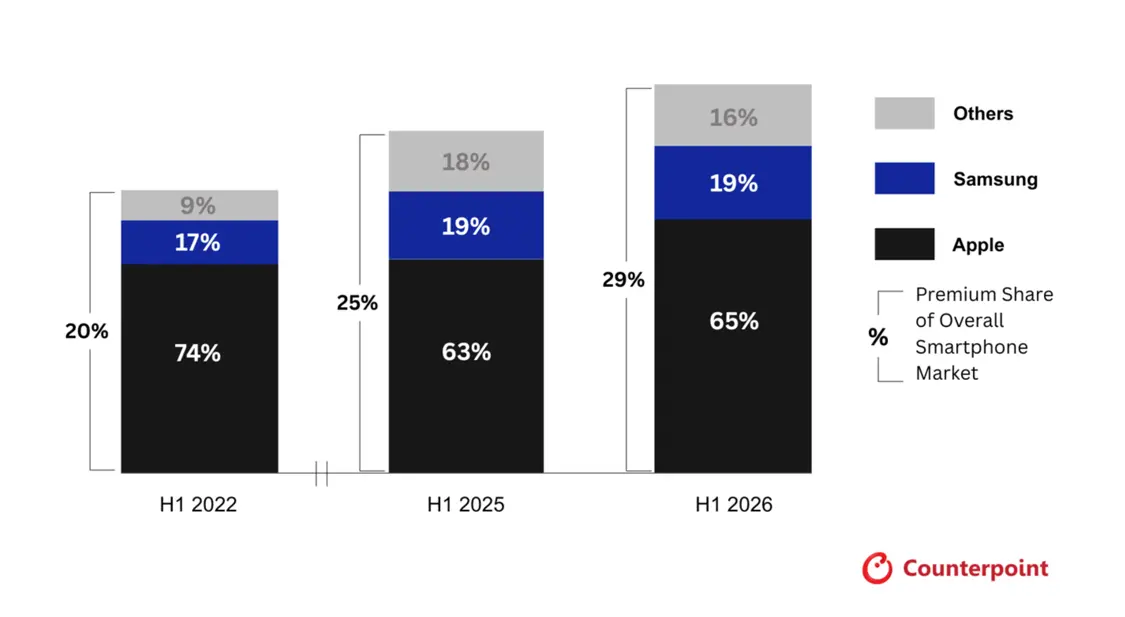
A record premium-phone share signals where advanced mobile AI experiences are most likely to launch first.
30-Second TL;DR
What Changed
Global high-end smartphone sales increased 5% year over year in the first half of 2026.
Why It Matters
A larger premium-device base expands the addressable market for on-device AI features and higher-performance mobile applications. Developers can expect flagship ecosystems to remain important targets for advanced AI experiences, although the report does not quantify AI adoption specifically.
What To Do Next
Prioritize on-device AI QA on current Apple and Samsung flagship phones, measuring latency, memory use, and battery impact before broadening support to lower-priced devices.
Key Points
- •Global high-end smartphone sales increased 5% year over year in the first half of 2026.
- •The $600-and-above wholesale-price segment reached a record 29% share of total smartphone sales.
- •Apple and Samsung remain the leading brands in the high-end smartphone segment.
Deep Insight
AI-generated analysis for this event — not the original article.
Enhanced Key Takeaways
- •The growth in the premium segment is largely driven by the 'premiumization' trend in emerging markets, particularly in Latin America and India, where consumers are increasingly opting for flagship devices.
- •Generative AI integration has become a primary differentiator for high-end devices in 2026, with manufacturers leveraging on-device LLMs to justify higher price points.
- •Despite the overall growth, the ultra-premium segment (wholesale price >$1,000) has seen a slight consolidation, with Apple maintaining a dominant market share due to strong ecosystem lock-in.
- •Foldable smartphone shipments have reached a critical mass in the high-end category, contributing significantly to the average selling price (ASP) increase for Samsung and Chinese OEMs.
- •Supply chain data indicates that component costs for high-end devices have risen by approximately 8% in 2026, forcing OEMs to maintain or increase retail prices to protect margins.
Competitor Analysis
- Apple (iPhone 17 Pro)
- A20 Bionic (3nm)
- Samsung (Galaxy S26 Ultra)
- Snapdragon 8 Gen 5
- Chinese Flagships (e.g., Xiaomi 16 Ultra)
- Snapdragon 8 Gen 5
- Apple (iPhone 17 Pro)
- Apple Intelligence (On-device)
- Samsung (Galaxy S26 Ultra)
- Galaxy AI (Hybrid)
- Chinese Flagships (e.g., Xiaomi 16 Ultra)
- Proprietary LLM Suites
- Apple (iPhone 17 Pro)
- LTPO OLED 120Hz
- Samsung (Galaxy S26 Ultra)
- Dynamic AMOLED 2X
- Chinese Flagships (e.g., Xiaomi 16 Ultra)
- LTPO OLED 144Hz
- Apple (iPhone 17 Pro)
- $999
- Samsung (Galaxy S26 Ultra)
- $1,199
- Chinese Flagships (e.g., Xiaomi 16 Ultra)
- $899 - $1,099
- Apple (iPhone 17 Pro)
- Ecosystem/Privacy
- Samsung (Galaxy S26 Ultra)
- Foldable/S-Pen
- Chinese Flagships (e.g., Xiaomi 16 Ultra)
- Fast Charging/Camera Hardware
| Feature/Metric | Apple (iPhone 17 Pro) | Samsung (Galaxy S26 Ultra) | Chinese Flagships (e.g., Xiaomi 16 Ultra) |
|---|---|---|---|
| Processor | A20 Bionic (3nm) | Snapdragon 8 Gen 5 | Snapdragon 8 Gen 5 |
| AI Integration | Apple Intelligence (On-device) | Galaxy AI (Hybrid) | Proprietary LLM Suites |
| Display | LTPO OLED 120Hz | Dynamic AMOLED 2X | LTPO OLED 144Hz |
| Starting Price | $999 | $1,199 | $899 - $1,099 |
| Key Differentiator | Ecosystem/Privacy | Foldable/S-Pen | Fast Charging/Camera Hardware |
Technical Deep Dive
- Adoption of 3nm and 2nm process nodes for SoCs has enabled higher NPU performance for local AI processing.
- Implementation of advanced vapor chamber cooling systems to manage thermal throttling during sustained AI workloads.
- Integration of satellite connectivity hardware as a standard feature in the $600+ tier for emergency and messaging services.
- Transition to LPDDR6 RAM modules to support memory-intensive generative AI models running locally on the device.
Future ImplicationsAI analysis grounded in cited sources
Timeline
- 2024-09Apple launches iPhone 16 series with expanded AI capabilities.
- 2025-01Samsung introduces Galaxy S25 series, focusing on integrated generative AI.
- 2025-09Apple releases iPhone 17, marking a shift toward deeper on-device AI processing.
- 2026-02Samsung releases Galaxy S26, setting new benchmarks for high-end AI-integrated hardware.
Weekly AI Recap
Read this week's curated digest of top AI events →
Related Updates

AI-curated news aggregator. All content rights belong to original publishers.
Original source: cnBeta (Full RSS) ↗
This is a summary, not the original. Read the source, or get the weekly briefing.
The weekly digest
One email a week. Unsubscribe anytime.