Anthropic to Release Mythos-class Opus 4.8 Model
Get ready for the next flagship model from Anthropic, promising higher performance and improved safety.
30-Second TL;DR
What Changed
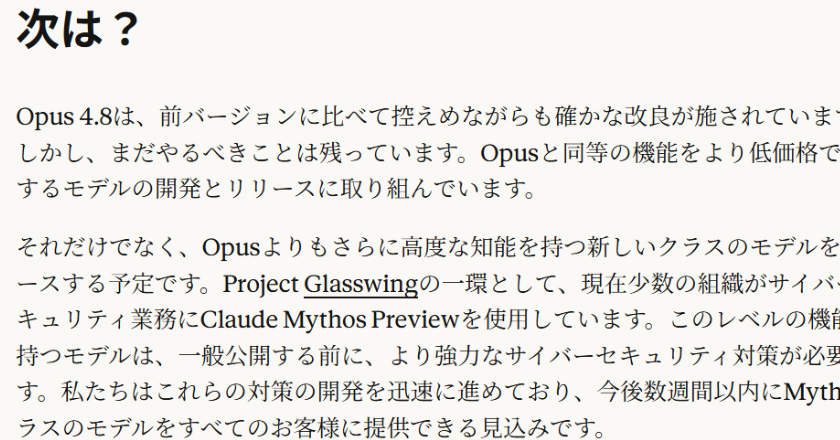
Opus 4.8 即將於數週內全面發布
Why It Matters
The release of Opus 4.8 represents a significant update to Anthropic's flagship lineup, likely setting new benchmarks for enterprise-grade AI performance and safety.
What To Do Next
Prepare your API integration workflows to test Opus 4.8 as soon as it becomes available in the Anthropic Console.
Key Points
- •Opus 4.8 即將於數週內全面發布
- •定位為 Mythos 等級的高效能模型
- •強調在發布前已強化安全防護機制
Deep Insight
Background and context from public sources — not the original article. 20 sources cited.
Enhanced Key Takeaways
- •Anthropic's Opus 4.8, released on May 28, 2026, introduces a 'Dynamic workflows' feature in Claude Code, enabling the model to run hundreds of parallel subagents for complex coding tasks.
- •The new model offers a 'fast mode' with pricing three times cheaper than previous models, making high-throughput inference more accessible for latency-sensitive production workloads.
- •Opus 4.8 incorporates an 'effort control' feature on claude.ai and Cowork, allowing users to manually adjust the model's processing intensity and associated token consumption for a given task.
- •Anthropic highlights Opus 4.8's improved 'honesty,' noting it is less prone to making unsupported claims and more likely to flag uncertainties in its work, enhancing reliability for users.
- •Opus 4.8 serves as a precursor to the more powerful 'Mythos-class' models, which are currently restricted to Project Glasswing partners for cybersecurity applications due to their advanced capabilities and the need for stronger cyber safeguards before general release.
Competitor Analysis
- Anthropic Claude Opus 4.8 (May 2026)
- $5 (regular), $10 (fast mode)
- OpenAI GPT-5.5 (May 2026)
- $5
- Google Gemini 3.1 Pro (May 2026)
- $2 (Preview >200K)
- Anthropic Claude Opus 4.8 (May 2026)
- $25 (regular), $50 (fast mode)
- OpenAI GPT-5.5 (May 2026)
- $30
- Google Gemini 3.1 Pro (May 2026)
- $18 (Preview >200K)
- Anthropic Claude Opus 4.8 (May 2026)
- 69.2%
- OpenAI GPT-5.5 (May 2026)
- 58.6%
- Google Gemini 3.1 Pro (May 2026)
- N/A
- Anthropic Claude Opus 4.8 (May 2026)
- 88.6%
- OpenAI GPT-5.5 (May 2026)
- N/A
- Google Gemini 3.1 Pro (May 2026)
- N/A
- Anthropic Claude Opus 4.8 (May 2026)
- 74.6% (high effort)
- OpenAI GPT-5.5 (May 2026)
- 78.2% (Terminus-2 public harness), 83.4% (Codex CLI harness)
- Google Gemini 3.1 Pro (May 2026)
- N/A
- Anthropic Claude Opus 4.8 (May 2026)
- 84%
- OpenAI GPT-5.5 (May 2026)
- N/A (beats GPT-5.5)
- Google Gemini 3.1 Pro (May 2026)
- N/A
- Anthropic Claude Opus 4.8 (May 2026)
- 1M tokens
- OpenAI GPT-5.5 (May 2026)
- N/A (under 272K input tokens for strong competition)
- Google Gemini 3.1 Pro (May 2026)
- N/A
- Anthropic Claude Opus 4.8 (May 2026)
- Advanced coding, complex agentic workflows, high-stakes enterprise tasks, dynamic workflows, effort control, multimodal (text, image, file inputs)
- OpenAI GPT-5.5 (May 2026)
- Strong on terminal/CLI workflows, web browsing, graduate-level science, native multimodal understanding (text, images, audio)
- Google Gemini 3.1 Pro (May 2026)
- Enhanced reliability, dynamic workflow capabilities, user-adjustable 'engagement levels'
| Feature/Metric | Anthropic Claude Opus 4.8 (May 2026) | OpenAI GPT-5.5 (May 2026) | Google Gemini 3.1 Pro (May 2026) |
|---|---|---|---|
| Input Pricing (per 1M tokens) | $5 (regular), $10 (fast mode) | $5 | $2 (Preview >200K) |
| Output Pricing (per 1M tokens) | $25 (regular), $50 (fast mode) | $30 | $18 (Preview >200K) |
| SWE-bench Pro | 69.2% | 58.6% | N/A |
| SWE-bench Verified | 88.6% | N/A | N/A |
| Terminal-Bench 2.1 | 74.6% (high effort) | 78.2% (Terminus-2 public harness), 83.4% (Codex CLI harness) | N/A |
| Online-Mind2Web | 84% | N/A (beats GPT-5.5) | N/A |
| Context Window | 1M tokens | N/A (under 272K input tokens for strong competition) | N/A |
| Key Capabilities | Advanced coding, complex agentic workflows, high-stakes enterprise tasks, dynamic workflows, effort control, multimodal (text, image, file inputs) | Strong on terminal/CLI workflows, web browsing, graduate-level science, native multimodal understanding (text, images, audio) | Enhanced reliability, dynamic workflow capabilities, user-adjustable 'engagement levels' |
Technical Deep Dive
- Context Window & Output: Claude Opus 4.8 features a 1 million-token context window and supports a maximum output of 128,000 tokens.
- Input Modalities: The model accepts text, image, and file inputs, producing text outputs.
- Dynamic Workflows: A new research preview feature in Claude Code allows the model to plan and execute tasks by running hundreds of parallel subagents in a single session.
- Effort Control: Users can adjust the model's 'effort' level (Low, Medium, High, Max, or adaptive thinking) on claude.ai and Cowork, influencing processing intensity and token usage.
- Constitutional AI: Anthropic continues to train its models, including Opus 4.8, using 'constitutional AI,' a technique designed to improve ethical and legal compliance by guiding AI behavior with predefined principles.
- Behavioral Improvements: Opus 4.8 demonstrates enhanced honesty, being less likely to make unsupported claims and more prone to flagging uncertainties, and shows improved self-correction in coding tasks.
- API Enhancements: The Messages API now accepts system entries mid-conversation, allowing developers to update Claude's instructions without breaking the prompt cache or incurring higher costs.
- Refusal Stop Details: The
stop_detailsobject on refusal responses is now publicly documented, providing categories of refusal to help applications route users appropriately.
Future ImplicationsAI analysis grounded in cited sources
Timeline
- 2021-01Anthropic is founded by former OpenAI executives.
- 2023-03Claude, Anthropic's first AI-based chatbot, is released.
- 2024-03Claude 3 model family (Haiku, Sonnet, Opus) is launched, introducing multimodal image support.
- 2024-06Claude 3.5 Sonnet is released, outperforming Claude 3 Opus and introducing the Artifacts feature.
- 2025-05Claude Opus 4 and Claude Sonnet 4 are released, with Opus 4 classified as a 'Level 3' safety risk.
- 2026-05Claude Opus 4.8 is released, with 'Dynamic workflows' and 'effort control,' and teases the upcoming general release of Mythos-class models.
Sources (20)
Factual claims are grounded in the sources below. Forward-looking analysis is AI-generated interpretation.
Weekly AI Recap
Read this week's curated digest of top AI events →
Related Updates
AI-curated news aggregator. All content rights belong to original publishers.
Original source: ITmedia AI+ (日本) ↗
This is a summary, not the original. Read the source, or get the weekly briefing.
The weekly digest
One email a week. Unsubscribe anytime.