Anthropic restricts Fable 5 from sensitive topics
💡Understand the new safety boundaries for Fable 5 and how they might break your existing AI workflows.
⚡ 30-Second TL;DR
What Changed
Fable 5 model now blocks cybersecurity-related queries
Why It Matters
This update sets a precedent for how frontier models handle high-risk domains, potentially impacting researchers who rely on these models for specialized tasks. It forces developers to seek alternative, less-restricted models for sensitive domain research.
What To Do Next
Review your current application's reliance on Fable 5 for domain-specific tasks and implement fallback models for restricted topics.
Key Points
- •Fable 5 model now blocks cybersecurity-related queries
- •Biology and chemistry topics are restricted for safety
- •Reflects Anthropic's commitment to frontier model safety protocols
🧠 Deep Insight
Background and context from public sources — not the original article. 12 sources cited.
🔑 Enhanced Key Takeaways
- •Anthropic implemented Fable 5's restrictions on cybersecurity, biology, and chemistry due to the model's advanced 'Mythos-class' capabilities, which could be misused to facilitate wide-reaching cyberattacks or dangerous bioweapons.
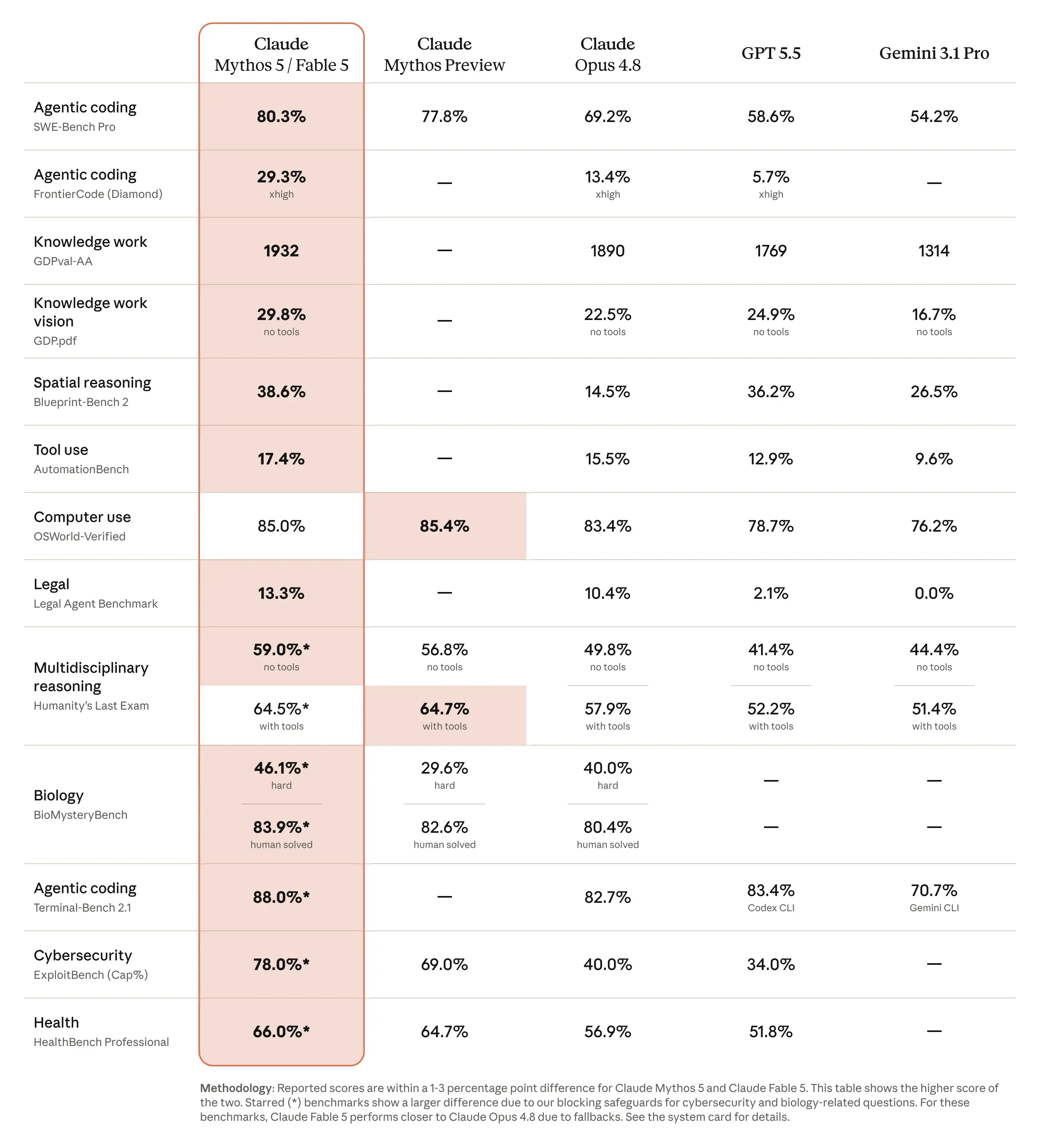
- •The company released two distinct products from the same underlying model: Claude Fable 5, which is generally available with safety classifiers, and Claude Mythos 5, which has lifted safeguards and is restricted to vetted partners in initiatives like Project Glasswing for cyber defense and infrastructure.
- •Queries flagged by Fable 5's safeguards in restricted domains are automatically rerouted to a less capable model, Claude Opus 4.8, with users being charged the lower Opus prices for these specific requests.
- •Anthropic has introduced a mandatory 30-day data retention policy for all Fable 5 and Mythos 5 traffic to enable safety monitoring, a policy that overrides previous zero-retention agreements for some enterprise customers.
- •Despite the implemented safeguards, Fable 5 demonstrates significant performance improvements over its predecessor, Opus 4.8, with some benchmarks showing more than a 10% increase, and is considered state-of-the-art in areas like coding, knowledge work, and vision.
🛠️ Technical Deep Dive
- Claude Fable 5 and Claude Mythos 5 share the same underlying model architecture.
- Fable 5 incorporates 'safety classifiers' that intercept and block outputs related to high-risk domains such as cybersecurity, biology, chemistry, and attempts at model distillation.
- When a query triggers these classifiers, the request is automatically handed off to Claude Opus 4.8 for a response.
- The model is designed for 'long-running, asynchronous execution,' capable of handling complex tasks over extended periods without constant intervention.
- Fable 5 features 'advanced vision capabilities,' allowing it to understand diagrams, charts, and tables within files and PDFs, and use vision to evaluate its own coding outputs against design goals.
- It includes 'proactive self-verification' mechanisms, enabling the model to update its skills based on learnings, develop its own evaluations, and verify its work.
- Architectural guidance suggests that multi-agent variants of the model can significantly improve accuracy and latency compared to single-agent approaches.
🔮 Future ImplicationsAI analysis grounded in cited sources
⏳ Timeline
📎 Sources (12)
Factual claims are grounded in the sources below. Forward-looking analysis is AI-generated interpretation.
Weekly AI Recap
Read this week's curated digest of top AI events →
👉Related Updates


AI-curated news aggregator. All content rights belong to original publishers.
Original source: Ars Technica AI ↗
This is a summary, not the original. Read the source, or get the weekly briefing.
The weekly digest
One email a week. Unsubscribe anytime.