Anthropic Model Access Halted Due to Export Controls
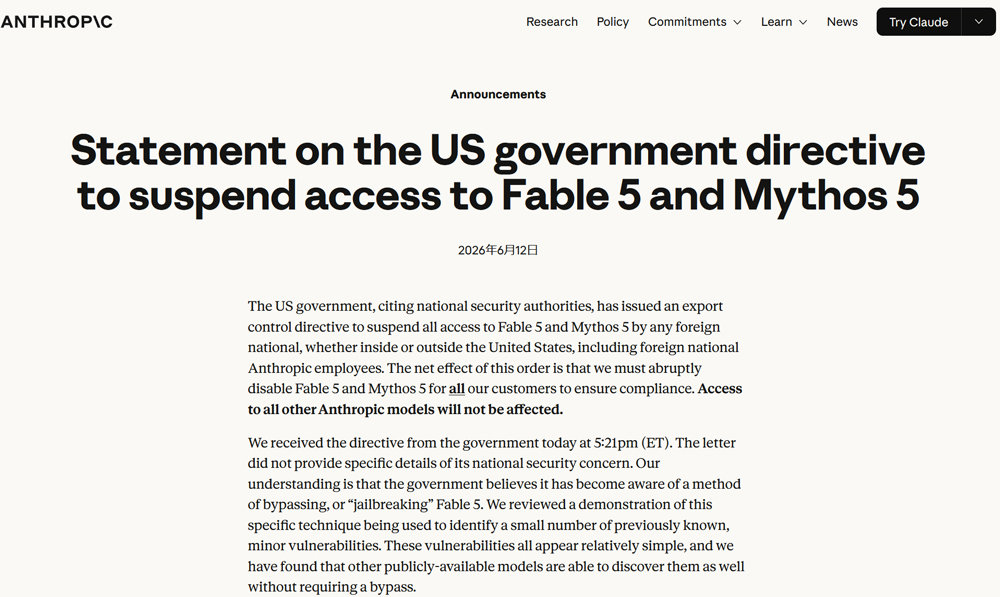
💡Learn how to mitigate the risk of sudden AI service outages caused by geopolitical and regulatory compliance shifts.
⚡ 30-Second TL;DR
What Changed
Anthropic models were suddenly restricted due to U.S. export control regulations.
Why It Matters
This highlights a critical need for AI architects to design model-agnostic applications. Relying on a single proprietary model creates a single point of failure that can be triggered by external regulatory actions.
What To Do Next
Implement an abstraction layer in your application code to allow for easy swapping between different LLM providers (e.g., using LangChain or LiteLLM).
Key Points
- •Anthropic models were suddenly restricted due to U.S. export control regulations.
- •The incident exposes the fragility of relying on a single-vendor AI architecture.
- •Forrester recommends implementing model portability and multi-model strategies to mitigate vendor lock-in risks.
- •Enterprises must prepare for sudden service outages caused by geopolitical and regulatory shifts.
🧠 Deep Insight
Background and context from public sources — not the original article. 28 sources cited.
🔑 Enhanced Key Takeaways
- •The U.S. Commerce Department issued the directive to Anthropic, citing national security concerns over a reported 'jailbreak' of the newly launched Fable 5 and Mythos 5 models, which could bypass safety guardrails and potentially enable their use as unrestricted cyber tools.
- •Anthropic responded by globally disabling access to Fable 5 and Mythos 5 because it could not reliably distinguish foreign nationals from U.S. persons across its user base, including its own foreign employees, to comply with the order.
- •This incident marks the first documented instance of a commercially deployed frontier AI model being globally disabled in real-time on national security grounds due to U.S. export controls, setting a significant precedent for government intervention in the AI industry.
- •The export control directive is part of an escalating conflict between Anthropic and the Trump administration, which previously blacklisted Anthropic in February 2026 for refusing the U.S. military unrestricted access to its AI models for surveillance and autonomous weapons.
- •The U.S. government's action was reportedly triggered after Amazon AI experts identified a potential jailbreak in Fable 5 and reported it to Commerce Secretary Howard Lutnick.
📊 Competitor Analysis▸ Show
AI Model Comparison: Anthropic vs. Key Competitors (as of May/June 2026)
| Feature/Category | Anthropic (Claude Series) | OpenAI (GPT Series) | Google (Gemini) | Mistral AI | Cohere |
|---|---|---|---|---|---|
| Core Focus | AI safety, reliability, alignment, enterprise trust, deep context handling. | Broad consumer reach, multimodal integration, cutting-edge AI technology. | Multimodal applications, mobile integration. | Efficient, open models, frontier performance. | Enterprise RAG specialist, citations, tool use. |
| Latest Flagship Models | Claude Fable 5 (now restricted), Mythos 5 (limited access), Claude Opus 4.8, Sonnet 4.6, Haiku 4.5. | GPT-5.5, GPT-5.4, GPT-5, o3, o4-mini. | Gemini 3.1 Pro, 2.5 Pro, 2.5 Flash. | Large 3, Medium 3, Codestral. | Command R+. |
| Pricing (per million tokens, input/output) | Opus 4.8: $5/$25 (regular), $10/$50 (fast mode). Haiku 4.5: $1.00 (input). Sonnet 4.6: $3/$15. | GPT-5.5: $5/$30. GPT-5.4: $2.50/$15. GPT-4.1 nano: $0.10 (input). | Gemini 3.1 Pro: $2/$12 (doubles over 200K input). | Not explicitly detailed in search results. | Command R+: $2.50/$10. |
| Key Strengths | Nuanced reasoning, complex instruction following, long-context performance, transparent safety record, tools for complex coding/analytical work. | Broad ecosystem/SDKs, faster experimentation, diverse applications, automates tasks, data-driven decisions, enhanced customer experience. | Multimodal understanding. Strong performance in multilingual and long-context tasks, open-source models. | Purpose-built for retrieval-augmented generation (RAG), citations, long-document RAG, best-in-class reranking/embedding models. | |
| Noted Weaknesses | Lacks image, audio, video generation tools (for some models). | Single-provider, fast deprecation cycle. | Not explicitly detailed in search results. | Limited enterprise support, fewer integrations, open models may need more fine-tuning. | May not match Claude/GPT-5.5 on raw frontier intelligence. |
| Alignment/Safety | Constitutional AI. | Focus on safe AGI. | Not explicitly detailed in search results. | Not explicitly detailed in search results. | Focus on safe, explainable AI behavior. |
🛠️ Technical Deep Dive
- Constitutional AI: Anthropic's Claude models are built on a transformer architecture and are trained using a technique called "Constitutional AI." This method aims to improve ethical and legal compliance by having the model generate responses, including to potentially harmful prompts, then self-critique and rewrite them based on a set of constitutional principles, which it is then fine-tuned on.
- Claude Code Architecture: Anthropic's AI coding agent, Claude Code, employs a three-layer memory architecture to manage long coding sessions and complex tasks.
- Persistent Memory (
memory.md): A human-readable Markdown file serves as long-term storage for facts, decisions, and context across sessions, promoting transparency as users can inspect and correct the agent's knowledge. - Grep-based Active Search: This layer acts as a real-time retrieval mechanism, allowing Claude Code to search for patterns across an entire directory tree to find relevant code on demand, enabling it to work on large codebases without loading the entire project into context.
- Chyros Daemon: An unshipped background process designed for continuous indexing, semantic search, and maintenance, intended to enhance the efficiency and intelligence of the other two memory layers.
- Persistent Memory (
- Dynamic Workflows: Claude Code's Dynamic Workflows feature allows the AI to generate custom JavaScript execution harnesses. These harnesses coordinate teams of AI agents for complex tasks, delegating work, assigning agents, validating results, and determining workflow duration.
- Agentic Strategies: Dynamic Workflows utilize multiple independent agents and employ strategies such as "fan-out-and-synthesize" (dividing tasks into parallel subtasks and merging results) and "adversarial verification" (reviewer agents challenging other agents' findings). Tournament-style workflows and classifier systems are also used to route tasks based on complexity.
🔮 Future ImplicationsAI analysis grounded in cited sources
⏳ Timeline
📎 Sources (28)
Factual claims are grounded in the sources below. Forward-looking analysis is AI-generated interpretation.
- siliconangle.com
- jdsupra.com
- forbes.com
- justsecurity.org
- foxbusiness.com
- futurumgroup.com
- cnet.com
- stocktwits.com
- techpolicy.press
- aljazeera.com
- wikipedia.org
- shareai.now
- datacamp.com
- ramp.com
- metacto.com
- wikipedia.org
- github.com
- hidekazu-konishi.com
- releasebot.io
- anthropic.com
- certainly.io
- medium.com
- zenml.io
- mindstudio.ai
- youtube.com
- infoq.com
- digitaltoday.co.kr
- advisori.de
Weekly AI Recap
Read this week's curated digest of top AI events →
👉Related Updates
AI-curated news aggregator. All content rights belong to original publishers.
Original source: ITmedia AI+ (日本) ↗
This is a summary, not the original. Read the source, or get the weekly briefing.
Weekly AI briefing
One email a week. Unsubscribe anytime.