Anthropic discovers 'J-space' in Claude's neural network
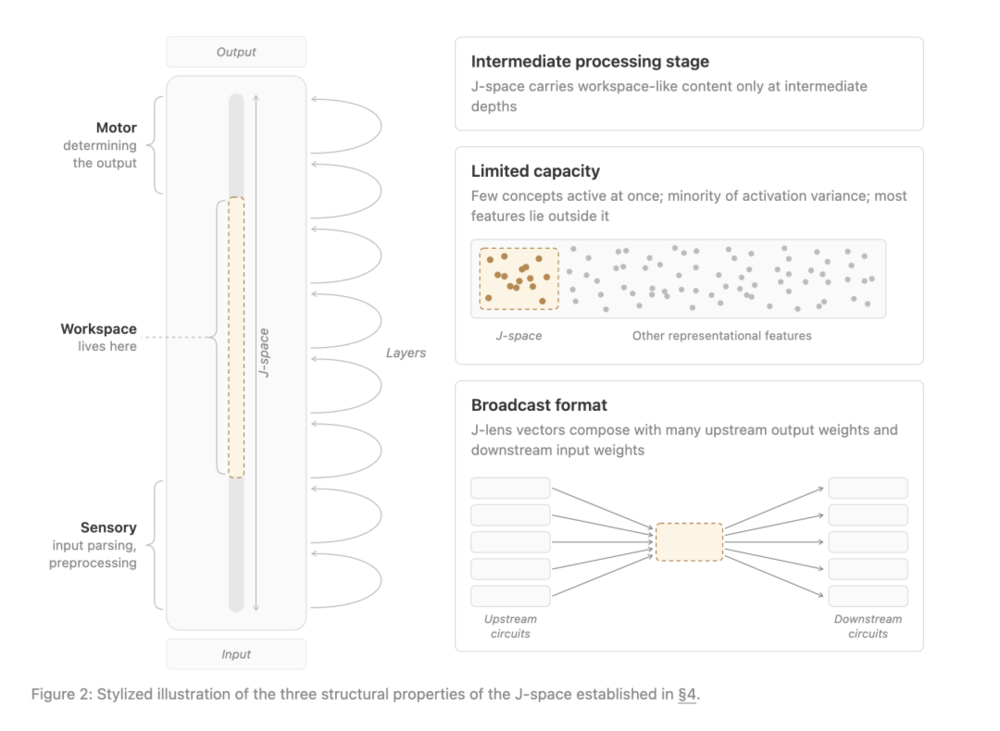
💡First-ever physical mapping of 'thought' in an LLM; reveals how to steer model reasoning by targeting specific neurons.
⚡ 30-Second TL;DR
What Changed
Identified 'J-space' using Jacobian Lens to map internal token representations.
Why It Matters
This discovery provides a breakthrough in mechanistic interpretability, potentially allowing for more controllable and transparent AI models. It suggests that complex reasoning in LLMs is localized, offering a path to 'debug' or steer model logic.
What To Do Next
Review Anthropic's 'Jacobian Lens' methodology to explore how you can apply similar interpretability techniques to your own model fine-tuning or safety auditing.
Key Points
- •Identified 'J-space' using Jacobian Lens to map internal token representations.
- •Demonstrated that manipulating J-space can inject or alter the model's 'thoughts' before output.
- •Confirmed J-space acts as a shared workspace for multi-step reasoning and cross-task information retrieval.
- •Removing J-space activity severely degrades multi-step reasoning capabilities while leaving basic tasks intact.
🧠 Deep Insight
AI-generated analysis for this event — not the original article.
🔑 Enhanced Key Takeaways
- •The 'Jacobian Lens' technique utilizes a specific mathematical decomposition of the model's residual stream to isolate activation patterns that correlate with high-level semantic reasoning rather than mere token prediction.
- •Anthropic's research suggests that J-space exhibits properties of a 'global workspace' similar to the Global Workspace Theory (GWT) in cognitive neuroscience, where information is broadcast to specialized modules.
- •Experiments showed that J-space activity is highly correlated with the model's 'uncertainty' or 'deliberation' phase, often spiking during complex chain-of-thought generation.
- •The discovery of J-space provides a potential mechanism for 'mechanistic interpretability' to detect deceptive alignment, as researchers can monitor this space for hidden reasoning that contradicts the final output.
- •J-space is not a fixed physical location in the hardware but a dynamic, emergent subspace within the activation vectors that persists across different model sizes within the Claude 3.5 and 3.6 architectures.
📊 Competitor Analysis▸ Show
| Feature | Anthropic (Claude) | OpenAI (GPT-4/5) | Google (Gemini) |
|---|---|---|---|
| Interpretability Focus | High (Mechanistic focus) | Moderate (Behavioral focus) | Low (Black-box focus) |
| Reasoning Transparency | High (J-space mapping) | Low (Proprietary) | Low (Proprietary) |
| Control Mechanism | Direct activation steering | RLHF-based alignment | RLHF-based alignment |
🛠️ Technical Deep Dive
- J-space is identified as a low-dimensional manifold within the high-dimensional activation space of the transformer's residual stream.
- The Jacobian Lens method involves computing the Jacobian matrix of the output logits with respect to internal layer activations to identify which neurons contribute most to reasoning-heavy tokens.
- Researchers applied sparse autoencoders (SAEs) to decompose the J-space activations into interpretable features, revealing clusters related to logical operators and causal reasoning.
- Manipulation of J-space is achieved through 'activation steering' or 'vector addition,' where a specific steering vector is added to the residual stream during the forward pass to amplify or suppress reasoning patterns.
🔮 Future ImplicationsAI analysis grounded in cited sources
⏳ Timeline
Weekly AI Recap
Read this week's curated digest of top AI events →
👉Related Updates



AI-curated news aggregator. All content rights belong to original publishers.
Original source: 虎嗅 ↗
This is a summary, not the original. Read the source, or get the weekly briefing.
Weekly AI briefing
One email a week. Unsubscribe anytime.