Anthropic Builds an Enterprise AI Moat
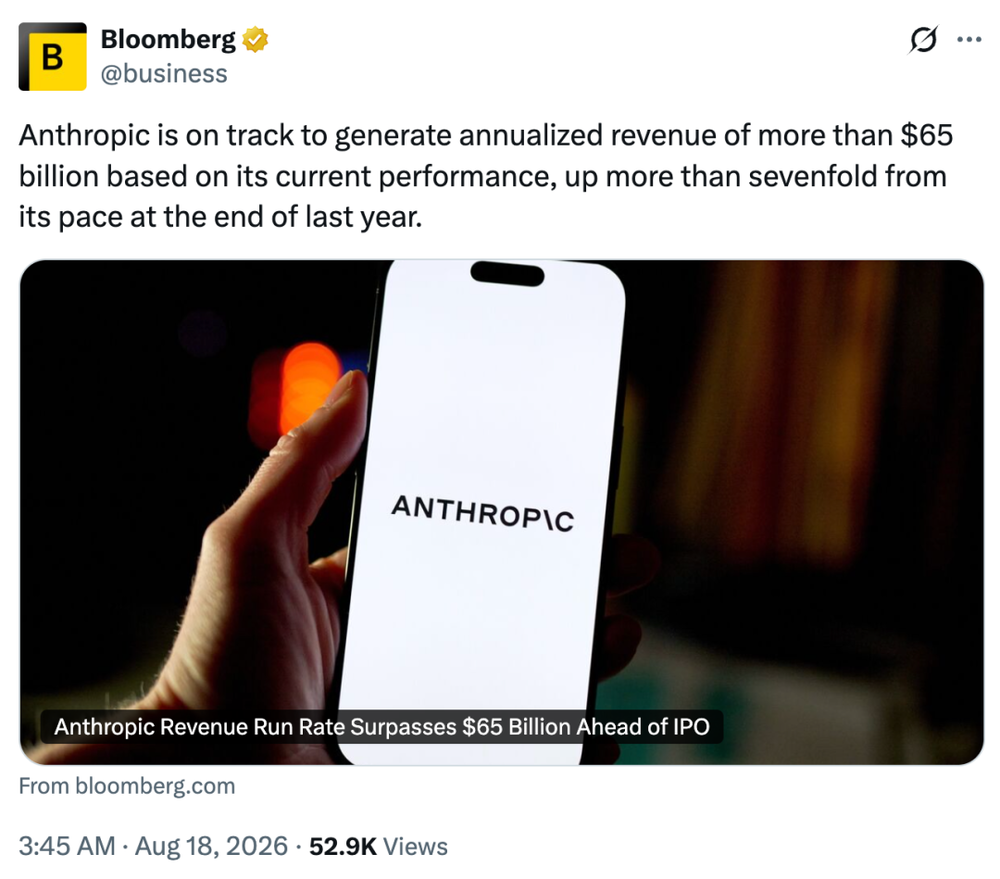
💡Anthropic’s hiring and Claude Code strategy shows where enterprise AI competition is heading next.
⚡ 30-Second TL;DR
What Changed
Anthropic reportedly grew ARR from $9 billion to $65 billion and reached $11.5 billion in Q2 revenue.
Why It Matters
The article suggests that AI competition is moving beyond model quality toward enterprise workflow integration, inference efficiency, and hardware control. For AI companies, talent concentration in chips, agents, and robotics may increasingly determine margins and product defensibility.
What To Do Next
Benchmark your coding-agent workload for token cost, latency, and energy efficiency before committing to an enterprise deployment.
Key Points
- •Anthropic reportedly grew ARR from $9 billion to $65 billion and reached $11.5 billion in Q2 revenue.
- •Claude Code turns model calls into long-running, token-intensive software engineering workflows.
- •Anthropic hired talent from OpenAI and Google for chip efficiency, robotics, hardware, and AI for Science.
- •OpenAI is reorganizing around ChatGPT and enterprise delivery while reducing the independence of some safety functions.
🧠 Deep Insight
Background and context from public sources — not the original article. 5 sources cited.
🔑 Enhanced Key Takeaways
- •Anthropic's enterprise run-rate revenue reached approximately $47 billion by late May 2026, marking a significant acceleration from the $9 billion reported at the end of 2025.
- •Data from the Ramp AI Index in April 2026 showed Anthropic surpassing OpenAI in enterprise adoption, with 34.44% of American businesses paying for Claude compared to 32.3% for ChatGPT.
- •Anthropic's 'Constitutional AI' methodology has become a primary procurement differentiator in regulated sectors like finance and healthcare, as it provides a verifiable framework for ethical alignment.
- •As of February 2026, Anthropic secured a 70% win rate in head-to-head enterprise sales competitions against OpenAI for new AI service contracts.
- •The company successfully scaled its high-value client base to over 1,000 enterprise customers, each contributing at least $1 million in annual recurring revenue by mid-2026.
📊 Competitor Analysis▸ Show
| Feature | Anthropic (Claude) | OpenAI (ChatGPT) |
|---|---|---|
| Primary Enterprise Focus | Agentic workflows & 'Co-Work' | Consumer-to-enterprise transition |
| Alignment Methodology | Constitutional AI (Rule-based) | RLHF (Human-feedback based) |
| Market Adoption (Apr '26) | 34.44% | 32.3% |
| Win Rate (New Biz) | ~70% | ~30% |
🛠️ Technical Deep Dive
- Claude Code utilizes multi-step agentic workflows that integrate directly with corporate repositories and external scientific databases.
- Claude Science architecture enables models to interface with over 60 distinct scientific databases to perform autonomous, multi-stage research tasks.
- Claude Co-Work implementation allows for parallel task execution across repositories, enabling autonomous management of complex operational workflows like payroll and threat analysis.
- Model training incorporates Constitutional AI, replacing traditional human-feedback loops with a set of predefined ethical principles to ensure consistent output in regulated environments.
🔮 Future ImplicationsAI analysis grounded in cited sources
⏳ Timeline
📎 Sources (5)
Factual claims are grounded in the sources below. Forward-looking analysis is AI-generated interpretation.
Weekly AI Recap
Read this week's curated digest of top AI events →
👉Related Updates



AI-curated news aggregator. All content rights belong to original publishers.
Original source: 虎嗅 ↗
This is a summary, not the original. Read the source, or get the weekly briefing.
Weekly AI briefing
One email a week. Unsubscribe anytime.