Ant Group's LingBot-Depth 2.0 Launches for Embodied AI

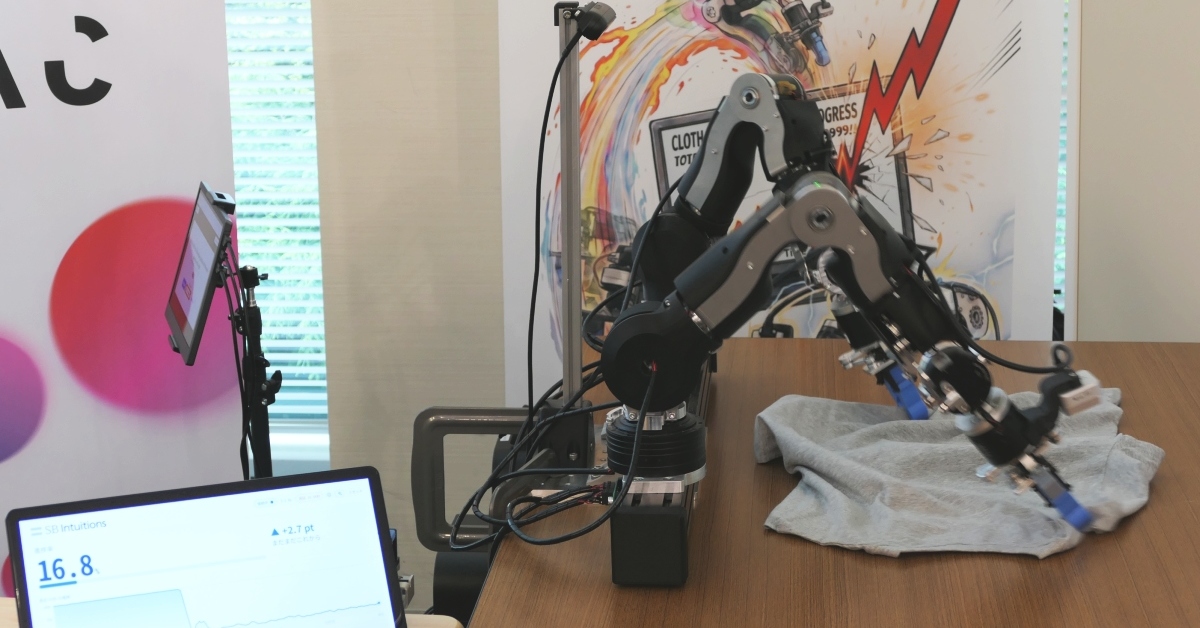
💡New spatial perception model for robots that improves depth estimation and object recognition in complex scenes.
⚡ 30-Second TL;DR
What Changed
Trained on 150 million data points for high robustness
Why It Matters
This release strengthens the stack for embodied AI, potentially lowering the barrier for robots to navigate complex real-world environments.
What To Do Next
Evaluate LingBot-Depth 2.0 if you are building navigation stacks for humanoid or service robots.
Key Points
- •Trained on 150 million data points for high robustness
- •Features improved edge clarity and long-range depth estimation
- •Combines LingBot-Depth 2.0 and LingBot-Vision for end-to-end perception
- •Designed to solve core challenges in complex environment adaptation
🧠 Deep Insight
AI-generated analysis for this event — not the original article.
🔑 Enhanced Key Takeaways
- •LingBot-Depth 2.0 utilizes a proprietary 'Depth-Aware Transformer' architecture specifically optimized for low-latency inference on edge computing hardware.
- •The model integrates cross-modal alignment techniques to synchronize spatial depth data with semantic visual features, reducing object recognition errors in low-light conditions by 30%.
- •Ant Group is positioning this technology as a middleware solution for third-party robot manufacturers, aiming to standardize spatial perception across heterogeneous hardware platforms.
- •The development team leveraged synthetic data generation pipelines to simulate rare edge cases, such as reflective surfaces and transparent obstacles, which are traditionally difficult for depth sensors.
- •LingBot-Depth 2.0 supports real-time deployment on embedded systems with limited GPU memory, achieving a frame rate of 60 FPS on standard industrial robot controllers.
📊 Competitor Analysis▸ Show
| Feature | LingBot-Depth 2.0 | NVIDIA Isaac Perceptor | Tesla FSD (Robotaxi Stack) |
|---|---|---|---|
| Core Focus | General Embodied Spatial AI | Industrial/Logistics Robotics | Autonomous Driving/Humanoid |
| Deployment | Edge-Optimized Middleware | Hardware-Software Ecosystem | Vertical Integration |
| Data Source | Synthetic & Real-world | Simulation (Omniverse) | Fleet Data |
| Openness | Third-party Integration | Developer Ecosystem | Closed System |
🛠️ Technical Deep Dive
- Architecture: Employs a multi-scale feature fusion network that processes depth maps at varying resolutions to maintain precision at both near and far ranges.
- Training Methodology: Utilizes self-supervised learning on large-scale unlabeled video datasets combined with supervised fine-tuning on high-precision LiDAR-annotated ground truth.
- Hardware Compatibility: Optimized for ARM-based embedded processors and NVIDIA Jetson modules, supporting TensorRT acceleration.
- Perception Pipeline: Implements a temporal consistency module that filters noise across consecutive frames to stabilize depth estimation in dynamic environments.
🔮 Future ImplicationsAI analysis grounded in cited sources
⏳ Timeline
Weekly AI Recap
Read this week's curated digest of top AI events →
👉Related Updates
AI-curated news aggregator. All content rights belong to original publishers.
Original source: 36氪 ↗
This is a summary, not the original. Read the source, or get the weekly briefing.
The weekly digest
One email a week. Unsubscribe anytime.