Ant Group unveils breakthrough robot vision for transparent objects
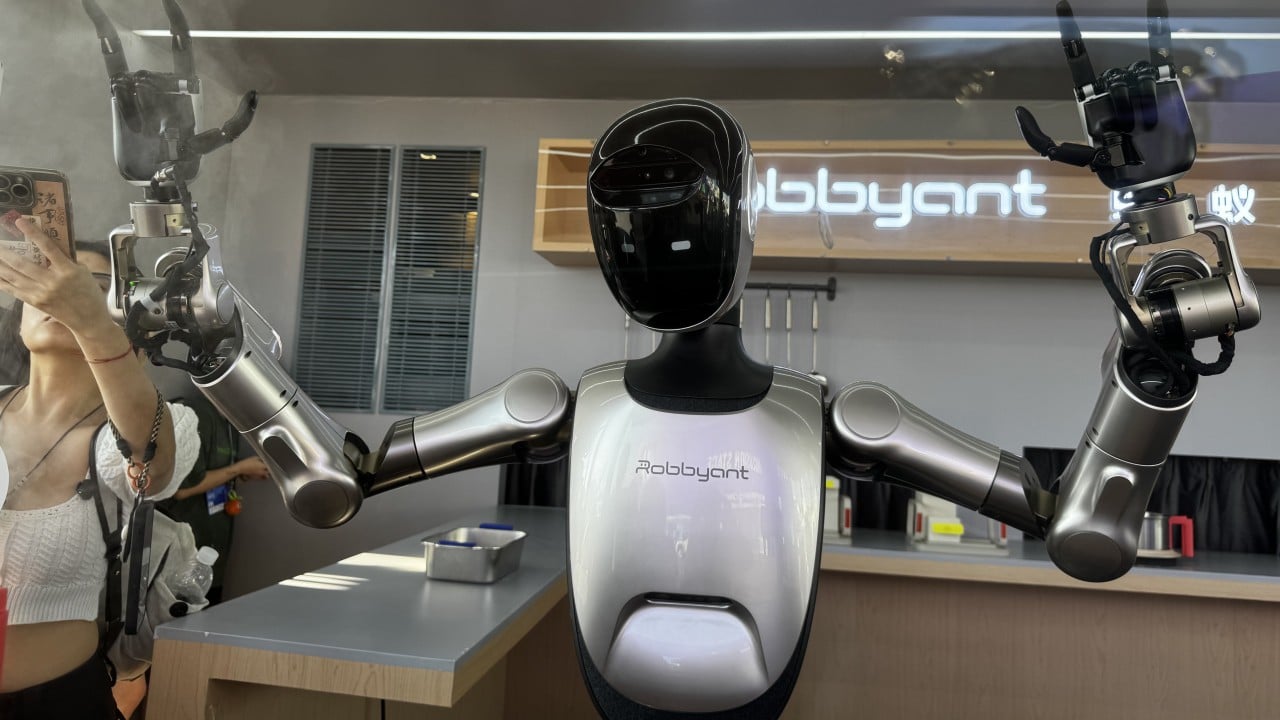
💡New vision models from Ant Group solve the 'glass problem' in robotics, a major hurdle for indoor autonomous navigation.
⚡ 30-Second TL;DR
What Changed
Launched LingBot-Depth 2.0 spatial perception model for improved depth sensing.
Why It Matters
This advancement significantly improves the operational reliability of robots in indoor environments like offices or homes where glass partitions are common. It marks a critical step toward more autonomous and safer human-robot interaction.
What To Do Next
If you are developing navigation stacks for mobile robots, investigate how these vision models handle specular reflections to improve your robot's obstacle avoidance in glass-heavy environments.
Key Points
- •Launched LingBot-Depth 2.0 spatial perception model for improved depth sensing.
- •Introduced LingBot-Vision, a new foundational visual model for robots.
- •Addresses the long-standing industry challenge of detecting transparent surfaces like glass and mirrors.
- •Developed by Robbyant, the embodied AI division of Ant Group.
🧠 Deep Insight
AI-generated analysis for this event — not the original article.
🔑 Enhanced Key Takeaways
- •The LingBot-Depth 2.0 model utilizes a novel multi-modal fusion architecture that integrates LiDAR point clouds with high-resolution RGB-D data to resolve refractive errors common in transparent object detection.
- •Robbyant's research team has open-sourced a portion of the training dataset, dubbed 'Trans-Object-1M', which contains over one million annotated images of glass, mirrors, and polished metallic surfaces in indoor environments.
- •The technology is specifically optimized for deployment on low-power edge computing hardware, allowing for real-time inference at 30 frames per second without requiring cloud-based processing.
- •Ant Group intends to integrate these vision models into its existing fleet of autonomous delivery robots and service bots currently operating in commercial office buildings across major Chinese cities.
- •The development of LingBot-Vision was accelerated by Ant Group's proprietary 'Ant-Brain' computing cluster, which utilized synthetic data generation to simulate complex lighting conditions and reflections on transparent surfaces.
📊 Competitor Analysis▸ Show
| Feature | LingBot-Depth 2.0 | NVIDIA Isaac Perceptor | Tesla FSD (Vision) |
|---|---|---|---|
| Transparent Object Handling | Native/Specialized | General Purpose | General Purpose |
| Edge Inference | High Efficiency | High Performance | High Performance |
| Primary Focus | Service/Indoor Robots | Industrial/Warehouse | Autonomous Vehicles |
| Pricing Model | Enterprise Licensing | SDK/Hardware Bundled | Proprietary/Internal |
🛠️ Technical Deep Dive
- Architecture: Employs a Transformer-based encoder-decoder structure specifically tuned for depth completion in sparse data environments.
- Sensor Fusion: Uses a gated-attention mechanism to weigh LiDAR inputs against visual cues, effectively filtering out 'ghost' reflections caused by glass.
- Training Methodology: Leverages self-supervised learning on unlabeled video streams to improve temporal consistency when tracking moving transparent objects.
- Latency: Achieves sub-30ms latency on NVIDIA Jetson Orin modules, facilitating rapid obstacle avoidance in dynamic environments.
🔮 Future ImplicationsAI analysis grounded in cited sources
⏳ Timeline
Weekly AI Recap
Read this week's curated digest of top AI events →
👉Related Updates
AI-curated news aggregator. All content rights belong to original publishers.
Original source: SCMP Technology ↗
This is a summary, not the original. Read the source, or get the weekly briefing.
The weekly digest
One email a week. Unsubscribe anytime.