🐯虎嗅•Stalecollected in 3m
Analyzing the Speed and Severity of Ebola Outbreaks
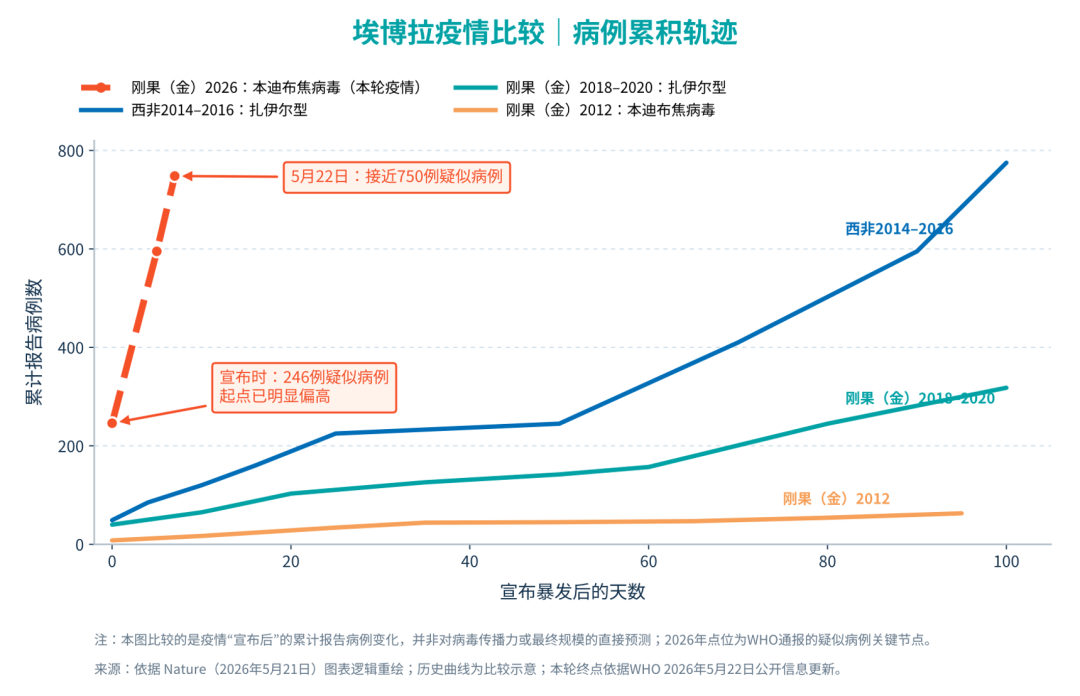
💡Understand how data reporting lags can skew public health crisis analysis.
⚡ 30-Second TL;DR
What Changed
Delayed detection significantly impacts the initial reported infection counts.
Why It Matters
Highlights the importance of early detection and data-driven response in public health crises.
What To Do Next
If building health-tech models, ensure your training data accounts for reporting delays and regional infrastructure limitations.
Who should care:Researchers & Academics
Key Points
- •Delayed detection significantly impacts the initial reported infection counts.
- •Congo's history of 17 Ebola outbreaks makes it uniquely prepared for containment.
- •International aid and WHO intervention are critical for managing outbreaks in conflict zones.
🧠 Deep Insight
Web-grounded analysis with 41 cited sources.
🔑 Enhanced Key Takeaways
- •The current (May 2026) Ebola outbreak in the Democratic Republic of Congo (DRC) is caused by the Bundibugyo ebolavirus, a strain for which there is currently no approved vaccine or specific treatment, unlike the Zaire ebolavirus.
- •Conflict and insecurity in eastern DRC significantly impede Ebola response efforts, leading to increased transmission rates, displacement of populations, and attacks on healthcare workers and facilities, exacerbating the humanitarian crisis.
- •The rVSV-ZEBOV vaccine (Ervebo) has demonstrated high effectiveness (approximately 84-100%) against the Zaire ebolavirus in real-world settings and clinical trials, and two monoclonal antibody treatments (REGN-EB3 and mAb114) significantly reduce mortality for Zaire ebolavirus infections.
- •Development of a specific vaccine for the Bundibugyo strain is underway, with the most promising candidate estimated to be 6-9 months away from having sufficient doses for clinical trials, highlighting a critical gap in immediate response capabilities.
🛠️ Technical Deep Dive
- Ebola Virus Structure: Ebola virus is a filamentous, enveloped virus with a negative-sense, single-stranded RNA genome. It contains seven viral proteins: nucleoprotein (NP), VP35, VP40, glycoprotein (GP), VP30, VP24, and RNA-dependent RNA polymerase (L). The GP is located on the virion surface and is crucial for host cell attachment and membrane fusion.
- Diagnostics: Reverse transcription–polymerase chain reaction (RT-PCR) is considered the gold standard for Ebola diagnosis due to its high specificity and sensitivity in detecting viral RNA. Rapid diagnostic tests (RDTs) are also available, primarily based on immunochromatographic methods that detect viral antigens like VP40, NP, and GP, though their sensitivities can vary.
- rVSV-ZEBOV Vaccine (Ervebo): This is a recombinant, replication-competent viral vector vaccine. It utilizes a live attenuated recombinant vesicular stomatitis virus (VSV) that has been genetically engineered to express the main glycoprotein from the Zaire ebolavirus, thereby provoking a neutralizing immune response.
- Monoclonal Antibody Treatments (REGN-EB3/Inmazeb and mAb114/Ebanga): Both are antibody-based therapies. REGN-EB3 is a cocktail of three fully human monoclonal antibodies, each targeting a unique, non-overlapping epitope on the EBOV glycoprotein. This mechanism prevents viral replication and triggers the host's immune system to eliminate infected cells. mAb114 is a single human immunoglobulin G1 (IgG1) monoclonal antibody that binds to the EBOV envelope glycoprotein.
🔮 Future ImplicationsAI analysis grounded in cited sources
Development of pan-Ebola vaccines and treatments will accelerate.
The current Bundibugyo outbreak highlights the lack of specific countermeasures for all Ebola species, driving urgent research into broader-spectrum solutions to prevent future outbreaks.
Integrated public health and security strategies will become standard for outbreak response in conflict zones.
The severe impact of ongoing conflict on Ebola containment in the DRC demonstrates the necessity of addressing security challenges alongside medical interventions to ensure effective and safe public health responses.
⏳ Timeline
1976
First recorded Ebola outbreak in Yambuku, DRC (then Zaire), leading to the virus's identification.
2014-2016
West Africa Ebola epidemic, the largest in history, which significantly spurred global vaccine and treatment development efforts.
2018-2020
Second largest Ebola epidemic in North Kivu and Ituri, DRC, where the rVSV-ZEBOV vaccine was widely deployed and monoclonal antibody treatments were evaluated in clinical trials.
2019
FDA approval of rVSV-ZEBOV (Ervebo) vaccine for the prevention of Ebola virus disease caused by Zaire ebolavirus.
2020
FDA approval of monoclonal antibody treatments REGN-EB3 (Inmazeb) and mAb114 (Ebanga) for treating Zaire ebolavirus infections.
2026-05
Current Bundibugyo Ebola outbreak declared in Ituri Province, DRC, and Uganda, subsequently declared a Public Health Emergency of International Concern by WHO.
📎 Sources (41)
Factual claims are grounded in the sources below. Forward-looking analysis is AI-generated interpretation.
- who.int
- indiatimes.com
- firstwordpharma.com
- gavi.org
- nih.gov
- pnas.org
- irishtimes.com
- nih.gov
- nih.gov
- rescue.org
- clinicaltrialsarena.com
- nih.gov
- nih.gov
- wikipedia.org
- nih.gov
- frontiersin.org
- nih.gov
- bu.edu
- nih.gov
- healthpolicy-watch.news
- theguardian.com
- pnas.org
- wikipedia.org
- rcsb.org
- nih.gov
- microbiologyinfo.com
- nih.gov
- netec.org
- bu.edu
- asm.org
- who.int
- wikipedia.org
- cdc.gov
- nih.gov
- nih.gov
- cdcfoundation.org
- cdc.gov
- cdc.gov
- wikipedia.org
- who.int
- npr.org
📰
Weekly AI Recap
Read this week's curated digest of top AI events →
👉Related Updates



AI-curated news aggregator. All content rights belong to original publishers.
Original source: 虎嗅 ↗