AMD’s Record Quarter Bets on Open AI Hardware
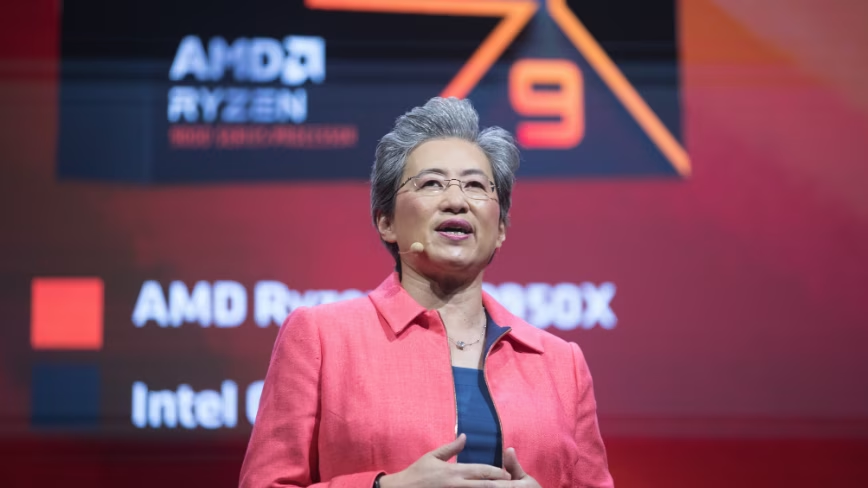
AMD’s AI data-center surge could reshape GPU choice, costs, and software lock-in.
30-Second TL;DR
What Changed
AMD’s quarterly revenue reached a record $11.5 billion, up 50% year over year.
Why It Matters
AMD’s growth gives AI infrastructure buyers a stronger alternative to Nvidia and could increase pressure on pricing, supply, and software compatibility. For practitioners, the strategic value of AMD will depend on whether its open approach translates into reliable production tooling and competitive performance.
What To Do Next
Benchmark a representative inference workload on AMD’s ROCm stack alongside your current Nvidia deployment, measuring performance, migration effort, and tooling gaps.
Key Points
- •AMD’s quarterly revenue reached a record $11.5 billion, up 50% year over year.
- •Data-center revenue rose to $6.7 billion, more than double the prior year.
- •AI hardware now drives the majority of AMD’s business, with data centers contributing 58% of revenue.
- •AMD is positioning openness and ecosystem flexibility as an alternative to Nvidia’s entrenched software moat.
Deep Insight
AI-generated analysis for this event — not the original article.
Enhanced Key Takeaways
- •AMD's ROCm software stack has reached version 7.0, significantly improving compatibility with PyTorch and JAX to lower the barrier for developers migrating from CUDA environments.
- •The revenue growth is heavily attributed to the ramp-up of the Instinct MI350 series, which utilizes 3nm process technology and HBM3e memory to compete directly with Blackwell-class performance.
- •AMD has expanded its strategic partnerships with major hyperscalers, including Microsoft Azure and Meta, who are increasingly adopting AMD hardware to diversify their AI infrastructure supply chains.
- •The company's 'open ecosystem' strategy includes a renewed commitment to the UXL Foundation, aiming to create a unified programming model that abstracts hardware-specific code across different GPU architectures.
- •Operating margins for the Data Center segment have expanded to 35%, indicating that AMD is successfully scaling production efficiency alongside its rapid revenue growth.
Competitor Analysis
- AMD (Instinct MI350)
- CDNA 4
- Nvidia (Blackwell B200)
- Blackwell
- Intel (Gaudi 3)
- Gaudi 3
- AMD (Instinct MI350)
- HBM3e
- Nvidia (Blackwell B200)
- HBM3e
- Intel (Gaudi 3)
- HBM3e
- AMD (Instinct MI350)
- Open (ROCm/UXL)
- Nvidia (Blackwell B200)
- Closed (CUDA)
- Intel (Gaudi 3)
- Open (oneAPI)
- AMD (Instinct MI350)
- Price/Performance
- Nvidia (Blackwell B200)
- Performance/Software Moat
- Intel (Gaudi 3)
- Efficiency/Cost
| Feature | AMD (Instinct MI350) | Nvidia (Blackwell B200) | Intel (Gaudi 3) |
|---|---|---|---|
| Architecture | CDNA 4 | Blackwell | Gaudi 3 |
| Memory | HBM3e | HBM3e | HBM3e |
| Ecosystem | Open (ROCm/UXL) | Closed (CUDA) | Open (oneAPI) |
| Primary Focus | Price/Performance | Performance/Software Moat | Efficiency/Cost |
Technical Deep Dive
- The Instinct MI350 series leverages the CDNA 4 architecture, optimized for FP8 and FP4 precision workloads essential for large language model inference.
- Implementation of Infinity Fabric 4.0 allows for high-bandwidth, low-latency interconnects between multiple GPUs, enabling massive scale-out clusters.
- ROCm 7.0 introduces improved graph capture and kernel fusion capabilities, reducing overhead in distributed training environments.
- The hardware supports advanced RAS (Reliability, Availability, and Serviceability) features, bringing AMD's data center offerings to parity with enterprise-grade requirements.
Future ImplicationsAI analysis grounded in cited sources
Timeline
- 2023-12AMD launches the Instinct MI300 series, marking a major pivot toward high-performance AI hardware.
- 2024-05AMD announces the UXL Foundation membership to promote open-standard AI programming.
- 2025-01AMD unveils the MI350 series at CES, focusing on 3nm architecture and enhanced AI performance.
- 2025-10ROCm 7.0 is released, featuring major updates to library support and developer tooling.
- 2026-08AMD reports record Q2 revenue of $11.5 billion, driven by data center AI demand.
Weekly AI Recap
Read this week's curated digest of top AI events →
Related Updates

AI-curated news aggregator. All content rights belong to original publishers.
Original source: The Next Web (TNW) ↗
This is a summary, not the original. Read the source, or get the weekly briefing.
The weekly digest
One email a week. Unsubscribe anytime.