AMD removes memory crypto from consumer CPUs
💡Understand the security implications of AMD's decision for local AI model privacy and data protection.
⚡ 30-Second TL;DR
What Changed
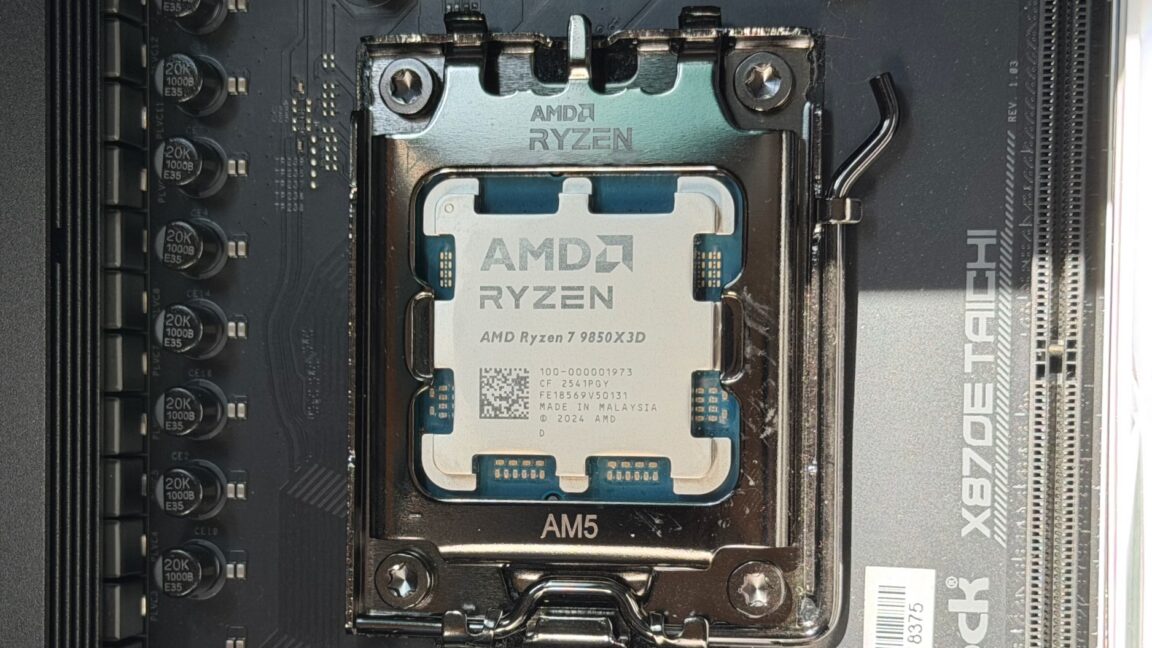
AMD removed TSME from consumer CPUs.
Why It Matters
Removing hardware-level memory encryption reduces the security posture for local AI inference and training. It may force developers to rely more heavily on software-based security measures.
What To Do Next
If you are running sensitive AI models locally, verify your CPU's security features and consider implementing application-level encryption for sensitive data.
Key Points
- •AMD removed TSME from consumer CPUs.
- •The change appears to be a deliberate and covert move.
- •Users are concerned about the impact on data privacy and security.
🧠 Deep Insight
Background and context from public sources — not the original article. 18 sources cited.
🔑 Enhanced Key Takeaways
- •The removal of Transparent Secure Memory Encryption (TSME), also known as AMD Memory Guard, was not publicly announced by AMD but was discovered by privacy-focused users in April 2026.
- •TSME encrypts all system memory using a hardware-generated key at boot, providing protection against physical attacks like cold boot attacks and DRAM interface snooping, with a minimal performance overhead typically below 5%.
- •The feature was disabled at the hardware level (fused off) on certain non-PRO consumer models, such as the Ryzen AI Max+ 395 and Ryzen 7 9700X, meaning it cannot be re-enabled via software or BIOS settings.
- •While TSME was previously available on some consumer Ryzen chips, AMD appears to be drawing a harder line, making it a PRO-only feature, as confirmed by tests showing PRO chips retain the functionality while consumer counterparts do not.
- •The underlying Secure Memory Encryption (SME) feature, which TSME builds upon, is supported in hardware by all Zen products (Ryzen and EPYC), but its enablement for full system encryption (TSME) is now restricted on consumer platforms.
📊 Competitor Analysis▸ Show
Competitor Analysis: Memory Encryption Features
| Feature/Aspect | AMD (Consumer - Post-TSME Removal) | AMD (PRO/Enterprise - SEV/SME) | Intel (Consumer - Post-SGX Deprecation) | Intel (Enterprise - SGX/TDX) |
|---|---|---|---|---|
| Memory Encryption | Limited/None (TSME removed) | Full system (SME/TSME), Per-VM (SEV) | Limited/None (SGX deprecated) | Per-enclave (SGX), Per-VM (TDX) |
| Target Market | General Consumer | Business, Enterprise, Cloud | General Consumer | Data Center, Cloud |
| Encryption Granularity | N/A | Full system or per-VM | N/A | Fine-grained (SGX), Whole VM (TDX) |
| Protection Against | N/A | Cold boot, physical attacks, hypervisor attacks (SEV) | N/A | Physical memory snooping, compromised OS/hypervisor (SGX/TDX) |
| Key Management | N/A | AMD Secure Processor | N/A | CPU/TDX Module |
| Integrity Protection | N/A | SEV-SNP adds memory integrity | N/A | TDX offers per-cache-line integrity |
| Performance Overhead | N/A | Minimal (TSME <5%) | N/A | Near-native (SEV), SGX can bottleneck with large workloads |
Analysis: AMD's removal of TSME from consumer CPUs creates a significant gap in hardware-level full system memory encryption for its mainstream offerings. While AMD continues to offer robust Secure Memory Encryption (SME) and Secure Encrypted Virtualization (SEV) features, including advanced versions like SEV-SNP, these are now primarily confined to its PRO and EPYC enterprise processors.
Intel, on the other hand, deprecated its Software Guard Extensions (SGX) on consumer chips in 2021, shifting its focus to the Xeon line for SGX and the newer Trust Domain Extensions (TDX) for confidential computing in data centers. This means that neither major x86 CPU vendor currently offers transparent, full-system memory encryption as a standard, enabled feature on their consumer-grade CPUs. Intel's SGX provides fine-grained, per-enclave encryption, while TDX encrypts entire virtual machines with strong integrity protection, but these are targeted at enterprise and cloud environments.
The absence of such a feature in consumer CPUs from both major players leaves a potential security vulnerability for physical attacks on memory, which is particularly relevant for local AI workloads where sensitive data might reside in RAM.
🛠️ Technical Deep Dive
- Transparent Secure Memory Encryption (TSME): A stricter subset of Secure Memory Encryption (SME) where all system memory is encrypted transparently, decoupled from the operating system or hypervisor.
- Encryption Mechanism: TSME utilizes a single AES-128 encryption key, which is randomly generated by the AMD Secure Processor at each system boot. This key is stored in dedicated hardware registers and is never exposed to software.
- Hardware Implementation: The encryption and decryption operations are performed by dedicated, high-performance Advanced Encryption Standard (AES) engines integrated into the on-die memory controllers. Data is encrypted when written to DRAM and decrypted when read.
- AMD Secure Processor (ASP): A 32-bit ARM Cortex-A5 microcontroller integrated within the AMD System-on-Chip (SoC) that functions as a dedicated security subsystem, managing key generation and other security functions.
- Secure Memory Encryption (SME): The foundational memory encryption feature that allows the host to encrypt most data in memory via page tables. It requires operating system or hypervisor support to mark specific memory pages for encryption using a 'C-bit' (physical address bit 47) in the page table entry.
- Secure Encrypted Virtualization (SEV): An extension of AMD-V virtualization that integrates main memory encryption to support encrypted virtual machines. SEV uses unique encryption keys for each virtual machine, managed by the AMD Secure Processor, to isolate guests and the hypervisor.
- SEV Enhancements:
- SEV-ES (Encrypted State): Extends SEV by encrypting all CPU register contents when a VM stops running, preventing information leakage to the hypervisor and detecting malicious modifications to CPU register states.
- SEV-SNP (Secure Nested Paging): Adds strong memory integrity protection to prevent malicious hypervisor-based attacks such as data replay, memory re-mapping, and certain side-channel attacks, creating a more isolated execution environment.
🔮 Future ImplicationsAI analysis grounded in cited sources
⏳ Timeline
📎 Sources (18)
Factual claims are grounded in the sources below. Forward-looking analysis is AI-generated interpretation.
Weekly AI Recap
Read this week's curated digest of top AI events →
👉Related Updates


AI-curated news aggregator. All content rights belong to original publishers.
Original source: Ars Technica ↗
This is a summary, not the original. Read the source, or get the weekly briefing.
Weekly AI briefing
One email a week. Unsubscribe anytime.