โ–ฒStalecollected in 18h

Amazon OpenSearch Serverless launches on Vercel Marketplace
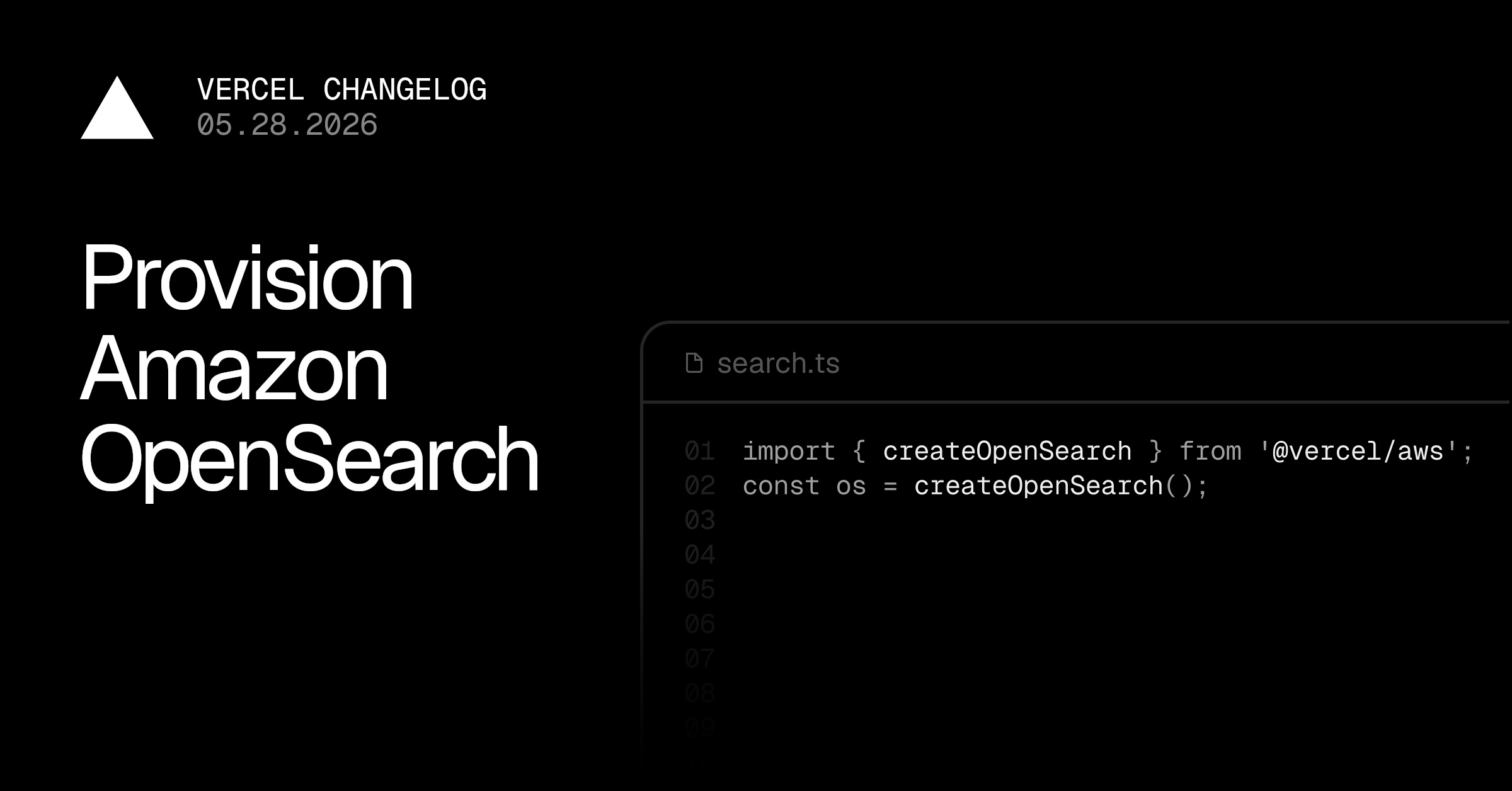
Amazon OpenSearch Serverless launches on Vercel Marketplace
PostLinkedIn
โ–ฒRead original on Vercel News

๐Ÿ’กSimplify your RAG infrastructure: Deploy Amazon OpenSearch Serverless directly from Vercel with automated configuration.

โšก 30-Second TL;DR

What Changed

Automated provisioning and environment variable injection directly from the Vercel dashboard.

Why It Matters

This integration significantly lowers the barrier for developers building RAG-based applications on Vercel by simplifying the connection to AWS search infrastructure. It allows teams to focus on agentic workflows without the operational overhead of managing search clusters.

What To Do Next

Deploy the Amazon OpenSearch starter template on Vercel to test how the automated environment variable injection simplifies your RAG pipeline setup.

Who should care:Developers & AI Engineers

Key Points

  • โ€ขAutomated provisioning and environment variable injection directly from the Vercel dashboard.
  • โ€ขUnified support for vector, lexical, hybrid, and agentic search within a single collection.
  • โ€ขServerless architecture scales up to 20x faster and supports scale-to-zero to eliminate idle costs.
  • โ€ขNew users can receive $100 in AWS credits via Vercel to test the integration.

๐Ÿง  Deep Insight

Web-grounded analysis with 17 cited sources.

๐Ÿ”‘ Enhanced Key Takeaways

  • โ€ขAmazon OpenSearch Serverless employs a pay-as-you-go pricing model, charging separately for compute and storage. Compute capacity is measured in OpenSearch Compute Units (OCUs), with each OCU comprising 6 GB of RAM, a virtual CPU, and associated storage, billed hourly for both indexing and search operations.
  • โ€ขThe service utilizes a cloud-native architecture that decouples indexing (ingest) and search (query) components, using Amazon S3 as the primary data storage for indexes. This separation allows each function to scale independently, unlike traditional OpenSearch clusters where these operations share infrastructure.
  • โ€ขOpenSearch Serverless automatically manages software upgrades, ensuring that collections run on the latest OpenSearch versions (currently 2.17.x) to incorporate new features, bug fixes, and performance improvements without manual intervention.
  • โ€ขThe integration supports existing OpenSearch clients and popular streaming ingestion pipelines such as Amazon Kinesis Data Firehose, Apache Kafka, Logstash, Fluent Bit, and Fluentd, facilitating seamless data integration for developers.
๐Ÿ“Š Competitor Analysisโ–ธ Show
Feature / ServiceAmazon OpenSearch Serverless (on Vercel)Elastic Cloud (Managed/Serverless)Meilisearch Cloud (on Vercel)Mixedbread (on Vercel)
Deployment ModelServerless (fully managed by AWS)Managed Cluster or Serverless optionsManaged Search Engine (PaaS)Search API (SaaS)
Key Search FeaturesVector, lexical, hybrid, and agentic search within a single collectionFull-text, vector, observability, security analytics, semantic searchRelevant full-text search, fuzzy matching, typo toleranceMultimodal (audio, video, images, text, code), multilingual, RAG, context engineering
Pricing ModelPay-as-you-go: OCUs (compute) for indexing/search, GB-month for S3 storageBased on resource consumption (compute, storage, data transfer)Usage-based pricingUsage-based pricing ($5 per 1,000 requests for Parallel Search)
Vercel IntegrationAutomated provisioning, environment variable injection, unified resource managementConnectable via API/SDK, not a direct Marketplace integrationDirect integration via Vercel Marketplace, environment variablesDirect integration via Vercel Marketplace, environment variables
Underlying TechnologyOpenSearch (Apache 2.0 licensed fork of Elasticsearch)Elasticsearch & Kibana (proprietary license for newer versions)Meilisearch (open-source, Rust-based)Proprietary AI/ML models for search and embeddings

๐Ÿ› ๏ธ Technical Deep Dive

  • Decoupled Architecture: OpenSearch Serverless employs a cloud-native architecture that separates indexing (ingest) components from search (query) components. Amazon S3 serves as the primary data storage for indexes, enabling independent scaling of ingest and query functions.
  • OpenSearch Compute Units (OCUs): Compute capacity is measured in OCUs. Each OCU is composed of 6 GB of RAM, a virtual CPU, and associated GP3 storage, capable of supporting up to 120 GiB of index data. OCUs are automatically provisioned and scaled based on workload demands.
  • Automatic Scaling and High Availability: The service automatically adjusts resources, scaling up to handle increased workloads and scaling down to zero to eliminate idle costs. For production workloads, redundant OCUs are deployed across multiple Availability Zones by default to ensure high availability.
  • OpenSearch Versioning: Serverless collections currently run OpenSearch version 2.17.x. The service automatically upgrades collections to newer versions as they are released, incorporating the latest features, bug fixes, and performance enhancements.
  • Security Features: Data within OpenSearch Serverless collections is encrypted in transit and at rest. Access control is managed through AWS Identity and Access Management (IAM), VPC security groups, and SAML 2.0, supporting hierarchical data access policies at the account, collection, and index levels.

๐Ÿ”ฎ Future ImplicationsAI analysis grounded in cited sources

Accelerated development of AI-powered applications on Vercel.
The streamlined integration of OpenSearch Serverless, with its support for vector and agentic search, directly enables Vercel developers to quickly build and deploy AI-driven features like semantic search and recommendation systems.
Increased adoption of serverless architectures for search and analytics.
The pay-as-you-go model, automatic scaling, and reduced operational overhead offered by OpenSearch Serverless on Vercel will likely encourage more developers to choose serverless options over traditional cluster management for varying workloads.
Vercel's platform will further evolve towards 'self-driving infrastructure'.
This integration, following previous AWS database integrations, aligns with Vercel's vision to minimize developer configuration time, allowing them to focus more on product building by automating infrastructure management.

โณ Timeline

2021-04
OpenSearch project created by Amazon Web Services as a fork of Elasticsearch and Kibana.
2022-12
Amazon OpenSearch Serverless preview announced at AWS re:Invent.
2023-01
Amazon OpenSearch Serverless generally available.
2024-09
OpenSearch Project transferred to the OpenSearch Software Foundation under the Linux Foundation.
2025-04
OpenSearch 3.0, the project's first major version release in three years, was released.
2026-01
AWS databases (Aurora PostgreSQL, Amazon DynamoDB, and Aurora DSQL) launched on Vercel Marketplace.

๐Ÿ“Ž Sources (17)

Factual claims are grounded in the sources below. Forward-looking analysis is AI-generated interpretation.

  1. instaclustr.com
  2. pump.co
  3. cloudchipr.com
  4. amazon.com
  5. amazon.com
  6. coralogix.com
  7. cloudchipr.com
  8. github.com
  9. last9.io
  10. amazon.com
  11. vercel.com
  12. vercel.com
  13. vercel.com
  14. vercel.com
  15. wikipedia.org
  16. amazon.com
  17. vercel.com
๐Ÿ“ฐ

Weekly AI Recap

Read this week's curated digest of top AI events โ†’

๐Ÿ‘‰Related Updates

AI-curated news aggregator. All content rights belong to original publishers.
Original source: Vercel News โ†—