Amazon nears launch of Starlink-rival satellite network
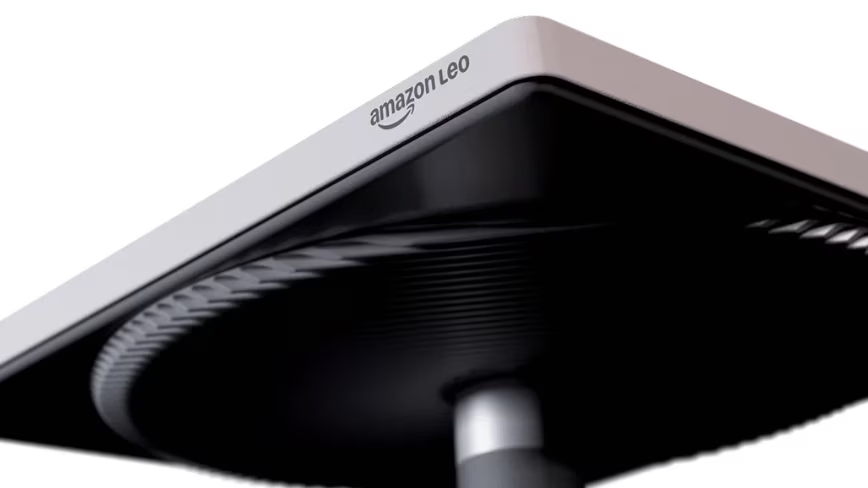
💡New satellite infrastructure for global connectivity. Vital for edge AI and remote data processing.
⚡ 30-Second TL;DR
What Changed
Amazon hits satellite count for Leo network launch
Why It Matters
Increased competition in satellite internet will likely lower costs and improve global connectivity for edge computing and remote AI deployments.
What To Do Next
Evaluate the potential for deploying edge AI models in remote locations using Amazon's upcoming satellite broadband as an alternative to existing providers.
Key Points
- •Amazon hits satellite count for Leo network launch
- •Service rollout scheduled for later this year
- •Direct competition with Starlink broadband
- •Recent launch of 29 satellites via Atlas V
🧠 Deep Insight
AI-generated analysis for this event — not the original article.
🔑 Enhanced Key Takeaways
- •Amazon's satellite constellation, officially branded as Project Kuiper, aims to deploy over 3,200 satellites into Low Earth Orbit (LEO) to provide global broadband coverage.
- •The project utilizes a multi-launch strategy, leveraging partnerships with United Launch Alliance (ULA), Blue Origin, and Arianespace to meet its aggressive deployment schedule.
- •Project Kuiper terminals are designed with a proprietary chip, codenamed 'Prometheus,' which enables high-throughput processing while maintaining a compact form factor for consumer and enterprise use.
- •The network architecture integrates directly with Amazon Web Services (AWS) infrastructure, allowing for low-latency cloud computing and edge networking capabilities for enterprise clients.
- •Amazon has committed over $10 billion to the development and deployment of the Kuiper system, fulfilling regulatory requirements set by the FCC for orbital debris mitigation and spectrum usage.
📊 Competitor Analysis▸ Show
| Feature | Amazon Project Kuiper | SpaceX Starlink | Eutelsat OneWeb |
|---|---|---|---|
| Orbit | LEO (590-630 km) | LEO (550 km) | LEO (1,200 km) |
| Target Market | Consumer, Enterprise, Gov | Consumer, Enterprise, Gov | Enterprise, Gov, Maritime |
| Integration | AWS Cloud Ecosystem | Standalone / Direct-to-Cell | Partner-based Distribution |
| Pricing Model | TBD (Competitive) | Tiered Subscription | Wholesale/Partner-based |
🛠️ Technical Deep Dive
- Satellite Bus: Designed for high-volume manufacturing with electric propulsion systems for orbital maneuvering and de-orbiting.
- Frequency Bands: Operates in Ka-band for both user links and gateway links to ensure high bandwidth capacity.
- Terminal Variants: Includes a standard consumer terminal, an ultra-compact portable version, and a high-performance enterprise dish.
- Optical Inter-Satellite Links (OISLs): Utilizes laser communication between satellites to route data in space, reducing reliance on ground stations in remote areas.
- Security: Implements end-to-end encryption for all data traffic, leveraging AWS-grade security protocols.
🔮 Future ImplicationsAI analysis grounded in cited sources
⏳ Timeline
Weekly AI Recap
Read this week's curated digest of top AI events →
👉Related Updates


AI-curated news aggregator. All content rights belong to original publishers.
Original source: The Next Web (TNW) ↗
This is a summary, not the original. Read the source, or get the weekly briefing.
Weekly AI briefing
One email a week. Unsubscribe anytime.