Amazon Bedrock Automates Policy Refinement
Learn how Bedrock can diagnose policy failures and propose reviewable formal-logic fixes.
30-Second TL;DR
What Changed
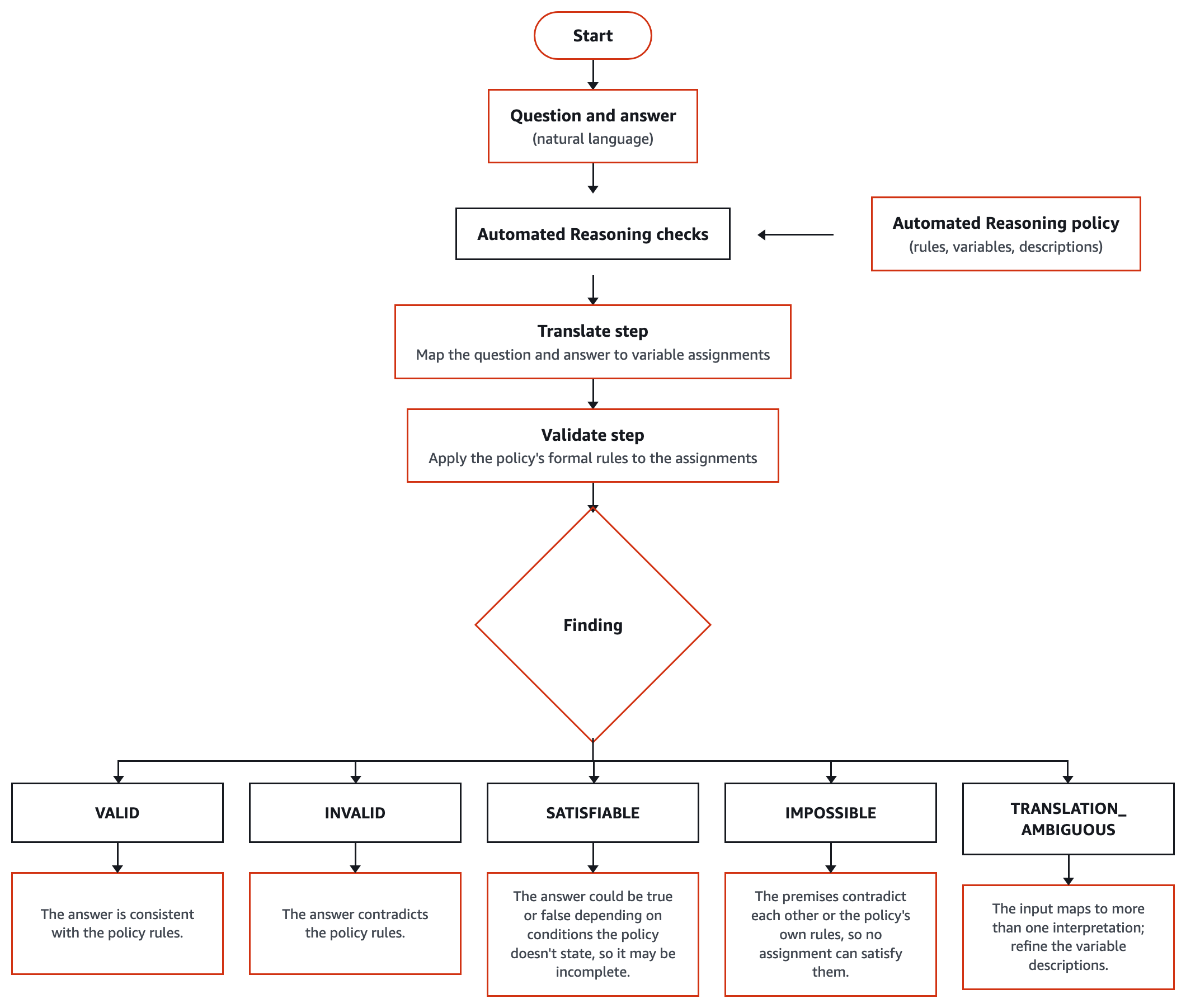
The refinement engine analyzes failing Automated Reasoning policy tests.
Why It Matters
This can reduce the manual effort required to debug and maintain formal reasoning policies in AI applications. Human approval controls help teams improve policies while retaining governance over production behavior.
What To Do Next
Create a test policy in Amazon Bedrock, run it against known failing cases, and review the Automated Reasoning refinement proposals before approving any change.
Key Points
- •The refinement engine analyzes failing Automated Reasoning policy tests.
- •It proposes formal-logic fixes for both rule issues and language issues.
- •Practitioners must approve each proposed policy change before deployment.
- •The workflow is documented through both API and Amazon Bedrock console flows.
Deep Insight
AI-generated analysis for this event — not the original article.
Enhanced Key Takeaways
- •The automated reasoning engine leverages AWS's proprietary Zelkova solver, which uses formal verification methods to mathematically prove policy compliance.
- •This feature integrates directly with AWS IAM Access Analyzer, allowing users to transition from policy validation to automated remediation within a unified interface.
- •The system utilizes a 'human-in-the-loop' reinforcement learning feedback mechanism where practitioner approvals are used to fine-tune the suggestion engine's accuracy over time.
- •It supports cross-service policy analysis, enabling the engine to identify conflicts between Amazon Bedrock resource-based policies and broader AWS organization-level service control policies (SCPs).
- •The refinement process generates a side-by-side diff of the formal logic, highlighting the specific clauses causing the policy violation before the user commits the change.
Competitor Analysis
- Amazon Bedrock (Automated Reasoning)
- Formal Logic/Zelkova Solver
- Google Cloud Policy Intelligence
- Heuristic/ML-based Analysis
- Microsoft Azure Policy
- Policy-as-Code/Rego
- Amazon Bedrock (Automated Reasoning)
- Automated Logic Fixes
- Google Cloud Policy Intelligence
- Recommendations/Insights
- Microsoft Azure Policy
- Manual/Scripted Remediation
- Amazon Bedrock (Automated Reasoning)
- Mathematical Proof
- Google Cloud Policy Intelligence
- Probabilistic
- Microsoft Azure Policy
- Compliance Auditing
| Feature | Amazon Bedrock (Automated Reasoning) | Google Cloud Policy Intelligence | Microsoft Azure Policy |
|---|---|---|---|
| Core Mechanism | Formal Logic/Zelkova Solver | Heuristic/ML-based Analysis | Policy-as-Code/Rego |
| Remediation | Automated Logic Fixes | Recommendations/Insights | Manual/Scripted Remediation |
| Verification | Mathematical Proof | Probabilistic | Compliance Auditing |
Technical Deep Dive
- The engine utilizes the Zelkova automated reasoning service, which translates IAM policies into SMT (Satisfiability Modulo Theories) formulas.
- It employs a constraint-based solver to identify the minimal set of changes required to satisfy the desired security posture without over-privileging.
- The system architecture includes a policy-to-logic transpiler that converts JSON/IAM policy syntax into formal logic representations.
- Integration with Amazon Bedrock APIs allows for real-time policy evaluation during the model deployment lifecycle, preventing insecure configurations from reaching production.
- The refinement engine uses a directed acyclic graph (DAG) to map policy dependencies and ensure that proposed fixes do not introduce circular logic or unintended access gaps.
Future ImplicationsAI analysis grounded in cited sources
Timeline
- 2018-11AWS introduces Zelkova, an automated reasoning service for security policy analysis.
- 2020-12AWS IAM Access Analyzer adds policy generation capabilities based on access activity.
- 2023-09Amazon Bedrock becomes generally available, establishing the foundation for generative AI governance.
- 2025-04AWS integrates advanced formal verification tools into the Bedrock security suite.
- 2026-08Amazon Bedrock launches automated policy refinement engine.
Weekly AI Recap
Read this week's curated digest of top AI events →
AI-curated news aggregator. All content rights belong to original publishers.
Original source: AWS Machine Learning Blog ↗
This is a summary, not the original. Read the source, or get the weekly briefing.
The weekly digest
One email a week. Unsubscribe anytime.