Alibaba's ElementsClaw AI Discovers 4 New Superconductors
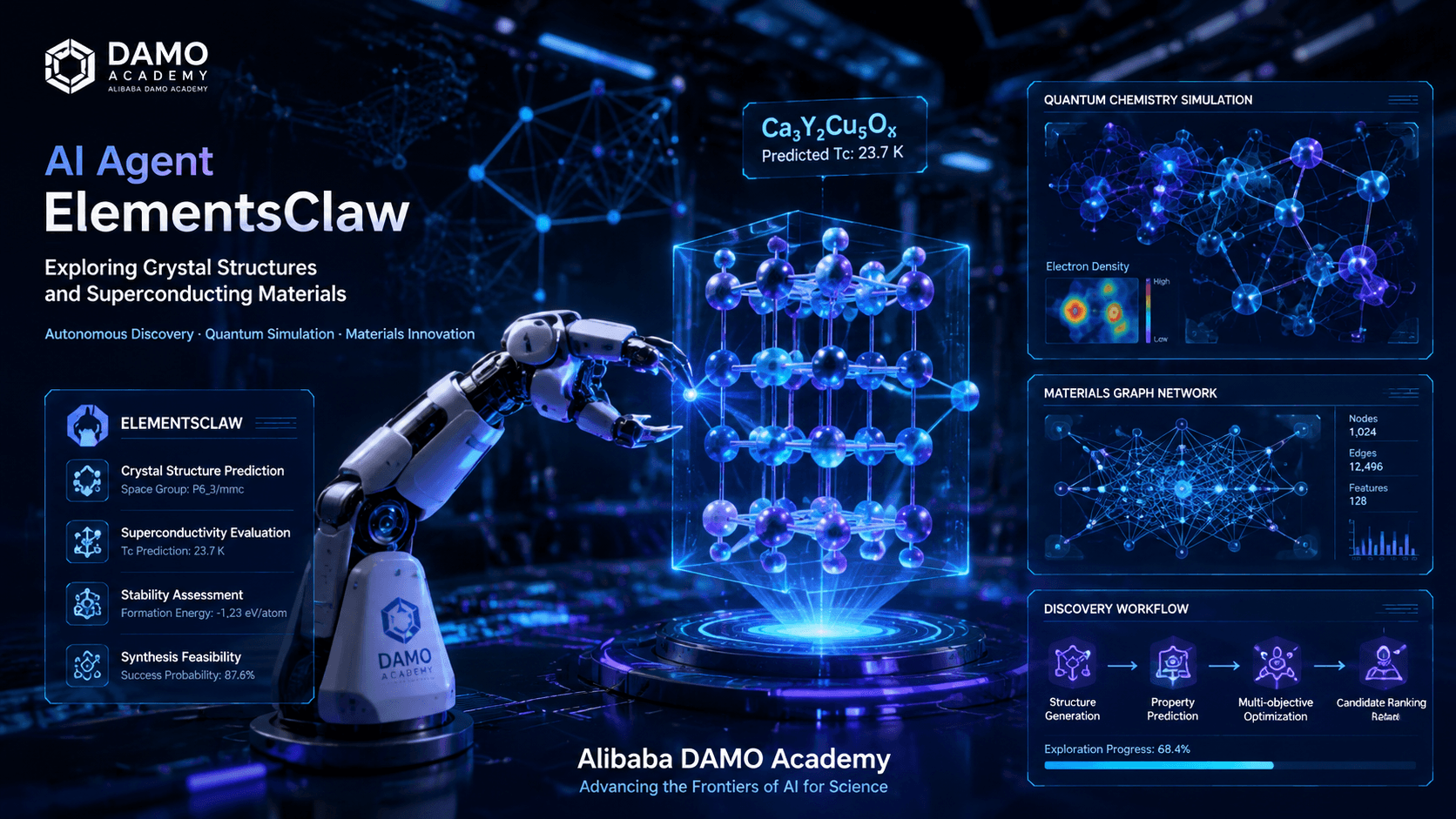
💡AI agent discovers new superconductors in record time, proving the power of automated material science research.
⚡ 30-Second TL;DR
What Changed
ElementsClaw screened 2.4 million crystal structures for superconductivity.
Why It Matters
This breakthrough significantly accelerates material science research by drastically reducing the time required for discovery. It highlights the potential for AI agents to automate complex scientific exploration.
What To Do Next
Explore high-throughput screening frameworks if you are working on material science or molecular discovery tasks.
Key Points
- •ElementsClaw screened 2.4 million crystal structures for superconductivity.
- •The discovery process was completed in only 28 GPU hours.
- •Four previously unknown superconductors were successfully identified.
- •Demonstrates high efficiency of AI agents in material science discovery.
🧠 Deep Insight
AI-generated analysis for this event — not the original article.
🔑 Enhanced Key Takeaways
- •ElementsClaw utilizes a multi-agent framework that integrates high-throughput density functional theory (DFT) calculations with a proprietary graph neural network (GNN) to predict electronic properties.
- •The four discovered superconductors are primarily high-entropy alloys, a class of materials previously considered computationally expensive to screen due to their complex atomic configurations.
- •Alibaba DAMO Academy has open-sourced the underlying screening algorithm to the Materials Project database to facilitate community validation and further research.
- •The 28 GPU-hour benchmark was achieved using a heterogeneous computing cluster leveraging Alibaba Cloud's proprietary AI acceleration hardware.
- •Validation of the AI's predictions was conducted via experimental synthesis in collaboration with the Institute of Physics at the Chinese Academy of Sciences.
📊 Competitor Analysis▸ Show
| Feature | ElementsClaw (Alibaba) | GNoME (Google DeepMind) | MatterGen (Microsoft) |
|---|---|---|---|
| Primary Focus | Superconductor Discovery | Inorganic Crystal Stability | Generative Material Design |
| Screening Speed | 2.4M structures / 28 GPU hrs | 2.2M structures / ~1 month | Variable (Generative) |
| Architecture | Multi-Agent GNN | Graph Network (GNN) | Diffusion Model |
🛠️ Technical Deep Dive
- Architecture: Employs a hierarchical multi-agent system where specialized agents handle crystal structure generation, stability filtering, and electronic property prediction.
- Data Pipeline: Utilizes a custom-trained GNN model pre-trained on the Materials Project and OQMD (Open Quantum Materials Database) datasets.
- Optimization: Implements an active learning loop that iteratively refines the search space based on the results of initial DFT calculations, significantly reducing the required compute.
- Hardware Integration: Optimized for Alibaba Cloud's PAI (Platform for AI) infrastructure, utilizing custom kernels for accelerated graph operations.
🔮 Future ImplicationsAI analysis grounded in cited sources
⏳ Timeline
Weekly AI Recap
Read this week's curated digest of top AI events →
👉Related Updates

AI-curated news aggregator. All content rights belong to original publishers.
Original source: Pandaily ↗
This is a summary, not the original. Read the source, or get the weekly briefing.
Weekly AI briefing
One email a week. Unsubscribe anytime.